


Your Cat Didn't Choose You. You're Just the Safe One.
Being your cat's favorite feels like winning a popularity contest nobody else entered. The truth is quieter and more useful: your cat isn't rejecting everyone else out of spite, they're managing risk, and that means the door to other people isn't locked.

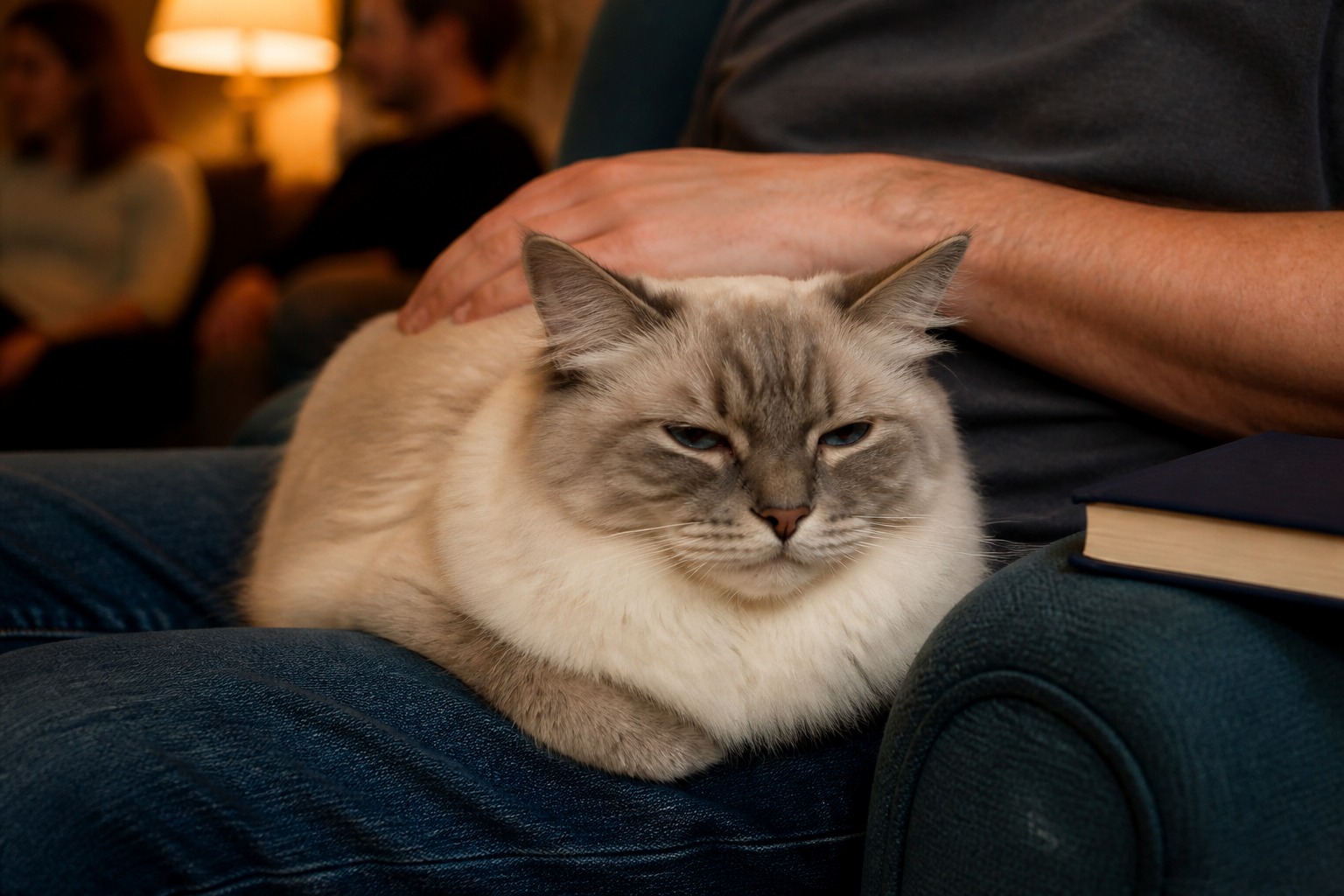
It’s flattering to believe your cat looked around the household, weighed everyone on their merits, and picked you. But that’s a very human story to tell about a very un-human animal, and it leads people to the wrong conclusions, like assuming their cat “hates” the partner, the roommate, or the friend who comes for dinner. Here’s the reframe this whole piece is built on: your cat almost certainly doesn’t hate anyone. What looks like devotion to you and disdain for everyone else is mostly a cat sorting the world into “safe” and “unsure,” and landing you firmly in the safe column. That’s good news, because safety can be taught to other people too.
The word “hate” is doing damage
Cats don’t run the emotional machinery that hate requires. Think about what spite would actually take: your cat would have to decide they’re angry with someone, imagine what would upset that person, and then act specifically to hurt their feelings. That’s a level of social scheming cats simply don’t do. It’s the same myth behind the idea that cats pee outside the box “to get back at you.” What reads as vengeance is almost always a cat that’s anxious and asking for help, using the only tools it has.
So when your cat hisses at a guest or vanishes when your partner walks in, translate it out of human terms. You’re not watching hatred. You’re watching a threat assessment.
What your cat is actually reacting to
A few instinctive drivers explain most “my cat only likes me” situations.
Fear or unfamiliarity. Cats get anxious in situations they can’t control, and a person they haven’t had good experiences with is exactly that. A stranger’s scent, a loud voice, or a fast walk can be enough to send a cat into hide-or-defend mode.
A naturally cautious temperament. In the wild, cats are both hunters and prey, so caution is survival. Some cats are wired more toward “assume danger first,” and those cats stay reserved with anyone they don’t deeply trust.
Plain individual preference. Cats have taste, just like us. Yours may prefer your quiet energy to a livelier housemate, or your way of handling them to a child’s. It’s not a moral judgment on the other person, it’s about what feels comfortable.
Why you specifically
If your cat has attached to you above others, a handful of things usually stacked up in your favor.
The biggest one is often early experience. Cats are shaped enormously by their first year or two. A kitten who met lots of different people early tends to stay easygoing; one who didn’t, or who had a bad scare with someone, can grow up wary of anyone outside their small circle. This is part of why so many cats adopted during pandemic lockdowns are one-person cats: there simply weren’t many visitors around to normalize.
Then there’s the fact that you’re likely the primary caregiver, the source of food, play, and cuddles, which a cat’s survival brain reads as important. You probably also read them well: you notice when the ears swivel back or the tail switches from a lazy sway to an irritated flick, and you stop before the interaction sours. Other people miss those signals and accidentally push past the cat’s limits, which teaches the cat that those people are less predictable. Add in quality time doing things the cat loves, and a temperament match between your demeanor and theirs, and you become the safe center of their world.
What newer research adds
For a long time, cats had a reputation as aloof loners who tolerate us for the kibble. The science has quietly demolished that. In a 2019 study out of Oregon State University, researchers ran cats through the same “secure base test” used on human infants and dogs, and found cats form the same kinds of attachments we do. About two-thirds of cats were securely attached, using their person as a base of comfort to explore from and return to, while roughly a third were insecure, tending to cling or avoid.
That’s the useful part. Your one-person cat isn’t a personality flaw, it’s an attachment style, the same category of thing you’d see in a nervous toddler. And attachment styles aren’t fixed forever. With patient, positive experiences, a wary cat can widen its circle of safe people. Being someone’s whole world is sweet, but it doesn’t have to mean everyone else stays a stranger.
Helping your cat warm up to other people
If a housemate wants a better relationship, or your cat seems genuinely frightened rather than just picky, you can shift things. The rule underneath all of it: never force contact, and let every good thing be the cat’s choice.
Start by making other people predict good stuff. When a visitor is around, that’s when the treats, the play, and the praise appear, even if your cat is watching from under the bed. You’re teaching a simple equation: other people showing up means wonderful things happen. Reward bravery in tiny increments, the peek around the doorway, the choice to stay in the room, the step closer, so courage keeps paying off. And reward any positive interaction with another person, however small: a sniff of their pant leg, a moment of sitting nearby, an accepted pet. The reward can be anything your cat values, food, praise, a tossed toy.
People come to me embarrassed that their cat ‘only likes them,’ like they’ve done something wrong. I tell them the opposite. You’ve built a cat who feels safe with at least one human, and that’s the foundation. Now we just widen it, one good experience at a time, and we never drag the cat toward the thing that scares them. Choice is the whole treatment.
When to loop in a professional
If your cat’s reaction to other people looks like real fear or anxiety, hiding at the doorbell, defensive aggression, a life visibly shrunk by stress, it’s worth a conversation with your vet. They can confirm there’s no medical problem ramping up the anxiety, and can discuss calming supplements or, in some cases, anti-anxiety medication. A certified feline behavior consultant, many of whom work virtually, can help pinpoint the triggers and build a confidence plan. And if none of it applies, if your cat is simply a discerning creature who thinks you hung the moon, there are far worse problems to have.
References
- Vitale, Kristyn R., et al. “Attachment Bonds Between Domestic Cats and Humans.” Current Biology, vol. 29, no. 18, 2019, pp. R864–R865. https://doi.org/10.1016/j.cub.2019.08.036
- Anderson, Jocelyn C. “6 Common Cat Behaviors Explained.” UC Davis, 19 Apr. 2021. ucdavis.edu/magazine/6-common-cat-behaviors-explained
- Cornell Feline Health Center. “Feline Behavior Problems: Aggression.” Cornell University College of Veterinary Medicine. vet.cornell.edu
- Ines, Mauro, et al. “My Cat and Me—a Study of Cat Owner Perceptions of Their Bond and Relationship.” Animals, vol. 11, no. 6, 2021, p. 1601. https://doi.org/10.3390/ani11061601
Dr. Kohl is a board-certified veterinary dentist with a particular interest in preventive oral care. She reviews all dental health content at The Pet Times and contributes practical guides on home dental routines, professional cleaning, and oral disease prevention.
Meet our experts ↗Keep reading
 TrainingYour Cat Isn't Being Dramatic. 8 Things That Genuinely Wound ThemDr. Nina Kohl · 6 min
 TrainingThat Adorable Chirping Is the Sound of a Cat FailingDr. Nina Kohl · 7 min
 TrainingYour Cat Isn't Attacking You. It's Sending One of 5 Messages.Dr. Amara Solis · 5 min
 TrainingYour Cat Keeps Running Off. The Fix Is to Chase LessLeila Torres · 8 min
 TrainingYour Cat Is Probably Securely Attached. Here's Why That's the Useful PartNina Vasquez · 5 min
 TrainingYour Cat Isn't Plotting Revenge. They Already Forgot.Dr. Nina Kohl · 5 min