


Your Cat Keeps Running Off. The Fix Is to Chase Less
It stings when your cat bolts the second you reach for them. But running away is rarely rejection. It's an attachment style, a mood, or a message, and the research points to a counterintuitive way to earn the closeness back.

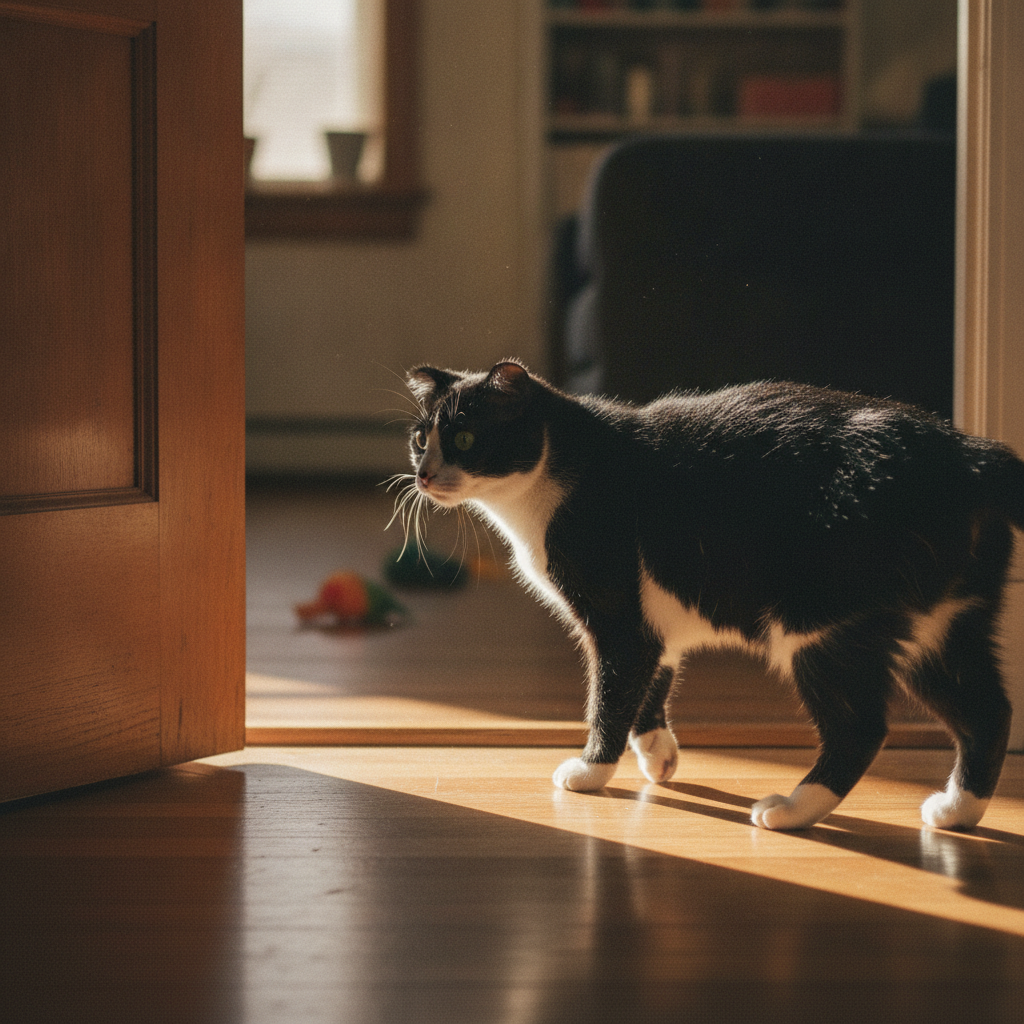
Few things dent a cat person’s ego like reaching out for a scratch and watching your cat evaporate. It reads as a snub, and it’s hard not to take personally. But the science of how cats bond has moved on from the old “aloof and ungrateful” cliché, and the picture it paints is both kinder and more useful. Your cat running off usually isn’t a verdict on you. It’s information, and once you can read it, the way to get more closeness is almost the opposite of what instinct tells you to do.
The instinct is to follow, coax, and reach. The better move, as it turns out, is to back off and let the cat come to you. Here’s why that works, and everything the bolt might be telling you first.
Start here: your cat is probably more attached than the running suggests
The reflex to see feline distance as indifference took a real hit in 2019, when researchers ran cats through the same “secure base test” used to measure attachment in human babies and dogs. The result surprised a lot of people: cats form genuine attachment bonds with their humans, and the majority, around two-thirds in the study, were securely attached. A securely attached cat, reunited with their person after a brief absence, settles quickly and splits their attention between the human and the room.
That matters for the running-away question because it reframes it. A cat that trots off is not necessarily a cat that doesn’t care. It’s far more often a cat exercising the very normal feline preference for interaction on its own terms. Understanding that takes the sting out of it and clears the way to actually respond.
The reasons behind the bolt
Running away isn’t one behavior with one cause. It’s a catch-all response, and the trick is matching it to the situation.
Personality. Cats are individuals, full stop. One will happily accept a head scratch from any passing hand; another spends the afternoon under the bed. Being on the reserved end of that spectrum is completely normal, not a problem to fix.
Mood. Cats are famously changeable. A shift in routine, a sudden noise, age, or plain overstimulation can flip the switch. A cat who’s fine one minute and gone the next may just be riding one of those unpredictable mood swings, and some cats are wired moodier than others.
Playfulness. Sometimes the run is an invitation. Tail up, a little scamper, a “come and get me” glance over the shoulder, that’s a cat asking to play, not to be left alone. Take the opening if you can.
Stress or fear. Cats broadcast fear by fleeing and hiding, and they pick up on triggers we don’t even register. If the running comes bundled with other stress signs, spraying, litter box lapses, incessant meowing, or aggression, your cat is trying to tell you something is off.
Illness or injury. Because cats mask discomfort, a behavior change can be the first symptom of a physical problem. Watch for shifts in energy or appetite, unusual discharge from the eyes or nose, overgrooming, or labored breathing. A cat in pain will squirm and flee when you try to lift them. When something feels wrong, call your vet.
Under-socialization. A cat who wasn’t handled much as a kitten, or whose early life is a mystery, may run simply because people are frightening. The good news is that socialization is still possible well past kittenhood.
Lost trust. Trust with a cat is earned and easily spent. Lose your patience over a scratched couch or a missed litter box, and a cat notices, and grows quicker to flee.
Environmental triggers. Thunder, the blender, the vacuum, any sudden loud thing can launch the feline flight response. So can you, if you’re approaching with the nail clippers or a pill.
Hunting instinct. Even a pampered indoor cat is a predator at heart. Outdoor cats in particular will drop everything for a bird or a mouse. A well-fed cat feels the pull a little less, but few can resist a good hunt entirely.
Territory. Cats stake out and defend their space. From their point of view, a guest room full of visiting friends, or a strange dog in the yard, is an invasion, and running to a safer spot is the sensible reply.
Mating drive. An unspayed female in heat may swing between clingy and standoffish, and an unneutered male may bolt off to find a mate. Both are strong arguments for getting your cat fixed.
The counterintuitive fix: become less interesting
Here’s the part that flips most people’s instincts. When a cat keeps its distance, the losing move is to pursue. The winning move is to make yourself worth approaching and then wait to be approached.
There’s a familiar dynamic at play: at a party, the cat gravitates to the one person ignoring it. Lean into that. Practice patience, play a little hard to get, and let trust build on the cat’s schedule. If you are going to close the distance, the rule of thumb is to arrive with something good, a treat, a toy, a reason for the cat to be glad you came.
“The mistake I see most is people chasing the closeness they want, and it does the opposite every time,” says Dr. Nina Kohl. “Cats reward the person who lets them make the first move. Sit still, be a little boring, keep the good stuff coming when they choose you, and you become the safe option instead of the thing that keeps looming over them.”
With that mindset set, a handful of specific habits do the heavy lifting.
- Slow blinking. This is the closest thing cats have to a friendly hello, and it’s backed by real evidence. In a 2020 study, cats were more likely to slow-blink back at owners who slow-blinked at them, and more likely to approach a stranger who offered the same soft-eyed look. To try it, face your cat, relax your face, and let your eyes drift shut and open again, slowly. It reads as “I’m calm and no threat.”
- Interactive play. Boredom itself can send a cat wandering off, and play beats boredom while building the bond. A wand toy is the gold standard for most cats, precisely because you can make it dart and flee like real prey. Aim for daily sessions that let your cat stalk, chase, and pounce.
- Small positive interactions. A gentle pat, a surprise treat, a bit of grooming, each one is a tiny deposit in the trust account and a reason for your cat to associate you with good things.
- Safe retreats. Cats need places to withdraw, a shelf, a covered bed, a cat tree, a blanket in a quiet corner. A cat that trusts it can retreat and rejoin on its own terms is a cat that runs less, not more.
- Respect the limits. Once you’ve given your cat safe spaces, honor them. Never haul a cat out from under the bed or down off a shelf. Forcing contact is the fastest way to spend the trust you’ve been building.
What newer research adds
The last decade has quietly rewritten the science of cat sociability, and it lands squarely on the side of “your cat is more bonded than it lets on.” The 2019 attachment work showed cats form the same secure and insecure attachment styles as babies and dogs. The 2020 slow-blink study gave owners an evidence-based way to say “I come in peace.” And going back to 2015, researchers found that cats actively respond to music composed for their hearing range, rubbing against the speakers and engaging with species-appropriate sounds while ignoring human music, which is why some owners find purpose-made cat music noticeably settles an anxious cat.
None of it changes the core truth: a cat comes and goes on its own terms. But it does mean the distance isn’t rejection, and the closeness is absolutely there to be earned, on the cat’s clock, one slow blink at a time.
References
- Vitale, K. R., Behnke, A. C., and Udell, M. A. R. “Attachment Bonds Between Domestic Cats and Humans.” Current Biology, 2019. https://www.cell.com/current-biology/fulltext/S0960-9822(19)31086-3
- Humphrey, T., Proops, L., Forman, J., et al. “The Role of Cat Eye Narrowing Movements in Cat-Human Communication.” Scientific Reports, 2020. https://www.nature.com/articles/s41598-020-73426-0
- Snowdon, C. T., Teie, D., and Savage, M. “Cats Prefer Species-Appropriate Music.” Applied Animal Behaviour Science, 2015. https://doi.org/10.1016/j.applanim.2015.02.012
- American Veterinary Society of Animal Behavior. “Is It Okay If Cats Aren’t Little Humans? A Deep Dive Into Cat Attachment to Humans.” https://avsab.org/is-it-okay-if-cats-arent-little-humans-a-deep-dive-into-cat-attachment-to-humans/
Common questions
Why does my cat suddenly run away from me?
Common reasons are fear, distrust, or under-socialization, but a sudden change can also mean your cat is sick, injured, feeling territorial, or has simply had enough handling for now. If running away is new and paired with other changes, get them checked.
How can I tell if my cat is scared versus just moody?
Read the tail. A scared cat tends to hold the tail straight and stiff, flatten the ears, and arch the back; an annoyed cat flicks the tail and may look ready to swat. A playful cat runs with the tail up and a bouncy, catch-me energy.
Why does my cat run when I stand up?
You probably startled them with a sudden movement. Stand up more slowly, especially with a newer cat you haven't fully bonded with yet, and the flinch usually fades.
Why does my cat cuddle me and then run away?
Because affection happens on the cat's clock, not yours. They gave you the contact they wanted to give, and when they're done, they're done. It's not a rejection so much as a boundary.
Leila Torres leads our Living coverage, from home life and travel to the products and rescue stories that come with sharing a life with animals. She edits and writes across the section, with a soft spot for pieces about the bond between people and their pets.
Meet our experts ↗Keep reading
 TrainingThat Adorable Chirping Is the Sound of a Cat FailingDr. Nina Kohl · 7 min
 TrainingYour Cat Isn't Attacking You. It's Sending One of 5 Messages.Dr. Amara Solis · 5 min
 TrainingYour Cat Isn't Plotting Revenge. They Already Forgot.Dr. Nina Kohl · 5 min
 TrainingYour Cat Didn't Choose You. You're Just the Safe One.Dr. Nina Kohl · 6 min
 TrainingYour Cat Isn't Guarding You in the Bathroom. They Hate the Door.Dr. Nina Kohl · 6 min
 TrainingThat Old Sweater Isn't Comforting Your Cat. It's Just Soft.Dr. Mara Chen · 8 min