


Your Cat Isn't Guarding You in the Bathroom. They Hate the Door.
The bathroom escort has almost nothing to do with protecting you and almost everything to do with a door that closed. Here's what the behavior actually is, the version that's worth worrying about, and how to get five minutes alone.

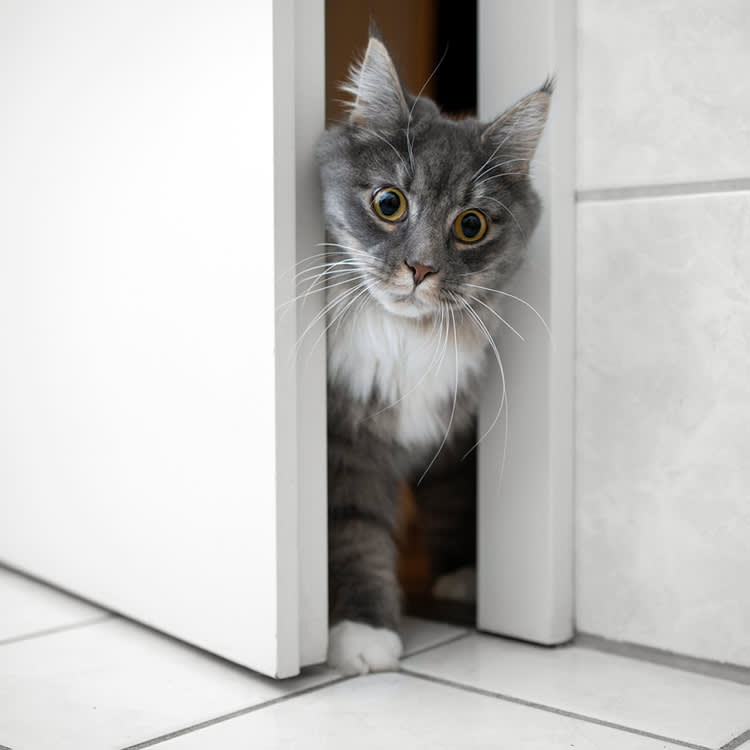
Get a cat, lose the ability to close a door. Within a week of adoption you learn that the bathroom is a shared space now, and that the paw reaching under the door has a persistence that is genuinely impressive at 6 a.m.
The internet has decided this is guarding. Your cat is protecting you at your most vulnerable, standing sentinel while you are indisposed, and so on. It’s a charming story.
It’s also mostly wrong, and the wrongness matters, because if you think the behavior is about protecting you, you will try to solve it by reassuring your cat. That fixes nothing. The behavior is not really about the bathroom or about you being vulnerable. It is about the door.
What “guarding” actually means, and why this isn’t it
In feline behavior, guarding is a real and specific thing, and it usually looks like a cat physically controlling access to a resource. A cat parked in front of the food station so the other cat can’t get to it. A cat camped by the litter box. It’s most common in multi-cat homes where the resources are bunched together in one place instead of spread out.
That is a resource-control behavior, and it comes with tension: a stiff body, a hard stare, ears flattening, another cat backing off.
What is happening in your bathroom is almost never that. What is happening in your bathroom is: a door that is normally open has become a door that is closed, with you on the other side of it. To a cat, that is not protection. That is an unacceptable change in the floor plan.
Cats do not like closed doors. Full stop. They want the same access to the same territory they had yesterday, and they want to know where their person is.
The single most useful thing I tell people is that the bathroom door is not a special case. Watch what happens when you shut a closet, or a bedroom, or a room they had no interest in an hour ago. The scratching starts. It was never about what you were doing in there.
Eight reasons your cat is standing there
Sorted roughly by how often they’re the actual explanation.
1. The door closed. The most common answer by a wide margin. Closed doors remove territory and remove information. Cats want both back.
2. You are more available than usual. You’re seated. You’re still. You’re at their height and your hands are free. From a cat’s economics, this is the highest-value window of your entire day.
3. It’s routine. Cats run on routine, and routine is genuinely good for them. If your cat has followed you to the bathroom every morning for two years, the morning it doesn’t happen is the morning something feels wrong. You’ve built a ritual without noticing.
4. It’s boredom. A cat with an unstimulating day will attach to whatever is happening. If the most interesting event on your cat’s calendar is you walking to the toilet, the problem isn’t the toilet.
5. The bathroom is a genuinely great room. Running water. Echoing sounds. A cold sink that’s the right size for a cat. Toilet paper, which is essentially a wall-mounted toy. Smells that change. If you sat in a room like that you’d be curious too.
6. It’s attention that reliably works. You are cornered in there. The cat meows, you talk to them. That’s a behavior with a very high hit rate, and cats repeat what works.
7. Curiosity, plainly. Especially in young cats. A closed door is a mystery, and cats are not built to leave a mystery alone.
8. It’s separation distress. This is the one that actually warrants attention, and it’s last because it’s the least common. If the door-pawing comes with real distress, frantic vocalizing, destructiveness, house-soiling, or a cat who is visibly unable to settle whenever you’re out of sight, that isn’t nosiness. That’s anxiety, and it’s a vet conversation.
The version to take seriously
Most bathroom escorts are a normal cat being a normal cat. But there is a line.
Watch for the difference between interested and distressed. Interested is a cat sitting on the mat, blinking, occasionally chirping at you. Distressed is a cat who cannot stop, who yowls, who scratches at the door hard enough to damage it, who has accidents outside the box when you’re gone, who is off their food.
That difference matters because separation-related problems in cats are real and were underestimated for years. A questionnaire study of 223 pet cats found that about 13.5 percent showed at least one indicator of a separation-related problem when their owner was away, most often destructive behavior, excessive vocalization, or inappropriate urination.
We also know cats form genuine attachment bonds. In a secure base test, the same protocol used with human infants and with dogs, about 64 percent of kittens showed a secure attachment style toward their caregiver, meaning they used their person as a base to explore from and settled quickly when reunited. The rest showed insecure patterns, which is roughly the human distribution.
So no, the bond is not imaginary. But a securely attached cat can tolerate a closed door. A cat who cannot is telling you something else.
How to get five minutes alone
If it doesn’t bother you, do nothing. There is no health argument for keeping your cat out of the bathroom.
If it does, the fix is boring and effective.
Stop paying for the noise. When your cat meows and paws at the door, do not respond. Not with your voice, not with “stop it,” not by opening the door “just to make them quiet.” Any of those teaches the cat that the noise works. Silence is the message.
Meet the need on your schedule, not theirs. A cat that’s had a real hunting-style play session and a meal in the last hour has far less to say to you. Move the enrichment to right before the time your cat usually escorts you. Feed the boredom before it turns into a paw under the door.
Give them a better job. Train an incompatible behavior, and pay it well. Clicker training is ideal for this: teach your cat to go to a mat, sit, target your hand, or high-five, and reward heavily. Then cue the mat behavior before you close the door. Your cat now has a thing to do that has a better payout than door-scratching.
Do not punish it. Spray bottles, yelling, and startling all raise stress, and a stressed cat gets more clingy, not less. You’ll trade a mildly annoying habit for an anxious cat.
Make the closed door boring. If the only door that ever closes in your home is the bathroom door, that door is a huge event. Close doors more often, for shorter periods, at random. When closed doors are ordinary, they stop being interesting.
What newer research adds
The old assumption was that cats were aloof and largely indifferent to whether their person was in the room. That has quietly collapsed over the last several years.
The attachment work has been the biggest shift: cats form the same categories of bond with a caregiver that infants and dogs do, and most pet cats are securely attached. That reframes bathroom-following. It’s not surveillance and it isn’t dominance. It’s proximity-seeking from an animal that is bonded to you and does not understand why a wall appeared.
The separation-problem research pushed in the same direction, and it’s the reason a good vet will now take “my cat freaks out when I close a door” seriously rather than laughing it off. The clingy cat is worth a look. The curious one just wants the door open.
References
- Vitale, Kristyn R., Alexandra C. Behnke, and Monique A. R. Udell. “Attachment Bonds Between Domestic Cats and Humans.” Current Biology, vol. 29, no. 18, 2019, pp. R864–R865. https://www.cell.com/current-biology/fulltext/S0960-9822(19)31086-3
- de Souza Machado, Daiana, et al. “Identification of Separation-Related Problems in Domestic Cats: A Questionnaire Survey.” PLOS ONE, vol. 15, no. 4, 2020, e0230999. https://journals.plos.org/plosone/article?id=10.1371/journal.pone.0230999
- Cornell Feline Health Center. “Feline Behavior Problems: Aggression.” https://www.vet.cornell.edu/departments-centers-and-institutes/cornell-feline-health-center/health-information/feline-health-topics/feline-behavior-problems-aggression
- American Association of Feline Practitioners and International Society of Feline Medicine. “Feline Environmental Needs Guidelines.” Journal of Feline Medicine and Surgery, vol. 15, no. 3, 2013, pp. 219–230. https://doi.org/10.1177/1098612X13477537
Common questions
Why does my cat rub against me while I'm on the toilet?
Rubbing deposits scent from glands on their cheeks and flanks. It's part affection and part bookkeeping, marking you as familiar and theirs. That you happen to be sitting still and at cat height makes it convenient.
Why does my cat get extra affectionate in the bathroom?
You're seated, still, at their level, and not looking at a screen. From a cat's point of view, that's the most available you get all day. The bathroom is also warm, enclosed, and saturated with your smell.
Should I just let my cat in?
If it doesn't bother you, yes. There's nothing unhealthy about it. Only intervene if it bothers you, or if your cat's distress at the closed door looks like real anxiety rather than nosiness.
Dr. Kohl is a board-certified veterinary dentist with a particular interest in preventive oral care. She reviews all dental health content at The Pet Times and contributes practical guides on home dental routines, professional cleaning, and oral disease prevention.
Meet our experts ↗Keep reading
 FoodYour Cat Won't Eat Without You. That's Sweet Until It Isn't.Dr. Nina Kohl · 7 min
 LivingOne Cat Tree Isn't Enough. The Rule Is One Per Room.Dr. Amara Solis · 6 min
 Health & WellnessBringing an Outdoor Cat Inside Isn't Cruel. Doing It All at Once Is.Dr. Nina Kohl · 8 min
 First DaysBringing a Cat Into a Dog's House? The Dog Is Your Real Project.Dr. Nina Kohl · 7 min
 TrainingYour Cats Don't Hate Each Other. They Just Don't Smell Like a Family Yet.Dr. Amara Solis · 9 min
 TrainingIntroducing Two Cats? Go Slower Than You ThinkDr. Nina Kohl · 7 min