


That Adorable Chirping Is the Sound of a Cat Failing
The window chatter is not your cat speaking bird. It is a hunting sequence hitting a wall of glass, and how often you hear it tells you something uncomfortable about their day.

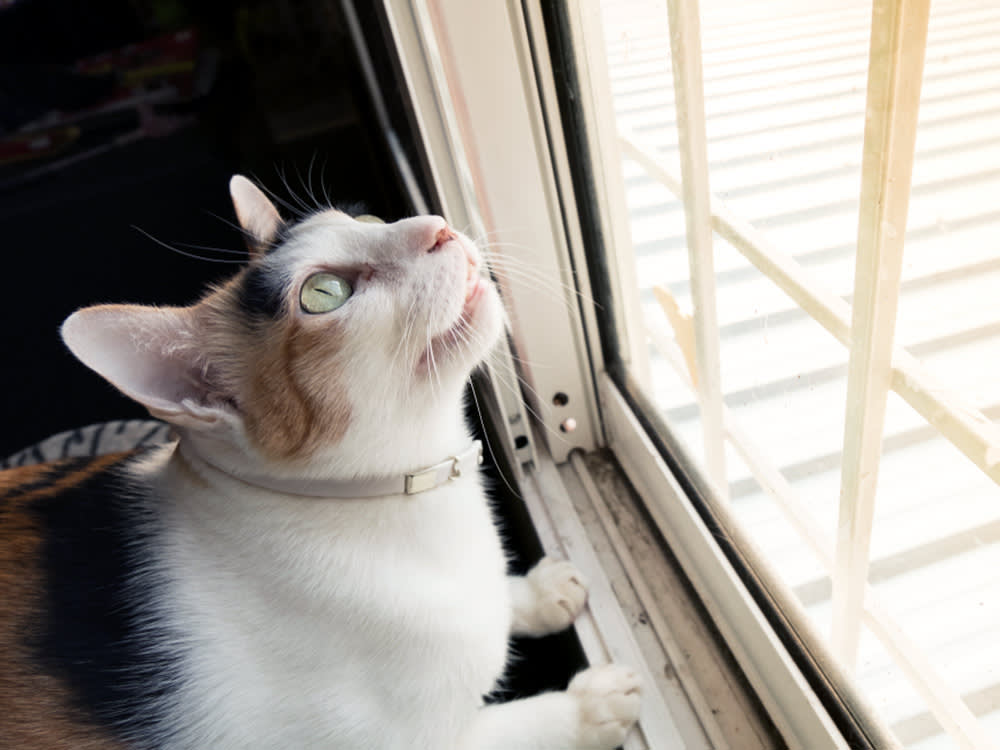
Your cat is at the window, crouched, tail going like a metronome, making a sound that is somewhere between a squeak, a stutter, and a cough. It is one of the most charming noises in the house, and people film it constantly.
Here is what you are actually filming: a complete predatory sequence firing at full strength and terminating in a pane of glass.
That is not a downer, it is the useful frame. The chirp is not a language, and it is not your cat talking to the birds. It is what a hunt sounds like when it cannot be finished, and its frequency is a readout of something you can actually do something about.
What the sound is made of
Feline vocalizations sort roughly by what the mouth does. Purrs, trills, and chirrups happen with the mouth closed. Meows and howls open and then close. And then there is this third thing: a rapid, percussive, stuttering burst, often described as “eh-eh-eh,” almost always accompanied by a chattering jaw, and always aimed at something.
That last part is the tell. A meow is aimed at you. A chatter is aimed at a target. The body underneath it is unambiguous: hyper-focused eyes, pupils blown, a low crouch, weight forward, tail twitching hard at the tip. That is not a cat having a nice time at the window. That is a cat that has fully committed to a kill and has nowhere to put the commitment.
The jaw chatter is the most interesting piece. One long-standing explanation is that it is the involuntary firing of the killing bite, the rapid jaw motion cats use to sever the spinal cord of prey, rehearsed in the absence of prey. The muscle pattern runs whether or not there is a bird in the mouth.
The mimicry theory, honestly
You will read that cats chatter to imitate bird calls and lure prey closer. It is a fun idea, and it is not baseless.
The strongest evidence for it does not come from house cats at all. It comes from the Amazon, where researchers documented a wild margay producing calls that imitated the vocalizations of pied tamarin monkeys, apparently to draw them in. That is a real, published observation of a felid attempting vocal mimicry of prey.
What it is not is evidence about the cat on your windowsill. There is no comparable demonstration that domestic cats are deliberately imitating songbirds, and the frustration explanation covers the behavior without requiring the extra assumption. The intellectually honest position: mimicry in cats exists, it has been seen in at least one wild species, and nobody has shown that it is what your cat is doing.
The part that matters: frustration
Behaviorists have converged on frustration as the core driver, and the logic is hard to argue with. Barriers produce chattering. Take the barrier away and cats do not chatter at prey, they stalk it silently, because silence is the entire point of the stalk.
Your cat sees the bird. Every system in their body has queued up the sequence. The window says no. The chirp is the overflow, the noise a system makes when the last step is denied. It is close to what a person does when they are muttering under their breath in traffic.
There is genuine excitement in there too. A fluttering bird is a jackpot stimulus for a predator, and the arousal is real and largely pleasurable. But arousal and frustration are not opposites, and the mix is what you are hearing: I want it, I cannot have it, I am still watching.
Owners hear the chirp and think their cat is delighted. Look at the tail. Delight does not lash. That is a cat with the safety off and nowhere to fire.
So how much chattering is too much?
This is the question the cute framing never gets to.
A cat who chatters at the window for a few minutes a day, then wanders off and naps, is fine. Great, even. The window is a legitimate enrichment source and the arousal is doing something useful in a life that is otherwise short on stimulation.
A cat who is at the window constantly, chattering and pacing and unable to disengage, is not being entertained. They are being taunted. Watch for the tells that arousal has curdled: escalating from chirps to yowls, pacing and unable to settle, an inability to be interrupted, a cat who whips around and lands a bite on your ankle after a session at the glass. That last one, redirected aggression, is the classic downstream cost of a cat who has been wound up by something on the other side of a window they cannot reach.
The fix is finishing the hunt
The hunting sequence has a shape: stalk, chase, pounce, catch, kill, eat. The window offers the first two and then hard-stops. A hunting sequence that never resolves does not dissipate; it accumulates.
So resolve it. This is the whole intervention and it takes ten minutes.
- Use a wand toy and run the actual sequence. Move it like prey: darting, hiding, freezing, going quiet, moving away from the cat rather than toward it. Let them stalk. Let them fail once or twice. Then let them catch it and hold it.
- End with a kill and a meal. Let them physically get the toy, bunny-kick it, hang on to it. Then feed a small meal or a few treats immediately after. That completes the loop the window opened, and it is the step nearly everyone skips.
- Do it before the window shift, not after. A cat who has already hunted looks at a sparrow with interest. A cat who has not looks at it with need.
- Cut the trigger if the arousal is chronic. If your cat is spending hours at the glass in genuine distress, or if there is a neighborhood cat outside driving territorial stress on top of the prey drive, close the curtain or put privacy film on the lower half of the window. Removing a stimulus is not a failure. It is a valid intervention.
- Add a bird feeder only if your cat can handle it. For a cat with a good play outlet, a feeder outside the window is excellent enrichment. For a cat who is already over-aroused, you have just built a permanent installation of the thing that is hurting them.
What’s new since this was written
The most consequential update is not about the chatter at all. It is about what modern feline behavior work has to say about play as a physiological need rather than a leisure activity.
Current guidance frames the hunting sequence as something a cat needs to complete on a regular basis, and frames its interruption as a genuine welfare problem, not a quirk. A cat with no way to run the sequence to conclusion shows exactly the pattern that gets misread as personality: restlessness, over-grooming, sudden pouncing on ankles, night activity, and a great deal of frustrated staring out of windows.
Which reframes the whole question you came here with. “Why does my cat chirp at birds” has a two-word answer: it is frustration. The better question is how often, and the answer to that one is under your control.
References
- Calleia, F. de O., Rohe, F., & Gordo, M. (2010). Hunting Strategy of the Margay (Leopardus wiedii) to Attract the Wild Pied Tamarin (Saguinus bicolor). Neotropical Primates.
- Delgado, M., & Dantas, L. M. S. (2020). Feeding Cats for Optimal Mental and Behavioral Well-Being. Veterinary Clinics of North America: Small Animal Practice.
- Ellis, S. L. H., et al. (2013). AAFP and ISFM Feline Environmental Needs Guidelines. Journal of Feline Medicine and Surgery.
- Amat, M., Camps, T., & Manteca, X. (2016). Stress in owned cats: behavioural changes and welfare implications. Journal of Feline Medicine and Surgery.
Common questions
What is cat chirping or chattering?
A sharp, rapid, stuttering vocalization, usually paired with a chattering jaw, aimed at prey the cat can see but cannot reach. It is distinct from a meow, a purr, or a trill because it is directed at a target rather than at you.
Is chattering at birds bad?
The sound itself is normal and healthy. Constant chattering, or chattering that escalates into yowling, pacing, or redirected aggression, is a sign your cat is running a hunting sequence with nowhere to put it.
Do cats chatter at anything besides birds?
Yes. Insects, squirrels, shadows, dust in a sunbeam, and prey-shaped toys will all do it. Anything small that moves erratically and cannot be caught.
Are cats imitating bird calls when they chatter?
It is a real hypothesis, and there is documented mimicry in at least one wild cat. But there is no good evidence that house cats are deliberately imitating anything, and frustration explains the behavior more simply.
Dr. Kohl is a board-certified veterinary dentist with a particular interest in preventive oral care. She reviews all dental health content at The Pet Times and contributes practical guides on home dental routines, professional cleaning, and oral disease prevention.
Meet our experts ↗Keep reading
 TrainingThat Sound Isn't a Meow. And It Isn't Good News.Dr. Lena Park · 8 min
 TrainingYour Cat Keeps Running Off. The Fix Is to Chase LessLeila Torres · 8 min
 Training8 Kind Things You Do That Your Cat Reads as ThreatsDr. Amara Solis · 8 min
 Health & WellnessYour Cat Isn't Being Spiteful. Almost Every 'Bad Cat' Behavior Is Anxiety.Dr. Priya Nair · 9 min
 TrainingThat Old Sweater Isn't Comforting Your Cat. It's Just Soft.Dr. Mara Chen · 8 min
 TrainingYour Cat Didn't Choose You. You're Just the Safe One.Dr. Nina Kohl · 6 min