


That Sound Isn't a Meow. And It Isn't Good News.
A caterwaul is a different instrument from a meow, produced a different way, and aimed at a different audience. Learn to hear the difference and it stops being creepy and starts being useful.

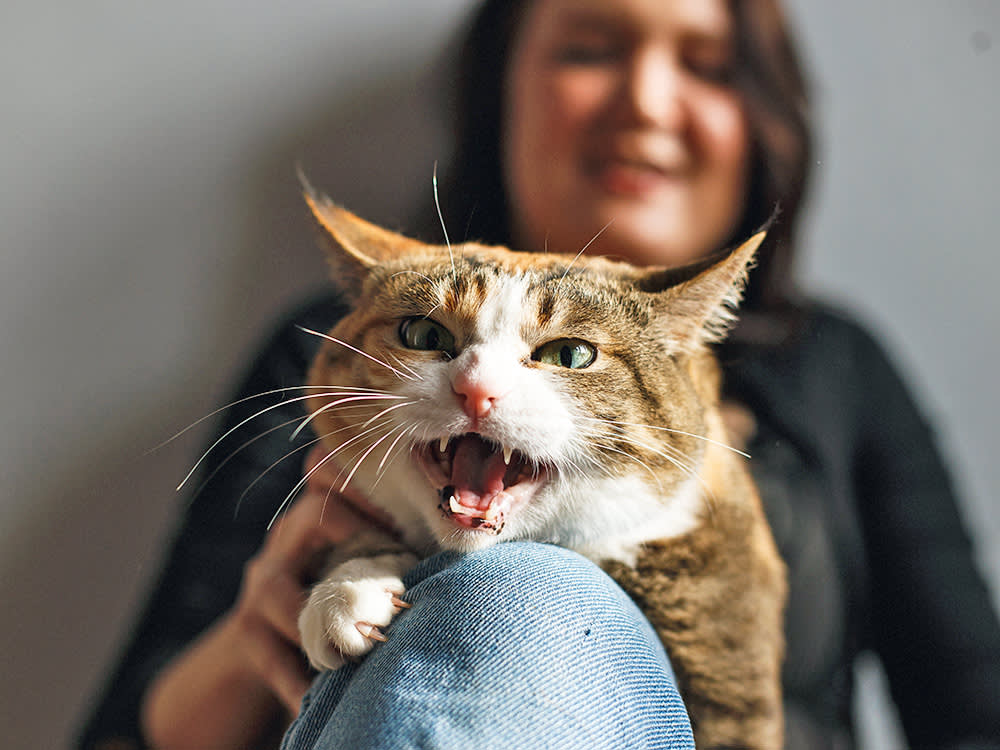
There is a specific sound that will get you out of bed at 2 a.m. and standing in a dark hallway with your heart going. It is not a meow. It is long, loud, and shaped almost exactly like a human infant crying, which is not a coincidence, because it is designed to be impossible to ignore.
Most cat owners have never heard their own cat make it, and that is the single most useful fact in this article. If you have a spayed or neutered indoor cat, a caterwaul is not part of the normal repertoire. It is not a mood. It is an alarm, and it means one of a short list of specific things.
So the goal here is not “what is caterwauling.” The goal is to make you able to tell it from the other loud noise your cat makes, because everything downstream depends on that, and then to hand you the list of what it means when you get it right.
First, the machinery
Behaviorists sort cat sounds by what the mouth is doing, which sounds fussy until you use it, and then it is the only system that works.
Category one: the mouth stays closed. Purrs, chirps, trills. Contentment, greeting, the noise your cat makes when a bird lands on the sill.
Category two: the mouth opens, then closes during the sound. This is where the meow lives, and also the howl. The closing is what gives a meow its shape, that little door swinging shut at the end.
Category three: the mouth stays open the entire time. The hiss. And the caterwaul.
That third category is the one to learn. Held open, a vocalization keeps going, unbroken and undamped, and it can be shaped and modulated for as long as the cat has air. That is why a caterwaul sounds like a siren and a meow sounds like a word.
Humans are frankly bad at this. We hear “loud cat noise” and stop analyzing. But a howl and a caterwaul are different sounds, doing different jobs, and the difference is in the mouth.
The howl vs. the caterwaul, in practice
A howl is a broad-spectrum complaint. Cats howl for a hundred reasons: nausea before a vomit, an empty bowl, a closed door, a cat they can see through glass, boredom at 4 a.m. It is negative, it is not specific, and it can mean almost anything.
A caterwaul is narrow. It is insistent, dramatic, sustained, and built to summon. And it shows up in essentially four contexts.
1. Territory
The most common one, and the one people most often misread as spookiness.
Caterwauling is frequently territorial: between two cats outdoors, or from an indoor cat who has spotted an intruder through the window. Think about what that is actually like from inside a cat’s head. Your entire world is one apartment. Something that should not be there is standing in it, or looking into it, and you cannot do anything about it. A stranger is in your yard and the door is locked.
The fixes are physical, not behavioral. Make the yard unwelcoming to visiting cats: secure the fence line, remove the food source if there is one, install motion-activated sprinklers. If you cannot control the yard, control the window. Privacy film on the lower half of the glass lets light in and takes the trigger away, and it is the single most effective thing most people can do here.
2. Mating
This is the one the sound was built for. An unspayed female in heat caterwauls to advertise. Intact males caterwaul back when they detect her. If you live near a feral colony, this is your soundtrack in spring, and the noise is the point.
Spaying and neutering removes it. If you have fixed indoor cats, you will most likely never hear this version, which is precisely why a fixed indoor cat suddenly caterwauling should not be filed under “cats are weird.”
3. Cognitive decline
Here is the one that matters most, and the one people apologize for instead of reporting.
As cats age, some develop cognitive dysfunction syndrome, the feline analog of dementia. Confusion, disorientation, disrupted sleep cycles, and distress. A cat standing in a lit hallway at 3 a.m. yowling at a wall may genuinely not know where they are.
It is not a rare condition. Roughly 28% of cats aged 11 to 14 show at least one behavioral sign of cognitive dysfunction. Past 15, it is about half. And vocalizing is one of the most consistent early signals: in a 2020 survey of owners of elderly cats, increased vocalization was reported in over 58% during the day and more than 30% at night.
The most revealing number in that study is what owners thought was causing it. Asked to name the main driver, they split almost evenly between disorientation (40.5%) and attention-seeking (40.5%), with resource-seeking such as food at 16.2% and pain at 2.7%.
Sit with that for a second. From the couch, a confused cat and a needy cat produce the same sound. You cannot separate them by ear, and neither can I, and neither can your cat’s own person of fifteen years.
The night yowling is the thing owners bring up last, almost as an aside, like they are wasting my time. It is frequently the most important thing they say all appointment. It shows up before the weight loss, before the bloodwork moves.
Two age-related conditions also present exactly this way and are eminently treatable: hyperthyroidism, which cranks up hunger, thirst, restlessness, and voice, and high blood pressure, which can cause vision loss and leave a cat genuinely disoriented in a room they have lived in for a decade. Neither is diagnosable from the hallway. Both are catchable with a blood pressure cuff and a blood panel.
Cognitive decline itself cannot be reversed. It can be slowed and managed, with diet, supplements, medication in some cases, and environmental changes that cost nothing: clear the clutter and the obstacles, keep the litter box in exactly the same place, and leave night lights on so a cat with fading vision can navigate.
4. Separation anxiety
Less studied in cats than in dogs, and often dismissed on the grounds that cats do not care whether you are home. They do.
A cat in distress at your absence may produce sustained, dramatic vocalization, sometimes alongside inappropriate elimination or destructive behavior. The management is the same as it is for most feline anxiety: predictability plus enrichment. Cats do best when the environment is stable and the day has a shape. More cognitive enrichment, more physical activity, more of the same routine. In severe cases, medication is warranted, and that is a vet conversation.
The rule that covers all four
You do not have to be able to name the sound correctly to do the right thing. You just have to notice a change.
A cat who was quiet and is now loud is telling you something has changed. That is true whether the noise is a caterwaul, a howl, or a new kind of meow at a new time of day. A sudden, sustained shift in vocal habits is the flag. The vet visit is the first step, always, and it is where you rule out the medical causes before you go looking for behavioral ones.
What newer research adds
The most useful update in the last few years is not about the sound at all. It is about how badly senior cats get under-diagnosed.
Cognitive dysfunction in cats used to be filed under “old age,” which is another way of saying nobody looked. It is now recognized as a distinct, common, and actionable syndrome, and clinical guidance has shifted toward actively screening for it in cats over ten rather than waiting for owners to complain. Since owners overwhelmingly report vocalization as the first thing they notice, the noise you have been apologizing about is, in a real sense, the screening tool.
The other thing the data changes is the emotional register of the whole subject. That 40.5% disorientation figure means a substantial share of cats yowling at 3 a.m. are frightened. Not being dramatic. Not asking for a snack. Lost, in their own house, in the dark. Night lights and a clear path to the litter box are a small ask against that.
References
- Sordo, L., & Gunn-Moore, D. A. (2021). Cognitive Dysfunction in Cats: Update on Neuropathological and Behavioural Changes Plus Clinical Management. Veterinary Record.
- Sordo, L., Martini, A. C., Houston, F. E., et al. (2020). Potential Causes of Increased Vocalisation in Elderly Cats with Cognitive Dysfunction Syndrome as Assessed by Their Owners. Animals.
- Gunn-Moore, D., Moffat, K., Christie, L.-A., & Head, E. (2007). Cognitive dysfunction and the neurobiology of ageing in cats. Journal of Small Animal Practice.
- American Animal Hospital Association. A compassionate approach to feline cognitive dysfunction.
Common questions
Is caterwauling the same as howling?
No, though they are easy to confuse. A howl starts with an open mouth and closes partway through. A caterwaul stays open throughout, which is what gives it that continuous, siren-like quality.
Do spayed and neutered indoor cats caterwaul?
Rarely. Take mating and roaming intruders off the table and most fixed indoor cats will go their whole lives without doing it. Which is exactly why it is worth paying attention when one starts.
When should caterwauling send me to the vet?
Any new or sustained change in your cat's vocal habits deserves a vet check, and that goes double for a cat over ten. Cognitive dysfunction, hyperthyroidism, high blood pressure, and pain all show up this way.
Dr. Park is a board-certified emergency and critical care specialist. She reviews our health and safety content for clinical accuracy and contributes guides on recognising urgent conditions. Her focus is helping owners act quickly and correctly when it matters most.
Meet our experts ↗Keep reading
 Health & WellnessYour Cat Eating Your Shoelaces Isn't a Quirk. It Might Be Pica.Dr. Mara Chen · 7 min
 TrainingYour Cat Is Trying to Bury Something. The Question Is What.Dr. Lena Park · 8 min
 Health & WellnessYes, Female Cats Spray. Spaying Doesn't Always Stop It.Dr. Lena Park · 7 min
 TrainingThat Belly Is Not an Invitation. It's a Sentence.Dr. Nina Kohl · 6 min
 TrainingYour Cat Isn't Attacking You. You Live on a Hunting Route.Dr. Amara Solis · 9 min
 Health & WellnessYour Cat Isn't Being Weird. Plastic Bags Smell Like Food.Dr. Mara Chen · 7 min