


Your Cat Isn't Being Weird. Plastic Bags Smell Like Food.
Cats don't chew plastic at random. Bags are manufactured with animal-fat lubricants, they crinkle like prey, and they hold the smell of whatever came home inside them. Which is why 'just play with your cat more' keeps failing.

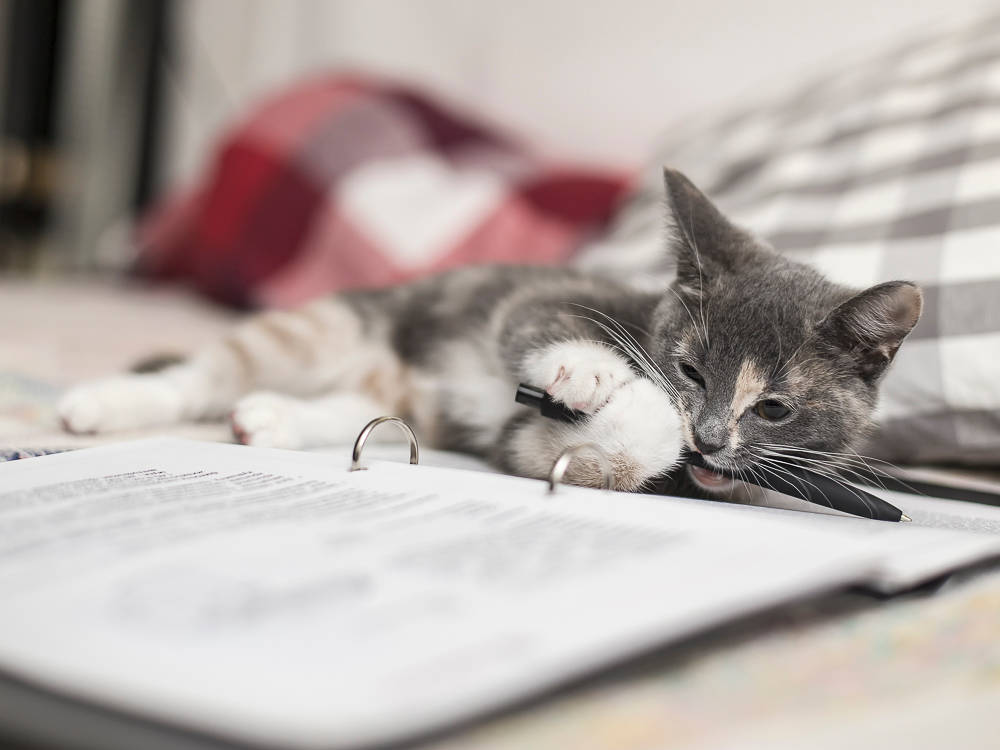
Every cat person knows the sound. That specific crackle from the other room, at the exact frequency of a plastic grocery bag being worked over by a small determined animal. You come in. Your cat looks up mid-crunch, mildly irritated at the interruption.
The standard advice for this is that your cat is bored and needs more enrichment. Play with them more. Rotate the toys. And, sure. But that advice keeps failing people, and it fails them because it skips the actual question.
Cats do not chew plastic at random. They chew plastic because a huge amount of the plastic in your house is, to a cat’s nose, food-adjacent. The behavior is not the mystery. The bag is.
Why plastic and not, say, the wall
Three things are usually working at once.
The bag is manufactured with animal fat. Polyethylene film sticks to itself, so manufacturers add lubricating compounds called slip agents to keep bags from fusing in the roll. Those agents are frequently stearates, and stearic acid is classically derived from tallow and other animal fats. A human nose gets nothing off a fresh grocery bag. A cat’s nose, running on a scent system built to find a mouse behind drywall, gets a faint but genuine animal smell. This is a widely repeated explanation among feline behavior consultants rather than something a controlled study has nailed down, so hold it loosely. It is also the most plausible reason your cat targets bags specifically and ignores the ceramic bowl right next to them.
The bag is compostable. Cornstarch-based and other plant-derived “biodegradable” bags have replaced petroleum film in a lot of households in the last few years. Those are literally made of food. If your cat’s plastic obsession got noticeably worse recently, check what changed in your kitchen drawer.
The bag sounds like prey. A crinkling bag makes a high-frequency, irregular, rustling sound. So does a mouse in dry leaves. Cats hear well above the human range and are wired to orient hard on exactly that texture of noise. The bag is not just something to chew. It reacts when you bite it.
Add the fourth, dumbest reason: the bag came home from the store with chicken in it.
People try to solve this with toys, and then they’re baffled when it doesn’t work. You can’t out-enrich a smell. The first move is not more playtime. It’s a drawer with a latch.
But it can also be a symptom
This is the part the “bored cat” framing buries, and it matters most.
Chewing and swallowing non-food material is pica, and pica is not a diagnosis. It is a sign, and sometimes the thing it is a sign of is medical. Before you decide your cat has a personality quirk, a vet should rule out:
- Gastrointestinal disease. Nausea, parasites, chronic GI inflammation. Discomfort in the gut can drive a cat to mouth strange things.
- Nutritional shortfall. Sometimes this is a genuinely inadequate food. Just as often, in my experience, it is a well-meaning owner feeding an aggressively calorie-restricted portion to a cat who is simply hungry. A hungry cat goes looking.
- Hyperthyroidism. Common in older cats, and it can show up as a ravenous, restless, strangely indiscriminate appetite.
- Anemia and other systemic disease. Less common, but on the list.
- Dental pain. Pressure on sore gums can be, counterintuitively, relieving.
If the behavior started suddenly in an adult cat, that history alone earns a vet visit. Sudden-onset pica in a cat who never did this is a symptom until proven otherwise.
The part that actually hurts
A tiny nibble that never leaves the mouth is not what puts cats in surgery. Swallowed plastic is.
Watch for:
- Vomiting, drooling, or diarrhea
- Lethargy
- A sudden drop in appetite, or refusing food entirely
- Behavior changes, especially reacting defensively when you touch or lift them
- Abdominal pain
- Weight loss
Plastic irritates the lining of the stomach and intestines, which is where the vomiting and diarrhea come from. The bigger danger is obstruction, where a piece lodges and blocks the gut. That is life-threatening and it is surgical.
And there are two specific things worse than a generic swallowed fragment:
Anything long and thin. A bag handle, a strip torn off a bag, a ribbon of shrink wrap. This is a linear foreign body, and it is a different category of emergency. One end can anchor while the gut keeps trying to move the rest along, and the material saws through the intestinal wall from the inside. Do not wait this one out.
Cords. A cat chewing a plastic power cord is not risking obstruction. They are risking electrocution and severe oral burns. Cord protectors are cheap. Buy them today.
What actually works, in order
The order is the whole trick. Enrichment is step four, not step one.
- See the vet. Rule out the medical drivers before you treat this as a behavior problem. If it’s thyroid disease, no amount of wand-toy time will touch it.
- Remove the supply. Bags go into a closed drawer or a latched cabinet, not a hook by the door. Cords get covered. Bread tags, milk-jug rings, pen caps, and shrink wrap come off the counter. This one step ends most cases, because you cannot chew what you cannot reach.
- Feed enough, and feed well. Check with your vet that your cat’s food and portion actually meet their needs. If your cat is being kept lean, make sure lean has not quietly become hungry.
- Give the behavior somewhere to go. Now enrichment earns its keep. Puzzle feeders, food-dispensing toys, real hunting play with a wand two or three times a day, scratching posts, cat grass. Something to chase, something to shred, something to chew that was made to be chewed.
- Reduce stress. Excessive chewing rises with anxiety. A move, a new baby, a new cat, a construction project next door. Routine, hiding spots, vertical space, and pheromone diffusers all help. If the stress is significant, your vet can treat it.
- Never punish it. You will get a cat who chews plastic when you are not in the room, which is exactly the version that ends in surgery.
What newer research adds
The old picture, that pica is mostly boredom, hasn’t held up well. The research keeps finding it clustered with other things.
Work on cats who eat fabric and other non-food items has repeatedly turned up an unusual, intense appetite in affected cats, which is part of why “is your cat actually getting enough food” is now a serious first question rather than a throwaway. Owner-report data from birth-cohort studies of pet cats has also found pica showing up early, often in the first year, and often alongside other oral behaviors like sucking. And breed is real: Siamese and Burmese lines keep appearing in the literature at higher rates than you’d expect by chance, which points at something inherited rather than something learned.
The practical takeaway hasn’t changed, though. Rule out disease, lock up the plastic, feed the cat properly, then make life more interesting. In that order.
References
- Bradshaw, John W. S., Sarah L. Neville, and Diana Sawyer. “Factors Affecting Pica in the Domestic Cat.” Applied Animal Behaviour Science, vol. 52, no. 3–4, 1997, pp. 373–379. https://doi.org/10.1016/S0168-1591(96)01136-7
- Demontigny-Bédard, Isabelle, et al. “Medical and Behavioral Evaluation of 8 Cats Presenting with Fabric Ingestion: An Exploratory Pilot Study.” Journal of Veterinary Behavior, vol. 17, 2016, pp. 1–8. https://doi.org/10.1016/j.jveb.2016.09.005
- Rowe, Elizabeth, et al. “Owner-Reported Pica in Domestic Cats Enrolled onto a Birth Cohort Study.” Applied Animal Behaviour Science, vol. 193, 2017, pp. 66–74. https://doi.org/10.1016/j.applanim.2017.03.005
- Cornell Feline Health Center. “Hyperthyroidism in Cats.” https://www.vet.cornell.edu/departments-centers-and-institutes/cornell-feline-health-center/health-information/feline-health-topics/hyperthyroidism-cats
- Merck Veterinary Manual. “Gastrointestinal Obstruction in Small Animals.” https://www.merckvetmanual.com/digestive-system/diseases-of-the-stomach-and-intestines-in-small-animals/intestinal-obstruction-in-small-animals
- Johnson-Bennett, Pam. “Why Does My Cat Chew or Lick Plastic Bags?” Cat Behavior Associates. https://catbehaviorassociates.com/why-does-my-cat-chew-or-lick-plastic-bags/
Common questions
My cat swallowed a piece of plastic. What now?
A tiny nibble that stays in the mouth is usually a non-event. A swallowed piece is not. Call your vet, tell them the size and shape of what's missing, and watch for vomiting, drooling, loss of appetite, lethargy, or a painful belly. Do not try to make your cat vomit at home. Anything long and stringy, like a bag handle or a cut strip of a bag, is an emergency, not a wait-and-see.
Is chewing plastic the same as eating it?
No, and the difference is the whole risk. Licking and gnawing without swallowing is a nuisance. Swallowing is what causes obstruction. Watch what actually goes down, not what goes in the mouth.
Do certain cats do this more?
Yes. Oriental breeds, particularly Siamese and Burmese, are over-represented in the pica literature, and pica is more common in young cats. That doesn't make it safe or normal in those breeds, it just means their people should be more careful about what's on the floor.
Not a substitute for your vet. Our guidance is educational. For urgent symptoms, contact a vet or emergency clinic right away. Editorial standards
Dr. Chen is a small-animal veterinarian who leads health and safety coverage at The Pet Times. She writes and reviews the bulk of our illness, condition, and safety content, translating clinical guidance into clear, practical advice owners can act on at home.
Meet our experts ↗Keep reading
 TrainingYour Cat Is Trying to Bury Something. The Question Is What.Dr. Lena Park · 8 min
 TrainingThat Sound Isn't a Meow. And It Isn't Good News.Dr. Lena Park · 8 min
 Health & WellnessThe Cat Loaf Has a Dark Version. It's in the Face, Not the Paws.Dr. Mara Chen · 8 min
 TrainingYour Cat Isn't Being Naughty. The Chewing Is a MessageDr. Nina Kohl · 9 min
 TrainingThat Belly Is Not an Invitation. It's a Sentence.Dr. Nina Kohl · 6 min
 TrainingYour Cat Screams at 3am Because You Never Let It Finish the HuntDr. Mara Chen · 8 min