


Your Cat Is Trying to Bury Something. The Question Is What.
The pawing-at-nothing thing isn't random and it isn't a quirk. Floor-digging is a cat reacting to a specific spot, and once you work out what's on that spot, the behavior usually explains itself.

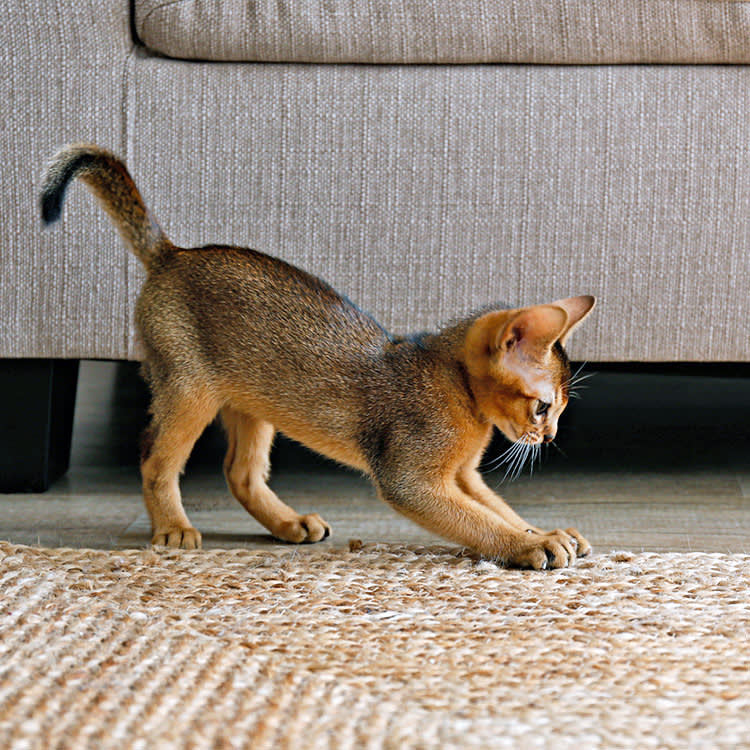
The behavior looks unhinged. Your cat stops in the middle of an ordinary floor, or beside a food bowl, or on a rug in a hallway with nothing on it, and starts raking at the surface with real conviction. Front paws, alternating, scraping something invisible over something that isn’t there.
Owners read this as a glitch. It is the opposite of a glitch. Your cat is running a very old, very specific program: cover this. The program is intact. The only thing missing is the material.
Which means the useful question is not “why is my cat doing this weird thing.” It’s the one your cat is already answering: what is on that spot?
Read the location, not the cat
Nearly every case of floor-digging resolves once you look at where it’s happening. The behavior is a reaction to a place. Start there.
Beside the food bowl. This is caching, and it’s the most common version by a wide margin. A wild cat with a kill it can’t finish covers the remainder to hide the smell from anything that might come looking. Your cat, presented with food it doesn’t want right now, runs the same routine at a bowl it cannot possibly bury. Some will attempt to bury a full bowl of food they’ve decided against, which is one of the more openly insulting things a cat can do.
What it tells you: your cat has a view about that food. If this is new, ask whether the food changed, whether the bowl is plastic and holding odors, or, more seriously, whether your cat is nauseated. A cat that starts burying meals it used to eat is worth a vet check.
Near, but not in, the litter box. The digging instinct is fully wired but the box is being rejected. Too dirty, too small, too covered, wrong litter, wrong place, or, critically, associated with pain. A cat with a urinary tract infection or cystitis learns that the box hurts and starts performing the ritual next to it instead.
What it tells you: fix the box first. But if there’s straining, crying, blood, frequent tiny trips, or urinating outside the box, especially in a male cat, that is a same-day emergency, not a housekeeping issue.
On a specific rug or a specific patch of hallway, repeatedly. Something happened there, or something smells like it did. Another animal marked it, a spill went into the fibers, a visitor’s shoes stood there. Cats have scent glands in their paw pads, so digging both removes an offending smell and lays down their own on top of it. It’s a two-way negotiation with the floor.
What it tells you: find the smell. An enzymatic cleaner does more here than any amount of redirection.
Where they’re about to lie down. Nesting. Wild cats flatten and clear a spot before sleeping, and the fact that your carpet is already flat and clear is an argument your cat has not accepted. This one is entirely benign, and honestly rather charming.
When there is no spot: the arousal version
Sometimes the location tells you nothing, because the driver isn’t the floor at all.
Boredom. A cat with too little to do invents things to do. Repetitive digging is a cheap, available outlet for energy that has nowhere else to go.
Attention. If digging at the carpet reliably makes you look up, laugh, sigh, or come pick the cat up, the cat has run the experiment and found the result reproducible. This gets stronger the more inconsistently you respond to it.
Stress. A move, a new pet, houseguests, building work, a schedule change. Repetitive behaviors are self-soothing, and a cat that can’t control its environment will settle for controlling one square foot of it. Look for the company this keeps: hiding, more vocalizing, changes in appetite, changes in litter box habits.
Habit. Behavior that started for one of the above reasons and simply stayed after the reason left. Cats are creatures of enormous routine, and a groove worn in over months does not vanish because the cause did.
The floor is almost never the point. What I want to know is what was there, what changed in the house, and how much the cat has to occupy itself with. Answer those three and the digging usually explains itself.
When it’s a health problem
Most floor-digging is normal. A minority isn’t, and the difference is character, not frequency.
Be concerned when the behavior is sudden, frantic, and compulsive, when the cat seems unable to stop, when it’s paired with skin rippling along the back, tail lashing, dilated pupils, sudden bolting, or apparent overreaction to being touched. That combination can point toward feline hyperesthesia syndrome, an uncommon condition involving heightened skin and nerve sensitivity.
Be concerned when it’s around the litter box and accompanied by any urinary sign at all. Straining, frequent small attempts, vocalizing, blood, or going outside the box. Urinary disease in cats moves fast, and in males it can become life-threatening within a day.
Be concerned when it’s around food and accompanied by a shrinking appetite, weight loss, or vomiting. A cat that suddenly wants to bury its meals may be telling you food makes it feel sick.
In all three cases the right response is a vet, not a training plan.
How to actually change it
Assuming health is ruled out, work in this order.
Give the instinct somewhere legitimate to go. This is the single highest-yield fix and most people skip straight past it. Your cat wants to dig and scrape. Offer surfaces that reward it: a horizontal cardboard scratcher, a sisal mat, a low carpeted pad, placed at the spot they’re already using, not in the corner where you’d prefer it. Then pay them for using it, with a treat or a bit of play, the first several times.
Clean the trigger out of the floor. Enzymatic cleaner on any patch with a history. Not a scented cleaner, which just adds a new smell to bury.
Fix the box before you fix the cat. Scoop daily. One box per cat plus one. Unscented, fine-grained litter. Uncovered, in a quiet, low-traffic spot with an escape route. This solves more “weird cat behavior” than any other single intervention.
Move the food, and change the bowl. Ceramic or stainless steel rather than plastic, which holds odor. Away from the water, away from the litter box, away from noisy appliances. Feed smaller portions so there’s nothing left over to want to cover, and use a wipeable mat.
Add work to the day. Two or three short play sessions with a wand toy. A puzzle feeder instead of a bowl for part of the ration. Vertical space. A window with something happening outside it. A bored cat and a busy cat behave very differently.
Stop rewarding the performance. If it’s attention-seeking, the only cure is genuinely, boringly, not reacting, while giving the cat a scheduled outlet for attention at other times.
What newer research adds
A large study published in 2024 in Frontiers in Veterinary Science looked at what actually predicts unwanted scratching in house cats. The researchers surveyed the owners of more than 1,200 cats about routines, environments, temperaments, and home life, and found that the strongest associations were not the ones people expect.
Scratching went up with stress and with arousal. Cats in homes with children scratched more. So did cats described as more playful, more nocturnally active, and cats whose play sessions ran long and intense without a clear ending.
That last finding is the practically useful one, and it’s slightly counterintuitive. More play is generally good, but play that winds a cat up and then just stops, with no catch, no kill, no meal at the end, can leave a cat vibrating with unspent energy that has to go somewhere. The researchers’ suggestion was short, frequent play sessions that finish properly: let your cat catch the toy, then feed them.
So if your cat digs at the carpet like a dog at the beach every evening after a long, unresolved chase with a laser pointer, that is not a coincidence. End the session with something to catch and something to eat, and see what happens over a fortnight.
The bottom line
Floor-digging is one of the clearest messages a cat sends, and we misfile it as randomness because we’re looking at the paws instead of the ground.
Look at the spot. Then look at the week: what changed, what smells, how much your cat has had to do. If nothing explains it and the behavior is frantic, obsessive, or paired with any change to eating or urinating, stop investigating and call your vet.
Everything else is a cat, doing exactly what a cat is for, on a floor that unfortunately refuses to move.
References
- Sarrafchi, A., et al. “Evaluating Undesired Scratching in Domestic Cats: A Multifactorial Approach to Understand Risk Factors.” Frontiers in Veterinary Science, vol. 11, 2024. https://www.frontiersin.org/journals/veterinary-science/articles/10.3389/fvets.2024.1403068/full
- Horwitz, D. “Cat Behavior Problems: Scratching Behavior.” VCA Animal Hospitals. https://vcahospitals.com/know-your-pet/cat-behavior-problems---scratching-behavior
- Sordo, L., and D. A. Gunn-Moore. “Cognitive Dysfunction in Cats: Update on Neuropathological and Behavioural Changes Plus Clinical Management.” Veterinary Record, vol. 188, no. 1, 2021. https://bvajournals.onlinelibrary.wiley.com/doi/10.1002/vetr.3
- Amengual Batle, P., et al. “Feline Hyperaesthesia Syndrome with Self-Trauma: A Retrospective Study of Seven Cases and Proposal for an Integrated Multidisciplinary Diagnostic Approach.” Journal of Feline Medicine and Surgery, vol. 21, no. 2, 2019, pp. 178–185. https://pubmed.ncbi.nlm.nih.gov/29649937/
- Carney, H. C., et al. “AAFP and ISFM Guidelines for Diagnosing and Solving House-Soiling Behavior in Cats.” Journal of Feline Medicine and Surgery, vol. 16, no. 7, 2014, pp. 579–598. https://journals.sagepub.com/doi/10.1177/1098612X14539092
Common questions
Is floor scratching bad for my cat's claws?
On carpet or a rug, no. On tile, laminate, or hardwood, repeated hard digging can split or fray a claw. If you're seeing claw damage or blood, cover the spot and give them something better to dig into.
My cat digs at the floor near the litter box, not in it. Why?
That is a complaint about the box. Too dirty, too small, too enclosed, the wrong litter, or the wrong location. Check all of those. If they're also straining or urinating outside the box, see a vet the same day.
Should I stop my cat from doing this?
Only if it's damaging something, or if it's escalating. Occasional floor-digging is normal feline behavior. Compulsive, frantic, hours-a-day digging is not, and that version deserves a vet.
Dr. Park is a board-certified emergency and critical care specialist. She reviews our health and safety content for clinical accuracy and contributes guides on recognising urgent conditions. Her focus is helping owners act quickly and correctly when it matters most.
Meet our experts ↗Keep reading
 TrainingThat Belly Is Not an Invitation. It's a Sentence.Dr. Nina Kohl · 6 min
 Health & WellnessYour Male Cat Isn't Being Spiteful. He's Leaving You a Note.Dr. Mara Chen · 7 min
 Health & WellnessYour Cat Isn't Being Spiteful. Almost Every 'Bad Cat' Behavior Is Anxiety.Dr. Priya Nair · 9 min
 Health & WellnessYes, Female Cats Spray. Spaying Doesn't Always Stop It.Dr. Lena Park · 7 min
 TrainingYour Cat Screams at 3am Because You Never Let It Finish the HuntDr. Mara Chen · 8 min
 TrainingYour Cat Isn't Being Naughty. The Chewing Is a MessageDr. Nina Kohl · 9 min