


That Belly Is Not an Invitation. It's a Sentence.
Cats roll for at least five good reasons and a few bad ones. The tell isn't the roll, it's what your cat is doing with her voice, her body, and her timing while she does it.

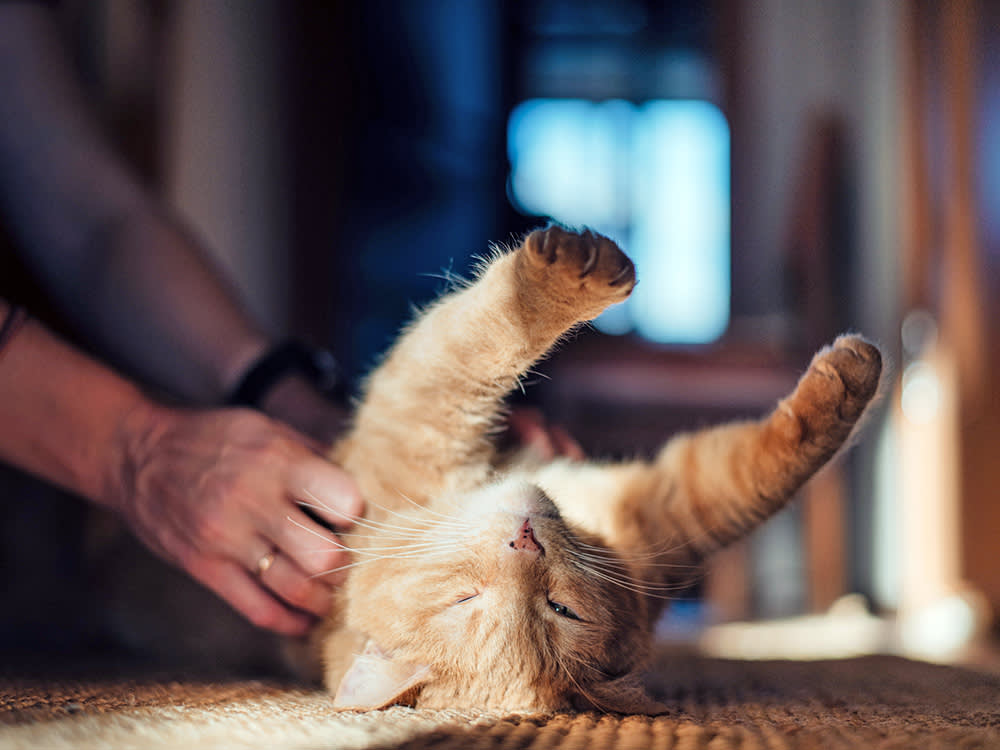
You know the flop. Your cat crosses the room, drops, and rolls onto her back like a fluffy worm doing a backstroke, and you take the same photo you have taken forty times before. It is one of the most charming things cats do.
It is also one of the most misread. Because rolling is not a single behavior with a single meaning, and the difference between “I am delighted” and “something hurts” is not in the roll at all. It is in the context around it: her voice, her muscle tone, where she is, and what happened thirty seconds earlier.
Learn to read the frame and the roll becomes one of the more informative things your cat does.
The two-question triage
Before you interpret anything, ask yourself two things.
Is she quiet, or is she making noise? A silent, loose, sprawling roll is a happy roll. Rolling with yowling, crying, or restless repetition is a distress signal until proven otherwise.
Is her body loose or tight? Relaxed cats roll with floppy limbs and a soft face. A cat rolling with tension in the body, especially one who keeps getting up and doing it again, is trying to make something stop.
If both answers are on the happy side, read the next section. If either is on the wrong side, skip to the one after it.
The good rolls
She wants to play
A relaxed, playful cat may roll onto her back as an opening move. In multi-cat homes, rolling during social play appears to work as a “no hostility here” signal, a way of saying the wrestling that follows is a game. Kicker toys are made for this: something to hold with the front paws and shred with the back ones. If your cat rolls and looks at you, the correct response is often a wand toy and five minutes of hunting, not a photo.
She is greeting you
A cat who is pleased to see you may roll near you, at your feet, on your path to the kitchen. This is where the belly misunderstanding lives. Showing you the underside is a statement of trust, an offer of vulnerability. It is very high praise in cat body language, and it is emphatically not a coupon for a tummy rub. Take the compliment. Scratch the chin.
She is signing her name
Cats carry scent glands in their cheeks, paws, chin, and at the base of the tail. Rolling and rubbing spreads that scent and those pheromones onto surfaces around the home, and a home that smells like her is a home where she feels territorially secure. So a cat rolling on the rug for no apparent reason, not playing, not asking for anything, is doing quiet emotional maintenance. It is a good sign.
She is cooling off
Cats like being warm, but they have limits, and they are wearing a permanent coat. Outdoors on a hot day, a cat may flop onto grass or soil and roll, scraping off the sun-warmed top layer to reach the cooler ground underneath. Indoors, you see the same behavior on tile or concrete. If your cat has started rolling on the bathroom floor every afternoon in July, that is not a mystery. That is air conditioning.
She is high
Catnip works through nepetalactone, and a classic response is exactly this: rolling, rubbing, blissful nonsense. Not every cat participates. Roughly one in three cats does not respond to catnip at all, which is normal and says nothing about your cat. Non-responders often still react to the alternatives, silver vine, Tatarian honeysuckle, or valerian root, which can produce the same rolling euphoria. And it is fine if she eats the stuff. Ingesting catnip or its alternatives comes with the territory.
The rolls that mean call the vet
Here is where the context question earns its keep. Several distress behaviors look, to a phone camera, exactly like joy.
She is in heat
An unspayed female in heat rolls, and rolls, and rolls, far more than she normally would, while rubbing her face on everything, yowling, and demanding attention with an intensity that is genuinely hard to live with. Confusingly, a cat in heat and a cat on catnip can look remarkably similar. The heat version comes with the vocalizing and it goes on for days. It is also miserable for her, not just for you, which is one of several good arguments for spaying.
She has just mated
Rolling intensifies in females after mating, and it is thought this behavior may help sperm reach the eggs more quickly. Worth knowing if you have an intact cat with outdoor access.
She is itchy
Itch is a very common driver of rolling, and the causes stack up fast: food or environmental allergies, matted fur pulling at the skin, and the usual parasite lineup of fleas, ticks, and lice. Make sure her parasite prevention is current and that she is grooming properly. If the coat is matting, a groomer can relieve it, and a lion cut is a perfectly respectable outcome.
She is in pain
This is the one people miss. Rolling can be an attempt to soothe discomfort. Treatments for fleas or ringworm can irritate sensitive skin and produce a burning sensation, and a cat will roll to try to make it stop. Pain-driven rolling also turns up with urinary tract trouble, with digestive problems at either end (constipation, diarrhea), and with hormonal imbalance.
So: no obvious trigger, plus a cat who looks unhappy. Or rolling that arrives alongside yowling, crying, bleeding, a change in her litter box habits, or a cat who has gone off her food. Any of that is a same-day vet visit.
The roll people bring me videos of is almost never the roll I am worried about. I am worried about the one that repeats. Contentment is a single, sloppy, silent flop. Discomfort is a cat who keeps getting up to do it again.
And the litter box roll
Rolling in litter is common and mostly about scent: your cat putting her own smell into the box, or wrapping herself in it. Cats often want to re-sign freshly changed litter. Kittens do it because flinging litter is a delight, and they usually grow out of it. The version worth noticing is a cat who hangs around in a dirty box, which can suggest she feels territorially insecure and needs more approved places to leave her scent around the house: more scratchers, more bedding of her own, more surfaces that belong to her.
What newer research adds
The catnip picture has gotten more interesting since most “why does my cat roll” explainers were written. Work on the active compounds in silver vine found that the great majority of cats respond to it, including a large share of the cats who ignore catnip entirely, which makes silver vine the better first try for a non-responder rather than a consolation prize.
Researchers have also proposed a genuinely surprising function for the rubbing and rolling itself: transferring the plant’s compounds onto the cat’s fur, where they appear to repel mosquitoes. That does not mean your cat is treating herself for bug bites on purpose. But it does suggest the rolling response evolved as more than a party trick, and it is a good reminder that “she’s just being weird” is rarely the whole story.
References
- Bol, S., et al. “Responsiveness of cats (Felidae) to silver vine (Actinidia polygama), Tatarian honeysuckle (Lonicera tatarica), valerian (Valeriana officinalis) and catnip (Nepeta cataria).” BMC Veterinary Research, vol. 13, no. 70, 2017.
- Uenoyama, R., et al. “The characteristic response of domestic cats to plant iridoids allows them to gain chemical defense against mosquitoes.” Science Advances, vol. 7, no. 4, 2021.
- Gajdoš Kmecová, N., et al. “Are These Cats Playing? A Closer Look at Social Play in Cats and Proposal for a Psychobiological Approach and Standard Terminology.” Frontiers in Veterinary Science, vol. 8, 2021.
- Johnson, A.K. “Normal Feline Reproduction: The Queen.” Journal of Feline Medicine and Surgery, vol. 24, no. 3, 2022, pp. 204-211.
- Ohkawa, N., and Hidaka, T. “Rubbing and Rolling Behavior in the Domestic Cat, Felis catus.” Memoirs of the Faculty of Science, Kyoto University (Series of Biology), vol. 16, no. 2, 1999, pp. 95-103.
Common questions
Is a belly roll an invitation for a belly rub?
Usually not. Exposing the belly means your cat trusts you enough to be vulnerable near you. It is a compliment, not a request. Plenty of cats who roll happily at your feet will still object, with claws, to a hand on the stomach.
Why does my cat roll around in the litter box?
Most often it is scent. Cats want their own smell in the box, especially after you change the litter. Kittens also roll and fling litter purely because it is fun. A cat who lingers in a dirty box, though, may be feeling territorially insecure and needs more places to leave her scent, like scratchers and bedding of her own.
Dr. Kohl is a board-certified veterinary dentist with a particular interest in preventive oral care. She reviews all dental health content at The Pet Times and contributes practical guides on home dental routines, professional cleaning, and oral disease prevention.
Meet our experts ↗Keep reading
 TrainingYour Cat Isn't Attacking You. You Live on a Hunting Route.Dr. Amara Solis · 9 min
 Health & WellnessYes, Female Cats Spray. Spaying Doesn't Always Stop It.Dr. Lena Park · 7 min
 TrainingYour Cat Isn't Being Naughty. The Chewing Is a MessageDr. Nina Kohl · 9 min
 TrainingThat Sound Isn't a Meow. And It Isn't Good News.Dr. Lena Park · 8 min
 Health & WellnessThe Cat Loaf Has a Dark Version. It's in the Face, Not the Paws.Dr. Mara Chen · 8 min
 Health & WellnessYour Cat Isn't Being Weird. Plastic Bags Smell Like Food.Dr. Mara Chen · 7 min