


Your Cat Isn't Attacking You. You Live on a Hunting Route.
Ankle-biting isn't aggression and it isn't random. It happens at the same three or four spots in your home, at the same two times of day, and once you can see the map, you can dismantle it.

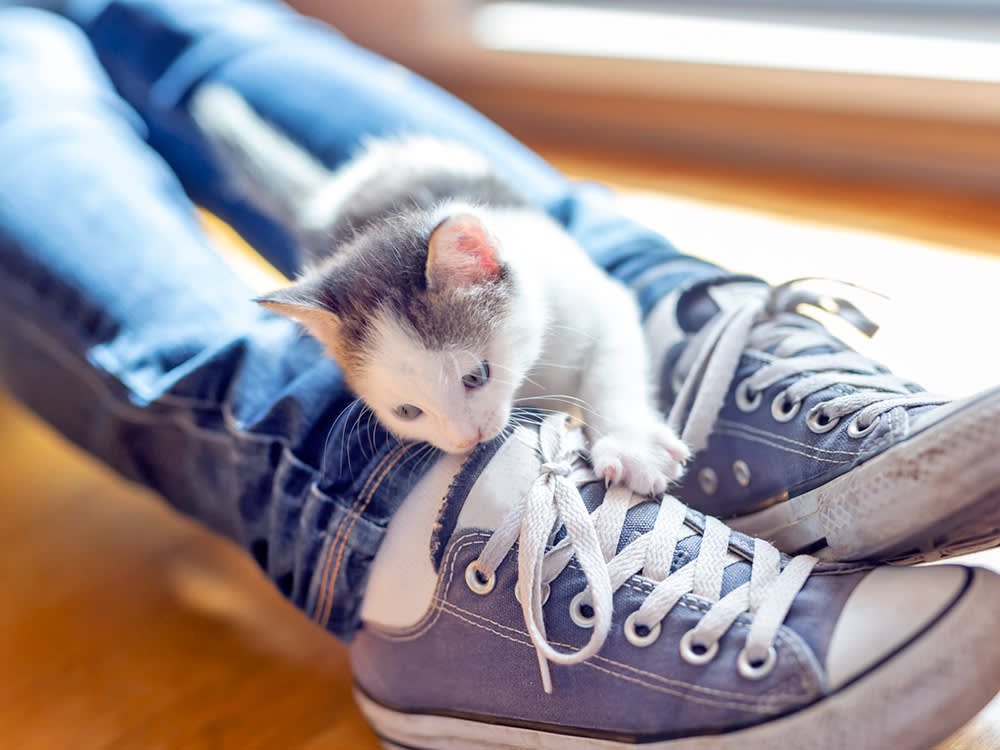
You are walking to the kitchen, barefoot, thinking about nothing. Something detonates out from under the couch, latches onto your ankle, and vanishes. The whole event takes under a second and leaves you with two small punctures and a genuine question about your cat’s feelings toward you.
Here is the reassuring part, and the part almost everyone gets wrong. This is not aggression, and it is not a message. Your cat is not telling you anything.
They are hunting. And they are hunting there, at that spot, because that spot works.
Ankle-biting feels random from the inside, which is exactly why people treat it as a personality flaw and try to punish it out of the cat. It isn’t random. It is one of the most predictable behaviors a house cat produces. It happens in a small number of fixed locations, at a small number of predictable times, and it follows a sequence you can interrupt. Once you can see the pattern, you stop taking it personally and start taking it apart.
Draw the ambush map
Before you buy a single toy, spend three days as a note-taker. Every time you get nailed, write down two things: where you were standing, and roughly what time it was.
Almost every cat parent who does this discovers the same thing. The attacks are not scattered across the house. They cluster at three or four specific places, and those places have a shape in common:
- A blind corner. The turn from the hallway into the kitchen, where you appear suddenly and at close range.
- A piece of furniture with a gap under it. The couch, the bed, the console table. Cover on one side, a clear lane on the other.
- A doorway or threshold. Especially a narrow one, where you have to slow slightly.
- The stairs. Ankles at eye level, a body moving away from them, a staircase that funnels you into a lane. Stairs are the single most reliable ambush site in a house.
What all four have in common is that they let a small predator wait in cover and strike a moving target at a distance of about a foot. That is not a coincidence, and it is not your cat being spiteful. That is an animal solving a geometry problem correctly.
Now look at the times. You will very likely find two clusters: early morning, and the hour or two around dusk. Cats are crepuscular, which means their hunting drive peaks at dawn and twilight, and it peaks whether or not there is anything in the house worth hunting. If you work a normal day, dusk is also, unhelpfully, the moment you walk in the door and start moving quickly around the kitchen.
The map is the whole diagnosis. A cat who ambushes you at the bottom of the stairs at 6pm is not a cat with an attitude problem. That cat is at the peak of their hunting window, positioned at the best ambush site in the building, and you are the only thing moving.
Why the hunt has nowhere to go
Cats are predators that we have barely renovated. Domestication softened the edges, but the machinery underneath is intact and it expects to be used. A cat in a house has the full stalk-chase-pounce-kill sequence loaded and ready, and typically nothing whatsoever to spend it on.
The drive does not switch off because there is no prey. It goes looking. And in an apartment, the pool of candidate prey consists of a shoelace, a moth, and you.
“The mistake people make is asking why their cat is doing this to them, when the useful question is what else that hunt was supposed to be for,” says Dr. Priya Nair. “The behavior isn’t a relationship problem. It’s an unspent budget. A cat who gets to complete a real hunt on a toy has a lot less left over for your feet.”
This is also why the drive-by nature of it is so distinctive. A hunting cat does not want a fight. They want a hit and an escape, which is precisely what you get: a strike from cover, and then they are gone before you have finished swearing. A cat who genuinely wanted to hurt you would stay.
Boredom pours fuel on this. Cats are intelligent, curious animals with a real need for stimulation, and an indoor cat with an empty day and an empty environment will find work. Without opportunities to hunt through play, cats can slide into boredom, and from there into stress, destructiveness, house soiling, and a shorter fuse generally.
The fix is a dose, and we know the size of it
Here is the part that turns this from folk advice into something you can actually run.
In 2021, researchers at the University of Exeter tested whether ordinary interventions could reduce hunting in cats with outdoor access. One of the things they tested was play: five to ten minutes a day with a feather wand, letting the cat stalk and pounce, and finishing by giving the cat a toy mouse they could physically “kill.” Cats on that regimen brought home 25% less prey. (Switching to a high-meat, grain-free food cut it by 36%, which is a separate finding but tells you something about how tightly hunting and feeding are wired together.)
That study was about wildlife, not ankles. But the mechanism is the same one operating in your hallway, and it gives you something rare in cat behavior advice: a dose.
Five to ten minutes, twice a day, and the hunt has to finish.
That last clause is the one people skip, and it is the one that matters. Waving a wand around until the cat gets bored does not discharge anything. It leaves the sequence hanging open, which is arguably worse than not playing at all. The sequence is stalk, chase, pounce, catch, kill, eat. Your job is to run it to the end:
- Move the toy like prey, not like a toy. Prey flees, hides, and freezes. It does not fly at the cat’s face. Drag the wand away from your cat, let it disappear behind a chair leg, let it twitch and go still.
- Let them win, repeatedly. Every few passes, let the cat actually catch it. A cat who never catches anything disengages, which is the opposite of a discharged hunt.
- End with a kill. Finish on a catch they get to grab, kick, and bite properly. A toy mouse or a kickeroo is ideal here.
- Feed immediately after. Hunt, then eat, in that order. This is the natural end of the sequence and it is what puts a cat into the sated, grooming, sleepy state you are aiming for.
Time the second session for late afternoon or early evening, right before your cat’s dusk peak and right before you start banging around the kitchen. You are spending the hunting budget before your ankles have to absorb it.
Ten to fifteen minutes of daily play is the general guideline for most cats. Kittens and young cats have a great deal more in the tank and will stay engaged far longer, so for them, the honest rule is to play until they genuinely tire out rather than until you have hit a number.
Rule out the cat who is biting because it hurts
Everything above assumes a healthy cat with a full tank. Before you commit to that assumption, check the other explanation, because it is the one with a deadline.
Pain makes cats bite. A cat who is hurting is quicker to become agitated and quicker to escalate, particularly when they are touched or startled. The tell is not the bite itself but the change: a cat who suddenly does something they have never done before is a cat you should be looking at medically.
Move a new or escalating biting habit to the top of your vet list if any of this is true:
- The cat is middle-aged or older and this behavior is new. Arthritis is common, quiet, and badly under-diagnosed in cats.
- They also bite or flinch when you pick them up or touch a specific area.
- There is bad breath, drooling, dropped food, or chewing on one side, which points at dental pain.
- They have started eliminating outside the litter box. Sometimes this is because it hurts to get into the box, or because it hurt the last time they were in it.
- The cat is a kitten in a teething phase, which is temporary, but which still needs an outlet that is not you.
Ankle-biting driven by pain will not respond to more wand time. It responds to treatment.
What to do in the moment, and what never to do
The instant after a bite is where most owners accidentally teach the cat that ankles are excellent.
Do not punish. No raised voice, no chasing, no scruffing, and above all no spray bottle. Punishment does not read to a cat as “biting is wrong.” It reads as “my human is sometimes frightening at random,” and it converts a normal play problem into fear-based aggression, which is a far bigger, far harder problem than the one you started with.
Instead:
- Freeze, then disengage. A sharp “ouch” and then stillness. The moving target stops moving, the game ends, and nothing interesting happens. Then simply walk away.
- Give the drive somewhere to go, immediately. Keep a wand toy stashed at each of the ambush points on your map. Redirect onto the toy, then let them finish the hunt on it.
- Reward the version you want. When your cat asks for attention or food properly, by meowing, by winding around your legs, by sitting and looking at you, pay it. Cats repeat what gets paid. This is the entire trick, and it works at any age.
- Wear socks or slippers for a few weeks. Not a solution, but it lowers the reward: bare skin flinches and yelps, a wool sock does not. It buys you time while the real work lands.
- Build a house worth living in. Vertical space, a window perch, a scratching post at each ambush point, puzzle feeders, a cardboard box. An environment that gives a cat something to do is doing behavioral work all day while you are at the office.
When to call in help
Book the vet if the biting is new, escalating, breaking skin regularly, or paired with any of the pain signs above. Rule out the body before you work on the behavior.
Look for a certified behaviorist if the biting persists after a month of honest, finished, twice-daily hunts, if it comes with other stress signals such as hiding, litter box avoidance, or unusual vocalizing, or if anyone in the house is genuinely afraid of the cat.
And a specific note about guests: a house full of people is a house where your cat is confused, overstimulated, and getting none of the attention they normally get at that hour. That is a night when ankles, including your visitors’ ankles, are in real danger. The kind thing is not to lock the cat out of their own home in the middle of it. Set them up before the doorbell rings, in a quiet room behind a closed door, with their litter box, water, and something to do, and reconnect once the house empties.
What newer research adds
The most useful recent shift is that we now have a measured dose rather than a vague instruction to “play more.” The Exeter work found that five to ten minutes of daily object play, with a wand and a killable toy at the end, cut hunting behavior by a quarter. That is a small, specific, repeatable ask, and it is the closest thing to a prescription that cat behavior currently offers.
The second shift is in how seriously we now take pain as a driver of sudden “personality” changes in cats. Feline pain is expressed behaviorally long before it is expressed obviously, and a cat who has started biting is giving you data, not attitude. If your cat is over about seven and something has changed, the vet comes before the toy store.
Neither of these makes ankle-biting a crisis. It mostly makes it solvable, which is better.
References
- Cecchetti, Martina, et al. “Provision of High Meat Content Food and Object Play Reduce Predation of Wild Animals by Domestic Cats Felis catus.” Current Biology, vol. 31, no. 5, 2021, pp. 1107-1111. https://doi.org/10.1016/j.cub.2020.12.044
- Cecchetti, Martina, et al. “Drivers and Facilitators of Hunting Behaviour in Domestic Cats and Options for Management.” Mammal Review, vol. 51, no. 3, 2021, pp. 307-322. https://doi.org/10.1111/mam.12230
- Boatright, Kate. “Behavioral Signs of Feline Pain.” dvm360, vol. 52, July 2021. https://www.dvm360.com/view/behavioral-signs-of-feline-pain
- “Behavioral Problems of Cats.” Merck Veterinary Manual. https://www.merckvetmanual.com/behavior/normal-social-behavior-and-behavioral-problems-of-domestic-animals/behavioral-problems-of-cats
Common questions
Is my cat being aggressive when they bite my ankles?
Almost never. True aggression comes with a warning display: flattened ears, a lashing tail, a low growl, a body that makes itself big. Ankle-biting arrives with none of that. It comes from a crouched, wide-eyed, silent cat with their weight shifted forward, which is a hunting posture, not a threat posture. Your cat is not angry at you. You are simply the only thing in the house that moves like prey.
Why does my cat only do this to me and not my partner?
Usually because of movement and timing, not preference. The person who walks the hallway first thing in the morning, or who moves fast in bare feet, is the person who triggers the sequence. Cats also learn what works. If your reaction is loud and animated and theirs is not, you are the more rewarding target.
Will my kitten grow out of it?
Partly. The teething component fades and the frantic kitten energy settles, usually somewhere after the first year. What does not fade on its own is a hunting drive with nowhere to go, or a habit that has been accidentally rewarded for months. Kittens who were separated from their litter early tend to bite harder and longer, because they never had siblings to teach them where the limit was.
My cat is older and this behavior is new. Does that change anything?
Yes, and it should move you toward the vet rather than the toy box. A behavior that appears suddenly in an adult or senior cat, especially one who is otherwise slowing down, is a pain question until proven otherwise. Arthritis and dental disease both make cats shorter-tempered and quicker to use their teeth.
Dr. Solis is a board-certified veterinary dermatologist with over twelve years of clinical experience. She advises on skin conditions, allergies, and grooming practices that affect coat and skin health. All dermatology and allergy content at The Pet Times is reviewed by her team before publication.
Meet our experts ↗Keep reading
 Health & WellnessYour Cat Peeing on Your Bed Isn't Spite. It's a Symptom.Dr. Priya Nair · 8 min
 TrainingThe Paw on Your Mouth at 4 A.M.? You Trained That.Dr. Amara Solis · 6 min
 TrainingCat Spraying Isn't Spite. It's a Message You Can Decode.Dr. Mara Chen · 7 min
 Health & WellnessThe Cat Loaf Has a Dark Version. It's in the Face, Not the Paws.Dr. Mara Chen · 8 min
 TrainingYour Cat Is Trying to Bury Something. The Question Is What.Dr. Lena Park · 8 min
 TrainingThat Sound Isn't a Meow. And It Isn't Good News.Dr. Lena Park · 8 min