


Your Cat Peeing on Your Bed Isn't Spite. It's a Symptom.
Cats don't wet the bed to punish you. They do it because something hurts, something changed, or the litter box has quietly become unusable. Here's the medical list, the behavioral list, and the one sign that means go to the vet tonight.

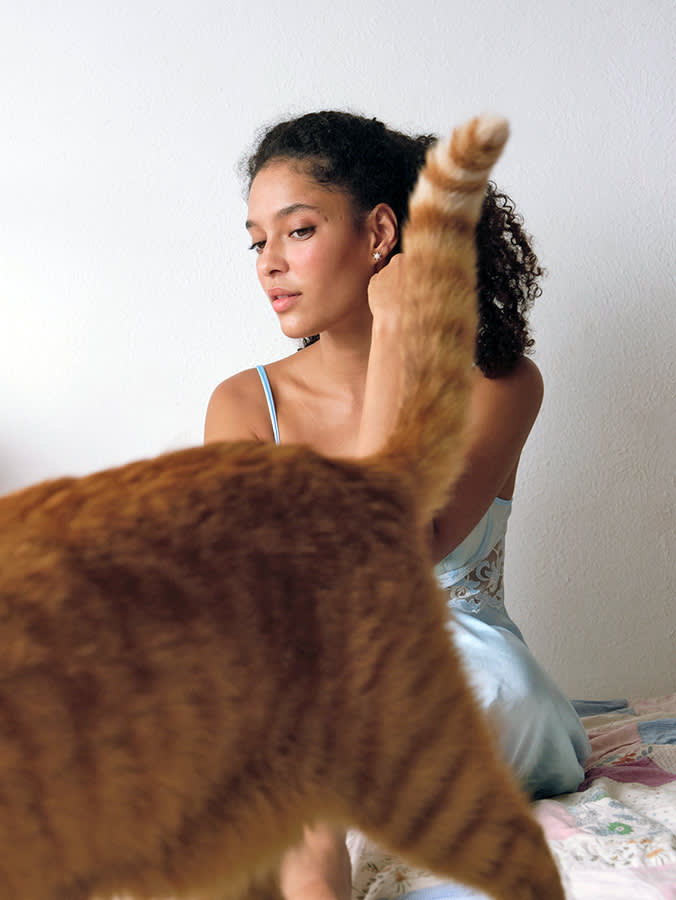
Nothing tests a relationship with a cat like a wet patch on the duvet at midnight. And nothing produces worse instincts. The first thought is always some version of why would you do this to me, followed by yelling, followed by shutting the bedroom door.
All three of those responses make the problem worse, because all three assume the cat made a choice about you.
They didn’t. A cat urinating outside the box is not sending a message. Peeing on the bed is abnormal, and abnormal behavior in a cat is a symptom until proven otherwise. Your job is not to interpret it. Your job is to find out what’s wrong.
Here’s the order to work through it, and the one scenario where you skip straight to the car.
Start here: the emergency
Before anything else, check for this.
A cat, usually male, who is straining in the box, going in and out repeatedly, producing little or no urine, crying, or licking obsessively at their genitals is a medical emergency. That is a possible urethral obstruction. The bladder cannot empty, pressure backs up into the kidneys, potassium rises, and cats die of it, sometimes within 24 to 48 hours. It does not wait for morning.
If that’s your cat, stop reading and get to an emergency vet.
Everything below assumes your cat is peeing normally, in volume, just in the wrong place.
The medical causes, and why they come first
There is no way to look at a wet duvet and know what caused it. You need an exam and testing. But here is what your vet is looking for.
Feline lower urinary tract disease (FLUTD). This is the umbrella term, and it covers several problems that all present the same way: peeing frequently, peeing outside the box, blood in the urine, straining, crying while urinating.
Feline idiopathic cystitis. The most common thing under that umbrella, and the one most people have never heard of. In cats under 10, idiopathic cystitis accounts for somewhere around 55 to 63 percent of lower urinary tract disease. “Idiopathic” means there’s no infection and no stone. The bladder wall is inflamed and painful anyway, and stress is deeply implicated in it. That is why the treatment for a cat peeing on the bed so often involves changing the household, not just handing over an antibiotic.
Bladder stones and crystals. Painful, and dangerous when they lodge in the urethra. Look for bloody urine, frequent trips, and straining.
Kidney disease. The kidneys stop concentrating urine, so a huge volume comes through and the cat physically can’t hold it. Usually paired with heavy drinking, a fading appetite, and notably bad breath.
Diabetes. Glucose spills into the urine and drags water with it, so, again, a lot of urine. A diabetic cat is often ravenous and losing weight at the same time.
Arthritis. Wildly underdiagnosed in older cats. Climbing into a high-sided box hurts, so the cat finds somewhere flat and soft. If your senior cat started missing the box, get them a box with a low entry before you assume anything psychological.
Urinary incontinence. The sphincter that holds the bladder closed can fail through nerve injury, muscle problems, or inflammation. Rarely, it’s anatomical, like an ectopic ureter, where the tube from the kidney bypasses the sphincter entirely. This one leaks, often while the cat is lying down, which is exactly why it shows up in a bed.
Bladder tumors. Uncommon, but real. A tumor irritates the bladder and produces the same signs as everything else on this list. Treatment can involve surgery, chemotherapy, or radiation.
Notice the pattern: every one of these mimics the others. That is precisely why “let’s just try a different litter” is not a plan.
Why the bed, of all places
Once medical causes are ruled out, the location starts to mean something, and it isn’t what people assume.
A bed is warm, absorbent, elevated, and completely saturated in your scent. For a cat with a painful bladder, it is the softest possible place to relieve a sensation that hurts. For a stressed cat, it is the most reassuring surface in the house. For a cat with a litter box they’d rather not use, it is the closest thing to litter that exists: soft, giving, and it swallows the mess.
It’s not an insult. It’s the best available option from the cat’s point of view, which tells you the box has become a bad option.
The behavioral and litter box causes
Stress and anxiety. Cats are far more sensitive to change than they look. A move, a renovation, a new baby, a new partner, a new cat, a schedule change, an outdoor cat visible through the window. Any of it can push a cat over. And through the idiopathic cystitis link, stress isn’t just “behavioral” here. It causes physical bladder inflammation.
Cognitive dysfunction. Aging brains forget things, including where the box is and what it’s for. Senior cats who start having accidents deserve a workup, not a scolding.
Urine marking. Different behavior, and it looks different: usually spraying on a vertical surface, small volume, in a cat who is otherwise using the box normally. More common in intact males, and often triggered by another cat, indoors or out.
The box is dirty. Days-old waste in an enclosed plastic tray is repellent to a fastidious animal. Scoop daily. Wash the box weekly.
Not enough boxes. One per cat plus one, and spread out. Four boxes in a row in the laundry room is one location, not four.
Bad box location. A box behind a door that gets closed is a box the cat can’t reach. So is a box up two flights of stairs from an arthritic cat, or one next to a noisy washing machine. Accessible but private.
Wrong box, wrong litter. Covered boxes trap odor and trap the cat. Scented litter is pleasant to you and overpowering to a nose that works far better than yours. Boxes that are too small mean the cat can’t turn, dig, and cover. Most cats do best with a large, uncovered box and unscented, fine-grained clumping litter, and if yours has opinions, the cat wins that argument.
What to actually do
- See your vet, first, before anything else. Bring a urine sample if you can get one. This is not optional, and it is not something to try after a month of new litter.
- Fix the box situation while the workup happens. Scoop daily, wash weekly. Get to N+1 boxes. Go big, go uncovered, go unscented. Spread them across the house, including one on every floor.
- Clean the bed properly. Ordinary detergent leaves the scent markers behind, and a cat will return to a spot that still smells like a toilet. You need an enzymatic cleaner made for pet urine.
- Lower the stress. Feed on a schedule. Give vertical space and hiding places. Play daily. Add pheromone diffusers. If there’s a specific trigger, an outdoor cat at the window, a resource fight between two cats, address that trigger directly.
- Do not punish. Ever. Punishment adds stress, stress worsens idiopathic cystitis, and you make the exact problem you’re trying to fix worse. There is no version of scolding that helps here.
- Reward the box. Praise, a treat, catnip near the box. Make the box the best bathroom in the building.
What newer research adds
The biggest change in how vets think about this is the stress-to-bladder link. Idiopathic cystitis used to be a diagnosis of exclusion that got shrugged at. It is now understood as a condition where a stress response and an abnormally permeable bladder lining feed each other, which is why the modern treatment plan for a cat peeing on the bed reads like an interior design brief: more boxes, more vertical space, more predictability, more play, fewer conflicts. That isn’t fluff. For this diagnosis, environmental change is the medicine, alongside pain control.
The other useful update is that pain is now taken far more seriously as a cause of house-soiling in older cats. Feline arthritis is extremely common in cats over 12 and is easy to miss because cats don’t limp the way dogs do. They just stop jumping, and stop climbing into things, including their box. If your cat is a senior, the cheapest first move you can make tonight is a box with a low, walk-in entrance.
References
- American Veterinary Medical Association. “Feline Lower Urinary Tract Disease.” https://www.avma.org/resources-tools/pet-owners/petcare/feline-lower-urinary-tract-disease
- Defauw, Pieter A. M., et al. “Risk Factors and Clinical Presentation of Cats with Feline Idiopathic Cystitis.” Journal of Feline Medicine and Surgery, vol. 13, no. 12, 2011, pp. 967–975. https://doi.org/10.1016/j.jfms.2011.08.001
- Cornell Feline Health Center. “Feline Diabetes.” https://www.vet.cornell.edu/departments-centers-and-institutes/cornell-feline-health-center/health-information/feline-health-topics/feline-diabetes
- Cornell Feline Health Center. “Cognitive Dysfunction.” https://www.vet.cornell.edu/departments-centers-and-institutes/cornell-feline-health-center/health-information/feline-health-topics/cognitive-dysfunction
- International Society of Feline Medicine. “ISFM Consensus Guidelines on the Diagnosis and Management of Feline Chronic Kidney Disease.” Journal of Feline Medicine and Surgery. https://doi.org/10.1177/1098612X16631234
- American Association of Feline Practitioners. “Feline Environmental Needs Guidelines.” Journal of Feline Medicine and Surgery, vol. 15, no. 3, 2013, pp. 219–230. https://doi.org/10.1177/1098612X13477537
Common questions
Is my cat doing this to get back at me?
No. Cats don't run revenge plots. What looks like spite is almost always pain, illness, or stress, and the bed gets chosen because it's absorbent, elevated, and drenched in your scent, not because it's yours.
How many litter boxes should I have?
One per cat, plus one. Three cats means four boxes, spread out across the home rather than lined up in one room. Boxes clustered in a single spot count as one location to a cat.
My male cat is straining and nothing is coming out. Can it wait until morning?
No. A male cat who is straining to urinate and producing little or nothing may have a urethral obstruction. That is a life-threatening emergency and it can kill within a day or two. Go to an emergency vet immediately.
Not a substitute for your vet. Our guidance is educational. For urgent symptoms, contact a vet or emergency clinic right away. Editorial standards
Dr. Nair is a veterinarian focused on diet and feeding. She covers everyday nutrition, treats, and the many "can they eat this?" questions owners ask, grounding each answer in what is actually safe and sensible for dogs and cats.
Meet our experts ↗Keep reading
 Health & WellnessYour Cat Pooping on the Carpet Isn't Spite. It's a Message You Rule Out in OrderDr. Amara Solis · 8 min
 Health & WellnessYour Cat Peed on Your Clothes. The Fabric Is the Clue.Dr. Lena Park · 8 min
 TrainingCat Spraying Isn't Spite. It's a Message You Can Decode.Dr. Mara Chen · 7 min
 Health & WellnessVets Are Done Calling Frequent Vomiting 'Normal' for CatsDr. Lena Park · 9 min
 Health & WellnessYour Kitten Can't Poop: When It's a Pumpkin Fix and When It's an EmergencyDr. Priya Nair · 7 min
 Health & WellnessMost Cat Colds Are Harmless. Learn the One Kind That Isn't.Dr. Mara Chen · 7 min