


Cat Spraying Isn't Spite. It's a Message You Can Decode.
Your cat isn't ruining your walls to punish you. Spraying is communication with a trigger behind it, which means you can usually find it and fix it. Here's how to tell spraying from peeing, the real causes, and what actually stops it.

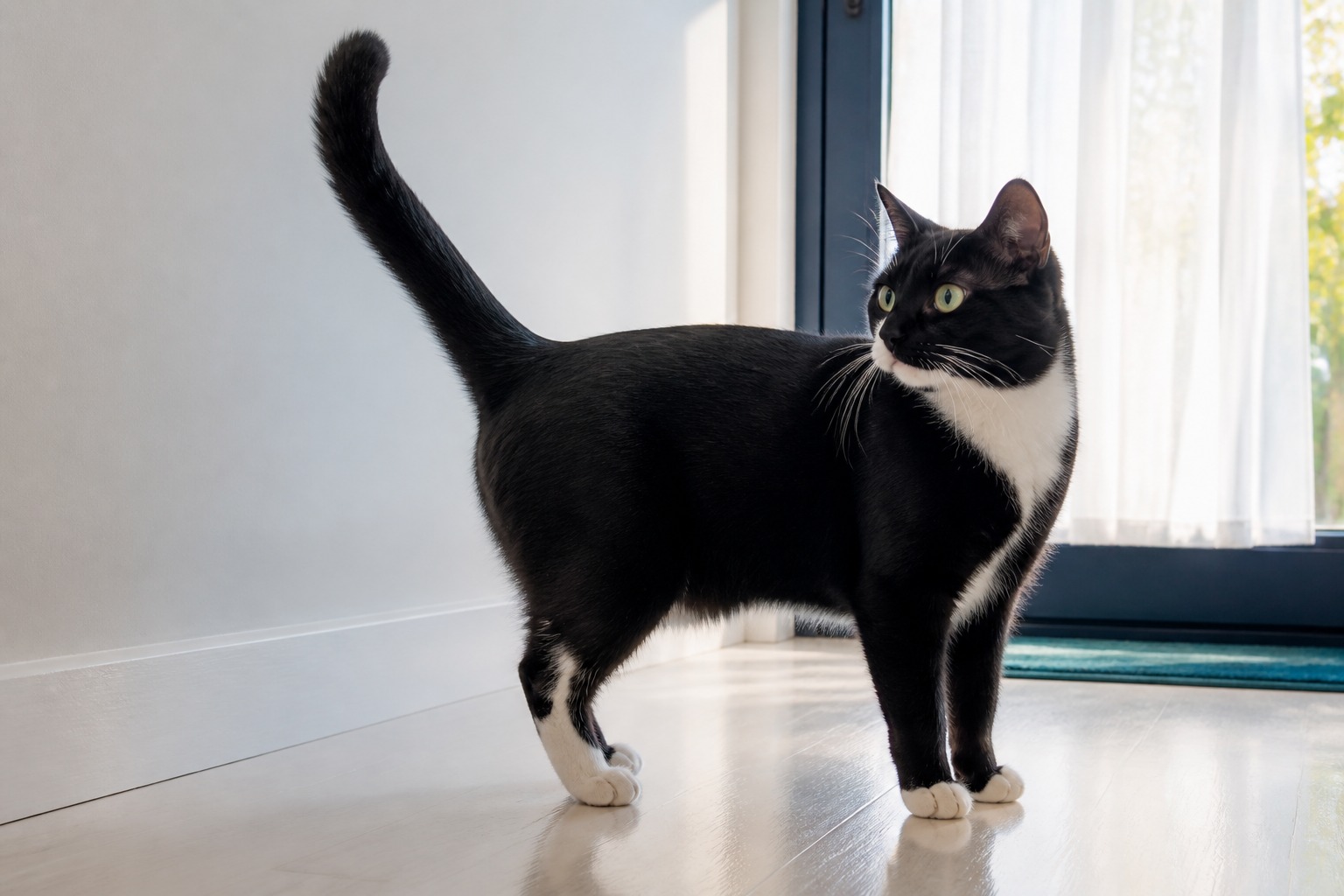
Few cat behaviors light a shorter fuse than spraying. It smells terrible, it wrecks your things, and it feels personal, like your cat has looked around your home and decided to protest. So let’s clear that up first: your cat is not spraying out of spite, and they are not doing it to get back at you. Spraying is an instinctive form of communication, and it almost always has a specific trigger behind it. That is the frustrating news and the hopeful news at once, because a behavior with a cause is a behavior you can usually track down and change.
The work is detective work. Somewhere in your cat’s world, something is prompting them to broadcast their scent, and your job is to figure out what. Once you know the trigger, the fixes are surprisingly practical. Let’s start by making sure spraying is actually what you are dealing with.
Spraying or peeing? They aren’t the same
Before you fix anything, confirm the behavior, because spraying and inappropriate peeing are different problems with different solutions. Spraying is a cat deliberately depositing scent. Peeing is emptying the bladder. There is some overlap, since cats can use urine to mark, but the tells usually give it away.
A spraying cat typically stands, backs up to something upright, a wall, a chair leg, the side of the couch, and the urine shoots out behind them rather than pooling below. You will often see marks or streaks on that vertical surface, though some can drip and puddle on the floor and fool you. The tail usually points straight up and quivers. Some cats tread with their back feet while they do it, like the front-paw kneading but at the other end. A spraying cat often sniffs the spot beforehand, checking for their own or a rival’s scent, and tends not to scratch or cover afterward, because the whole point is to leave the scent showing. One catch: some cats pee standing up too, especially if arthritis or another issue makes squatting painful, so standing alone does not settle it.
Why cats spray in the first place
Spraying is an instinctive reaction to something in the environment. Your cat is placing their scent in a chosen spot, on purpose, as a message to other cats and even potential threats, and as a way to soothe themselves, because being surrounded by their own smell is comforting to a cat. Because cats have not been selectively bred away from their wild instincts the way dogs have, they have held onto a lot of behaviors we would happily live without, and this is one of them. The upside is that these are workable problems.
The usual suspects
When you go looking for the trigger, these are the common culprits:
- Stress. Almost anything that unsettles a cat can show up as spraying: a changed routine that cuts into your time together, construction noise, or a new baby in the house. Big changes are big triggers.
- A medical problem. This is the one to rule out first. Urinary crystals, obstructions, and infections cause real pain, and pain spikes stress. Your vet is the first call to rule this out.
- Territory. Cats mark to tell other cats where and when they have been, and how recently.
- Mating drive. Intact males spray to warn off rivals and attract mates; intact females spray to signal availability.
- Old age. Senior cats face physical, emotional, and cognitive changes that can breed stress and make them more prone to marking.
- Litter box issues. A box that does not feel safe or does not suit your cat is another stressor that can spill over into spraying.
- Friction with other pets or people. Tension with another animal, a new pet in the home, or a person your cat does not trust can all set it off.
- Outdoor cats. This is one of the biggest. Seeing or smelling strange cats through your windows and doors drives indoor cats to mark, usually along exterior walls and windowsills.
The number one thing I tell owners is to see me before they see a trainer, because a huge share of spraying I get called about turns out to be a urinary issue that hurts. A cat in pain is a cat under stress, and stress is the on-switch for marking. Once we’ve ruled out crystals or an infection, then it’s genuinely detective work, and the clue is almost always where they’re spraying. Along the windows means outdoor cats. Around a new roommate’s door means a relationship problem. The location is the cat telling you the cause.
How to actually stop it
The first step is hunting for clear triggers, outside cats, a strained relationship, a possible medical cause, and dealing with those directly. Alongside that, work on lowering your cat’s overall stress. Here is what to try.
Bring the stress down. Play and enrichment are the simplest levers. Add bonding time. Repair any tense relationships in the home. Look hard at how your cat’s resources, food, water, boxes, resting spots, are arranged, and adjust to better fit their instincts.
Clean the spot, then re-scent it. This is the step people miss. Yes, use a quality enzymatic cleaner on sprayed areas. But cleaning alone can backfire, because your cat sprayed there specifically to have their scent in that place, and stripping it out just invites a repeat. After cleaning, replace the scent in a way you can live with. Set a litter box in the spot, or rub a soft cloth on your cat’s cheeks to collect their facial scent and wipe it around the area, or add a scratching post there. Even a sprinkle of catnip they can roll in leaves their scent behind acceptably.
Spay or neuter. It will not stop spraying every time, but it takes it from routine to rare, and the health benefits are worth it regardless.
Block the view. If outdoor cats are the trigger, limit what your cat can see for a couple of weeks and watch for improvement. You do not have to black out the window, just cover the lower portion so your cat cannot see the ground where visiting cats prowl. You keep your light, they lose the provocation.
Police the perimeter. Check around doors and windows for signs that outdoor cats are spraying inward, and inspect the weatherstripping. If a rival’s scent is seeping in, your cat may answer it with marking of their own.
When you cannot find a trigger, or your fixes are not landing, bring in reinforcements. A feline behavior consultant works with spraying constantly and has options you may not have considered, and your vet should confirm there is no lurking medical cause like pain or discomfort.
What newer research adds
There is now solid clinical evidence behind a tool worth adding to the list: synthetic feline facial pheromones, sold as diffusers and sprays. In controlled studies, cats treated with the F3 facial pheromone analog dropped from an average of roughly 15 marks per day to under 2 within a week, and in one trial nearly all of the cats had stopped marking entirely within a month, with no relapse over the following weeks. A 2024 study also compared a newer long-lasting gel diffuser against the standard plug-in version, giving owners more format options for delivering the same calming signal.
None of that replaces finding the trigger, and pheromones are not a magic switch. But the research supports pairing them with the detective work above, especially for stress- and territory-driven spraying, because the same facial pheromone that reassures a cat is the one they deposit when they rub their cheeks on your furniture. You are essentially handing your cat a bottled version of “this place is safe and mine,” which is exactly the message spraying is a stressed attempt to send.
References
- Cornell Feline Health Center. “Feline Behavior Problems: House Soiling.” Cornell University College of Veterinary Medicine. https://www.vet.cornell.edu/departments-centers-and-institutes/cornell-feline-health-center/health-information/feline-health-topics/house-soiling
- Da Graça Pereira, G., et al. “A long-lasting gel-based diffuser of feline pheromone can help reduce undesirable behaviors in cats at home.” Frontiers in Veterinary Science, 2024. https://www.frontiersin.org/articles/10.3389/fvets.2024.1445108/full
- Mills, D.S., and Mills, C.B. “Evaluation of a Synthetic Analogue of Feline Facial Pheromone (Feliway) for the Treatment of Spraying in Cats.” The Veterinary Record. https://pubmed.ncbi.nlm.nih.gov/11761257/
- Indoor Pet Initiative. “Spraying and Marking.” The Ohio State University College of Veterinary Medicine. https://indoorpet.osu.edu/cats/problem-solving/spraying-and-marking
Common questions
Is my cat spraying or peeing outside the box?
Spraying is usually done standing up, backed against a vertical surface, with the tail raised and often quivering, and the urine goes out behind the cat rather than down. Peeing is done squatting, with fluid going down. Some cats pee standing if arthritis makes squatting painful, so standing alone isn't proof. When in doubt, have your vet weigh in.
Do cats still spray after being spayed or neutered?
Yes, both males and females can spray after being fixed, because spraying isn't only about hormones. That said, spaying and neutering sharply reduce how often it happens and carry many other health benefits, so it's still strongly recommended.
When should I involve a vet or behaviorist?
Call your vet first to rule out urinary problems and other medical causes of pain or stress. If there's no clear trigger, or you've addressed the obvious ones and the spraying continues, a feline behavior consultant can help build a plan.
Dr. Chen is a small-animal veterinarian who leads health and safety coverage at The Pet Times. She writes and reviews the bulk of our illness, condition, and safety content, translating clinical guidance into clear, practical advice owners can act on at home.
Meet our experts ↗Keep reading
 TrainingYour Cat Screams at 3am Because You Never Let It Finish the HuntDr. Mara Chen · 8 min
 Health & WellnessYour Cat Peed on Your Clothes. The Fabric Is the Clue.Dr. Lena Park · 8 min
 TrainingYour Cat's Begging Is a Report Card on YouDr. Mara Chen · 8 min
 TrainingYour Couch Isn't Losing to Your Cat. It's Losing to Bad Real Estate.Dr. Nina Kohl · 9 min
 TrainingWhen a Cat Snubs the Litter Box, They're Filing a Complaint. Learn to Read It.Dr. Amara Solis · 9 min
 TrainingThe N+1 Litter Box Rule Isn't About Sharing. It's About ChoiceDr. Mara Chen · 7 min