


Your Cat's Begging Is a Report Card on You
Cats are not born knowing how to beg. They learn it from one specific teacher: you. Here is how to read what your cat is really asking for, and how to answer it well.

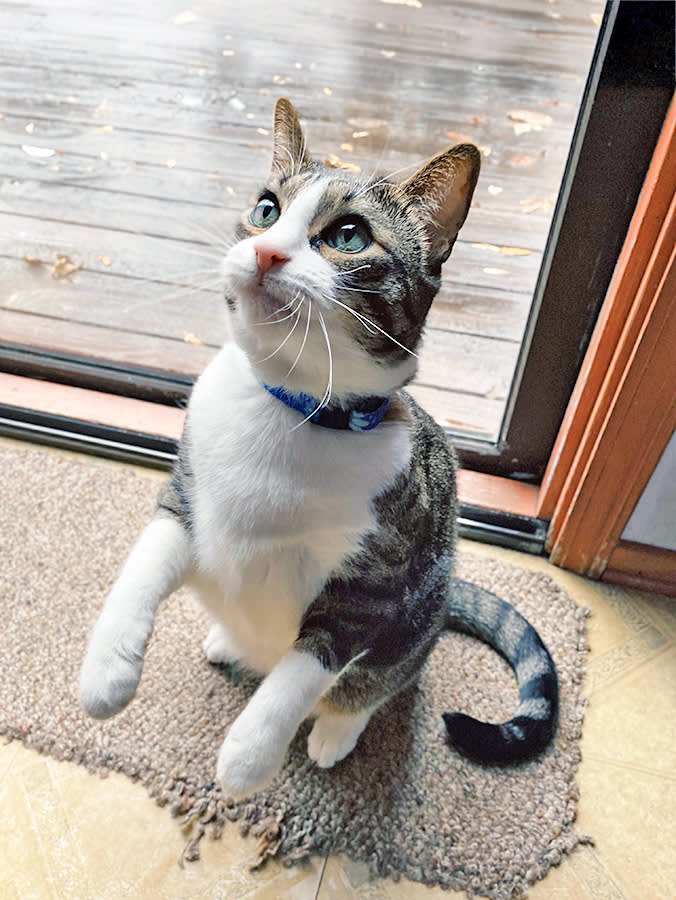
Here is the uncomfortable truth about a begging cat: they learned it from you. Cats do not arrive knowing how to work a human. Every paw on your knee, every 4 a.m. yowl, every meaningful stare toward the kitchen is a behavior that got rewarded at least once and stuck. Which means your cat’s begging is less a quirk of theirs than a record of what you have, knowingly or not, taught them pays off. Read it that way and the whole thing stops being annoying and starts being useful, because a report card tells you exactly what to fix.
You trained this, one accident at a time
The mechanism is plain behavioral learning, and cats are frighteningly good at it.
A cat figures out very quickly that a particular behavior produces a particular result from their human. Whether a behavior gets repeated comes down to whether it works. If meowing at you reliably gets you up and over to the food bowl, your cat has learned something true about you, and they will keep meowing.
That is the entire engine. The cat tries something, you respond, and if the response is what they wanted, the behavior is now in the rotation. Cats are, in Dr. Chen’s phrasing, skilled trainers of their humans, and most of us are far easier to train than we would like to believe.
Why “begging” looks different in every cat
Because begging is learned rather than instinctive, it takes a wildly different shape in each cat, shaped by their personality and their specific history with you. That is why it so rarely resembles the dog version, even though the goal is identical.
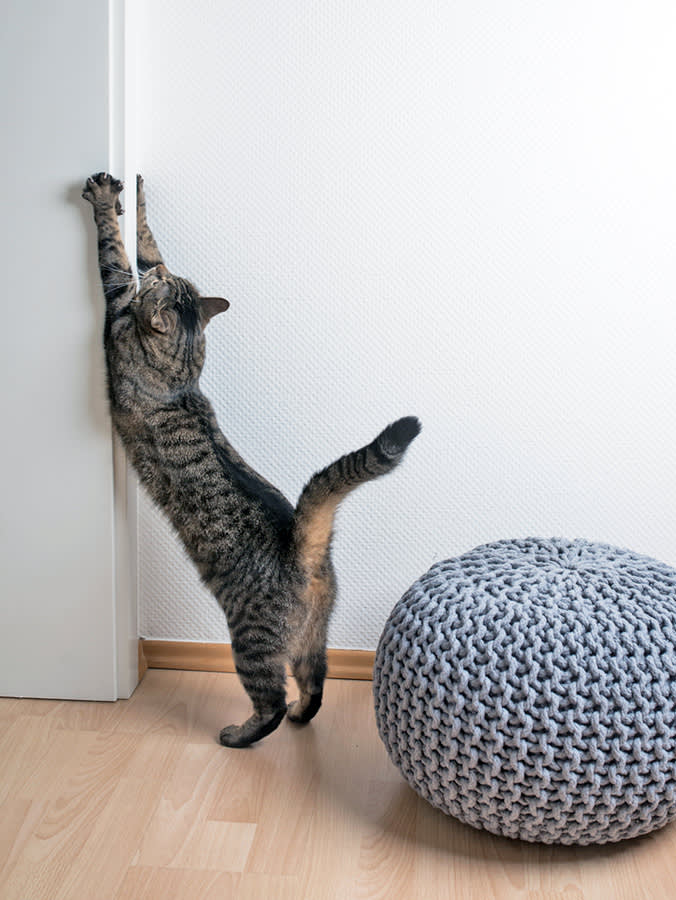
Take two cats in one home. One rears up on his hind legs and bats at the air like a tiny boxer when he wants to be lifted into a lap, but only at the desk, never anywhere else. The other never makes an overt gesture at all; she sits beside you and stares pointedly toward the kitchen when she is hungry, or glances back and forth between her wand toy and your face when she wants to play. Both are begging. Neither was deliberately taught.
The forms are endless because almost any repeatable behavior can become a begging behavior if it works: persistent meowing, weaving around your legs, planting themselves in your face, trailing you room to room, dawn yowling, dropping a toy at your feet, tapping the water bowl, pawing the fridge. One especially clever cat learned that messing with her owner’s earbuds, left on the couch, reliably summoned a human to deal with the earbuds and, while up, fetch the wand toy from a high shelf. She held eye contact the whole time, leaving no doubt she knew the trick worked.
What are they actually asking for?
The first job is to translate. Cats generally beg for a small set of things.
Cats usually beg for one of a few things: food, play, or affection. If they have access to the outdoors, they may also beg to be let out, because the world out there is one big enrichment buffet.
Frequency is the tell you should not ignore. Occasional begging is normal communication; a cat has a small toolkit for talking to you and this is one of the tools. Constant begging is a signal.
If your cat is begging constantly, it is often a sign that some need is not being met as well as they would like. That is not an accusation. It is information.
A relentless beggar is usually telling you they are hungry, bored, lonely, understimulated, or that some part of the daily routine is not working. Fix the underlying need and you get two wins at once: less begging and a stronger bond.
The two-part fix
Reshaping begging is not about willpower or ignoring your cat into submission. It is a sequence: meet the real need proactively, then reward calm instead of the demand.
Front-load the need so the cat has less to beg for. If the ask is food, switch from one or two big meals or free-feeding to smaller, more frequent portions delivered through work, not a bowl.
A cat’s natural pattern is to hunt ten to twelve times a day, succeeding maybe forty to sixty percent of the time. You can mimic that with interactive feeding: use food puzzles, scatter kibble around the house, tuck it on cat trees and inside boxes, or roll pieces across the floor for them to chase.
Most indoor cats are also chronically under-stimulated, so add real play: a five-to-ten-minute wand-toy session right before a meal recreates the natural hunt-eat-groom-sleep cycle and takes a startling amount of the edge off the neediness.
Then reward the behavior you want, not the one you don’t. Once needs are met, you can fade the begging itself. When they beg, do not react. The instant they stop, reward the quiet with a treat or attention. You are reinforcing the absence of the behavior. And when you catch your cat sitting calmly, seize that moment to offer the very thing they usually beg for, so they learn that calm, not demand, unlocks the good stuff.
The hard part is consistency, because cats are persistent and the math is brutal.
If you cave after two hours of begging, you have just taught your cat that two hours of begging is the price of getting what they want. And honestly, what else does your cat have on their schedule?
One firm rule underneath all of this: never punish a begging cat. They are not acting out of spite; they are communicating a need, and punishment removes none of it while damaging your relationship and all but guaranteeing the behavior returns. If a specific habit feels truly unmanageable, a certified feline behavior consultant can assess the routine, often over video, and build a custom plan.
If you actually want a cat who begs
There is a fun flip side. If you want your cat to sit up in the classic begging pose purely because it is adorable, go ahead and teach it. With patience, consistency, and positive reinforcement, plenty of cats will learn to sit up with their paws raised, along with a high five or coming when called. It takes effort, and many cats have no interest in tricks, but training is genuinely enriching for both of you. The idea that a cat is content to do nothing all day is a myth; cats crave challenge and interaction, and most simply never get the chance to show it.
What newer research adds
Research keeps reinforcing how precisely cats tune their communication to us. Studies of cat vocalization have identified the “solicitation purr,” a purr with an embedded high-frequency cry that humans find unusually hard to ignore, essentially a sound engineered to extract a response, which fits the idea that cats learn what works on their particular person. Separately, work on the human-cat bond has found that cats form secure attachments to their caregivers at rates comparable to human infants and dogs. That reframes a lot of begging as a bid for connection and routine rather than pure food-seeking, and it explains why meeting the underlying need works so much better than trying to stamp out the behavior.
References
- McComb, K., et al. “The cry embedded within the purr.” Current Biology, vol. 19, no. 13, 2009. https://www.cell.com/current-biology/fulltext/S0960-9822(09)01168-3
- Vitale, K.R., Behnke, A.C., and Udell, M.A.R. “Attachment bonds between domestic cats and humans.” Current Biology, vol. 29, no. 18, 2019. https://www.cell.com/current-biology/fulltext/S0960-9822(19)31086-3
Dr. Chen is a small-animal veterinarian who leads health and safety coverage at The Pet Times. She writes and reviews the bulk of our illness, condition, and safety content, translating clinical guidance into clear, practical advice owners can act on at home.
Meet our experts ↗Keep reading
 TrainingCord Chewing Is a Fire Hazard First and a Bad Habit Second. Treat It in That OrderDr. Nina Kohl · 7 min
 TrainingWe Did Everything Right Introducing Our Cats. It Was Still a DisasterTom Hadley · 7 min
 TrainingWhy Your Cat Wakes You at Night, and How to Reclaim Your SleepDr. Lena Park · 5 min
 Health & WellnessYour Cat Pooping on the Carpet Isn't Spite. It's a Message You Rule Out in OrderDr. Amara Solis · 8 min
 TrainingYour Cat Isn't Attacking the Wall. Read the Spot.Dr. Amara Solis · 7 min
 TrainingYour House Is Too Cold for Your Cat. Your Laptop Isn't.Dr. Nina Kohl · 6 min