


Why Your Cat Wakes You at Night, and How to Reclaim Your Sleep
Your cat treats 3 a.m. like a party invitation. Here is why it happens and the daytime habits that actually quiet the nighttime wake-ups.

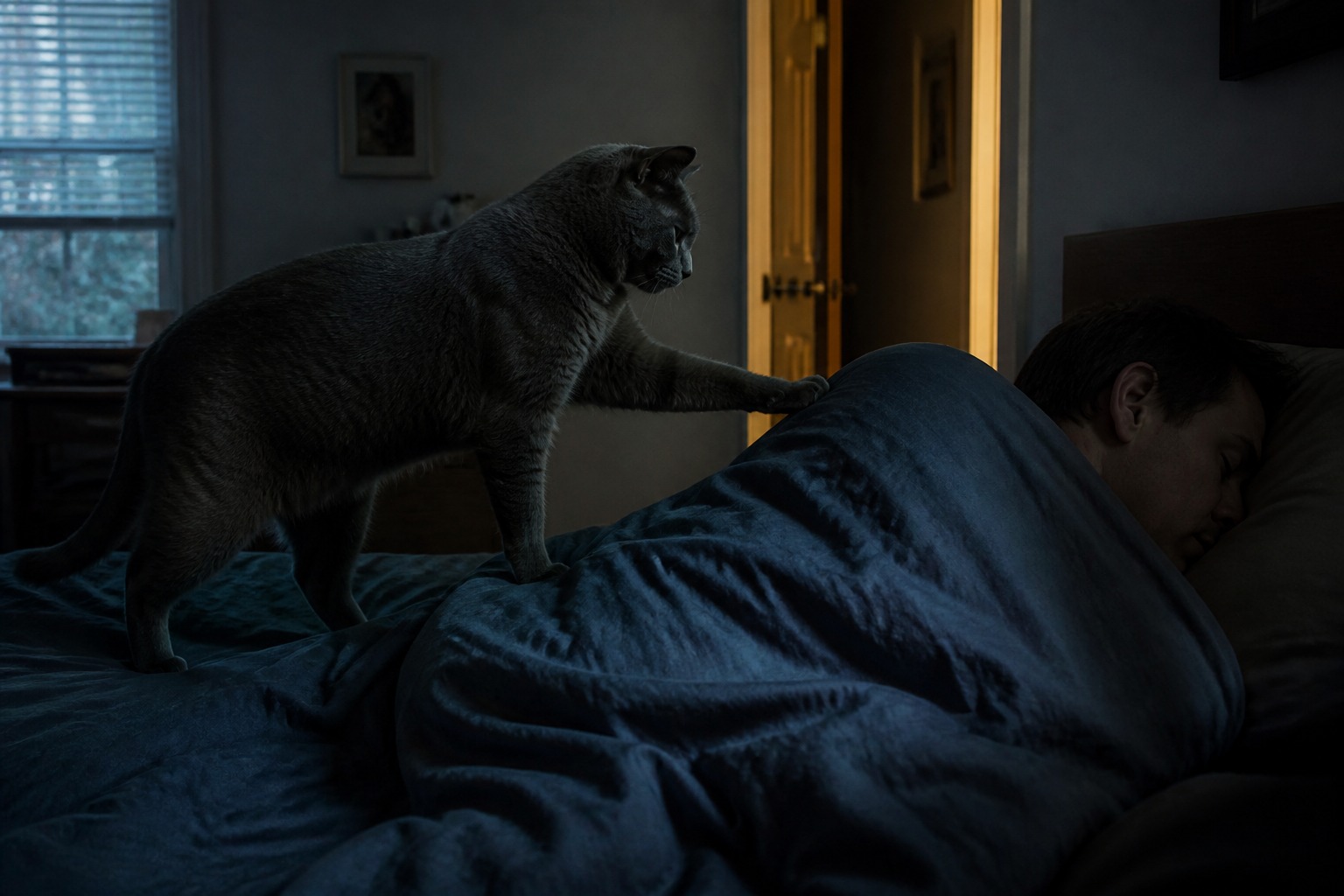
It usually starts with a paw on the cheek. Then a chirp. Then the unmistakable sensation of a small tongue working its way across your eyelashes while you lie there, eyes clamped shut, bargaining with the universe for just one more hour of sleep. Living with a cat is a joy, right up until your cat decides that 3 a.m. is the ideal time to socialize.
If your cat has turned into a furry alarm clock that you cannot snooze, the good news is that this behavior is fixable. The trick is understanding what your cat is actually asking for, because once you know that, you can head it off before the lights ever go out.
The myth of the nocturnal cat
People love to say cats are nocturnal, but that is not quite right. Cats are crepuscular, which means they are wired to be most active around dawn and dusk. That alone does not explain why yours is body-slamming your shins at 3 a.m.
When a cat wakes you in the dead of night, it is almost always because they want something. Maybe something they did not get enough of while you were awake, and now they have a captive, horizontal, semi-conscious audience.
What your cat is really after
A few motives come up again and again.
They are under-stimulated. If you are gone all day, your cat has spent hours alone with nothing to chase and no one to pester. They miss you, they are bored, and they have energy to burn. From their point of view, your sleep does not register as a real activity, so why wouldn’t they wake you to play?
They are hungry, or just want a snack. Sometimes the midnight wake-up is a food request, plain and simple. Cats are perfectly capable of wanting a 3 a.m. snack the same way you sometimes do.
They want a cozy spot. Not every nighttime disturbance is a demand. Sometimes your cat is just rearranging themselves into the perfect position, which happens to be wedged between your shoulder and your jaw, or directly on your pillow, or under the covers. The stomping around the mattress is them house-hunting.
The mistake owners make is trying to solve a nighttime problem at night. By the time your cat is on your chest at 3 a.m., you have already lost. The real work happens during daylight hours, when you set them up to be genuinely tired and content by bedtime.
First, rule out a medical cause
Before you treat this as a pure behavior problem, one important check, because the daytime-enrichment plan below assumes a healthy cat. A sudden change in nighttime behavior, especially loud, disoriented yowling in a middle-aged or senior cat, is not always about boredom or attention. It can be a medical signal.
“When an older cat starts yowling at night out of nowhere, I want to see them before we talk about play schedules,” Dr. Park says. “Overactive thyroid, high blood pressure, and feline cognitive dysfunction all show up as nighttime vocalizing and restlessness, and pain or failing hearing and vision can too. Those need a vet, not a laser pointer.”
So if your cat’s night waking is new, escalating, or paired with weight loss, increased thirst, confusion, or a change in litter box habits, book a checkup first. If your cat is young, healthy, and has always been a bit of an early-hours pest, the fix is almost certainly the daytime routine below.
The fix happens during the day
Reacting in the moment rarely works, and often makes things worse, because any attention, even an annoyed shove, is still attention. Prevention is the whole game.
Wear them out, body and brain
Tiring your cat out goes well beyond a quick laser session. You want to engage their body and their mind.
- Play hard, on purpose. Use wand toys to get your cat running, leaping, chasing, and pouncing. A few focused sessions during your waking hours do more than a toy left on the floor.
- Try training. Teaching your cat to sit, come, high-five, fetch, or hop through a hoop is mentally exhausting in the best way, and you get a more responsive cat out of the deal.
- Leave out solo enrichment. Food puzzles and self-play toys keep them busy when you are not available to be the entertainment.
Rethink the breakfast routine
Here is a sneaky one. If you feed your cat the second you get out of bed, you have taught them that waking you up makes food appear. So they start waking you earlier, and earlier, and earlier.
Break that link. Do not feed immediately on rising. Put some distance between getting up and the first meal so your cat stops connecting the two. A small snack right before bed can also take the edge off the early-morning hunger. If your vet signs off on free-feeding and your cat can handle it without overeating, that can help too, but check first.
A treat-fueled training session right before bed is a two-for-one. Your cat gets a snack and a dose of focused attention, and you get a cat who is more ready to settle.
Consider a second cat
For some cats, especially kittens, a feline companion is the answer to the boredom problem. Many cats genuinely enjoy having a buddy to wrestle and nap with, which is exactly why shelters often recommend adopting kittens in pairs. That said, this is not universal. Some cats love their only-pet status and would resent a roommate, so weigh your specific cat’s temperament before doubling up.
The bottom line
A cat who wants to hang out with you at all hours clearly adores you, which is sweet at noon and considerably less sweet at 3 a.m. Channel that energy into daytime play, training, and enrichment, fix the breakfast timing, and you can usually negotiate your way back to a full night’s sleep. Your cat will still think you are the best, just on a more reasonable schedule.
References
- “Hyperthyroidism in Cats.” Cornell University College of Veterinary Medicine, Cornell Feline Health Center. https://www.vet.cornell.edu/departments-centers-and-institutes/cornell-feline-health-center/health-information/feline-health-topics/hyperthyroidism-cats
- “Cognitive Dysfunction Syndrome in Cats.” VCA Animal Hospitals. https://vcahospitals.com/know-your-pet/cognitive-dysfunction-syndrome-in-cats
- “Environmental Enrichment for Indoor Cats.” The Ohio State University Veterinary Medical Center, Indoor Pet Initiative. https://indoorpet.osu.edu/cats
Dr. Park is a board-certified emergency and critical care specialist. She reviews our health and safety content for clinical accuracy and contributes guides on recognising urgent conditions. Her focus is helping owners act quickly and correctly when it matters most.
Meet our experts ↗Keep reading
 Health & WellnessCat Peeing in the Bathtub? Reach for the Vet, Not the Bleach.Dr. Lena Park · 9 min
 TrainingYour Cat Screams at 3am Because You Never Let It Finish the HuntDr. Mara Chen · 8 min
 TrainingYour Cats Don't Hate Each Other. They Just Don't Smell Like a Family Yet.Dr. Amara Solis · 9 min
 Health & WellnessYour Cat Peeing on Your Bed Isn't Spite. It's a Symptom.Dr. Priya Nair · 8 min
 TrainingYour Cat's Begging Is a Report Card on YouDr. Mara Chen · 8 min
 TrainingWe Did Everything Right Introducing Our Cats. It Was Still a DisasterTom Hadley · 7 min