


We Did Everything Right Introducing Our Cats. It Was Still a Disaster
A daily, occasionally unhinged diary of one couple merging two very different cats into one apartment, plus the real introduction protocol that explains why it went the way it did.


Here is the part nobody warns you about when you decide to merge two cats into one apartment: you can follow the rules exactly, the same-schedule feeding, the scent swapping, the slow door-cracked introductions, and still spend two weeks convinced you have ruined both animals’ lives. That is not a sign you did it wrong. It is what a proper cat introduction actually looks like from the inside. Messy, nonlinear, and a lot less Hallmark than the term “best friends” implies.
My partner and I learned this the hard way, in real time, while combining my son Fonzie (age four, believes every creature exists to play with him) with her daughter Emma Stone, full legal name (age five, possibly unaware that other cats, or she herself, are cats). What follows is the daily log of that experiment, lightly abridged for your sanity and mine. Stick around after for the part the diary kept joking about: what the experts actually recommend, and why it works even when it feels like it isn’t.
The log
Day 1. Homecoming for Fonzie. Emma senses change and resents it immediately. One swipe and hiss under the door, then Fonzie does his patented tiny screams between cuddles in the office, his basecamp for now.
Day 2. Emma headbutted me in my sleep; I am fairly sure I have a concussion. Fonzie screamed all day. A deeply divided team.
Day 3. Emma is on a soft food strike, surveying the perimeter an extra few minutes before eating. Fonzie cannot fathom why we keep him from the creature he is sure is his new best friend.
Day 4. Footsie under the door, the bad kind. We are doing everything by the book, same food schedule, feeding on opposite sides of a closed door so they pair each other’s scent with good things. Nobody explained what to do when the cats have opposite feelings about the project. Monopoly?
Day 5. Accidental meeting. The opposite of a meet-cute. Fonzie juked past me and bolted under the couch. Emma’s eyes have never been wider; the guttural sounds make me wonder if I should move out.
Day 6. Per “the experts,” we swap the cats so they get used to each other’s space and smell. Emma is in the office plotting a prison break. Fonzie has forgotten the office exists and is drooling on the bed.
Day 7. Swapped back. Now that Fonzie has tasted freedom, he makes the same Bad Sounds as Emma. Emma could not be less bothered.
Day 8. Experiment: can they share a room? While Emma plays in the living room, we release Fonzie. Result: BAD. Now the couch is Emma’s bunker. Separate corners, retry at night, longer but not better.
Day 9. I am nostalgic for the concussion. Fonzie screamed from inside the office door, Emma growled from outside it. Sleep is a memory.
Day 10. Cautious optimism. Fonzie claims Emma’s old windowsill in the bedroom; Emma takes the office sill, door open, and goes quiet. Almost too quiet.
Day 11. Too quiet. Fonzie pounced, Emma screamed, no injuries except feelings.
Day 12. More separation, supervised common-area time. My partner and I have now previewed our parenting styles: I am “don’t referee until someone actually throws a punch,” she is “never let the punch get thrown.”
Day 13. Fonzie develops a new power: walking toward Emma in slow motion, like a malfunctioning cat robot. She growls in real time but never leaves.
Day 14. First full day and night with both free. A few scuffles (scuffle: a moment when Emma decides Fonzie has breached her perimeter), no fur flew, and at one point, while I was on a call and MISSED IT, they fell asleep on the bed on opposite sides of my partner.
Day 21. Free-range utopia, sort of. They cannot stay apart, in a he-has-FOMO-and-she’s-too-stubborn-to-move way. Not love, not even like, but the screaming is at an all-time low. Success, I have unilaterally decided.
Day 1234, Flursday? Emma and Fonzie are in a brutal divorce and we are deciding who gets custody of us. Maybe a dog.
What the diary got right, and what it skipped
The jokes about “the experts” hide the fact that we actually were following the standard protocol, which is exactly why we got through it. Here is the real version, so your log can be a little less unhinged than mine.
Separate first, completely. New cats should start in different rooms with their own food, water, litter, and hiding spots, with no visual contact. We did this; the office basecamp was correct. Rushing past this stage is the single most common cause of a failed introduction.
Swap scents before sights. Feed on opposite sides of a closed door, and rotate the cats between spaces so each gets used to the other’s smell on neutral territory. This is the step that felt pointless on Day 6 and was doing the most work.
Then sights, then supervised contact. Only after the door-feeding goes calm do you progress to letting them see each other (a cracked door or baby gate), then short, supervised, treat-backed sessions you end before anyone melts down. Our mistake on Days 5 and 8 was letting accidental, un-managed meetings happen, which sets the timeline back.
Go at the pace of the more nervous cat. Emma set the speed, not Fonzie, and not us. Forcing it backfires every time.
Know that “success” is modest. A genuinely good outcome is often mutual tolerance, two cats coexisting without conflict, not a snuggling duo. Hissing during the process is normal. Sustained growling, swatting that draws blood, stalking, or a cat that stops eating or using the box means slow down and, if it persists, loop in your vet or a feline behaviorist, since stress can tip into real health problems.
The whole thing took us weeks, and most introductions take anywhere from a couple of weeks to a couple of months. If yours feels like a disaster on Day 9, you are probably right on schedule.
References
- American Association of Feline Practitioners. “Intercat Conflict and Introducing Cats.” catvets.com, https://catvets.com/guidelines/practice-guidelines/intercat-tension.
- The Ohio State University Indoor Pet Initiative. “Introducing a New Cat.” indoorpet.osu.edu, https://indoorpet.osu.edu/cats/newcat.
- International Cat Care. “Introducing a New Cat to Other Cats.” icatcare.org, https://icatcare.org/advice/introducing-a-new-cat-to-other-cats/.
Tom Hadley writes about training and behavior, helping owners understand what their pets are trying to tell them. His work covers everyday manners, decoding common behaviors, and the small changes at home that make dogs and cats easier to live with.
Meet our experts ↗Keep reading
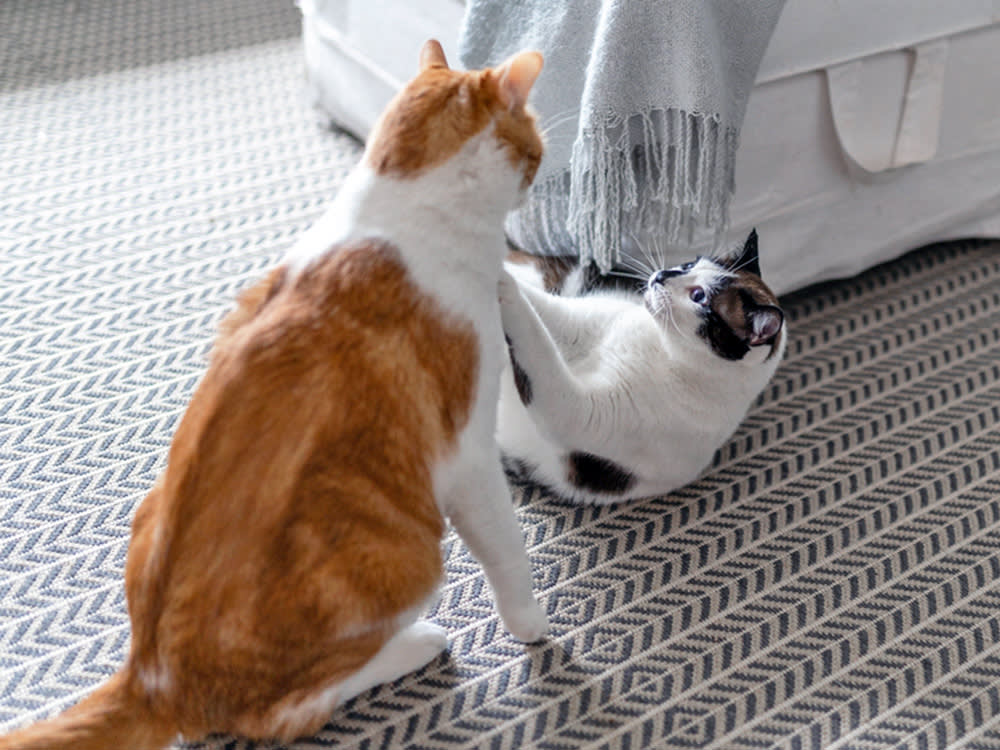 First DaysBy the Time Your Cats Are Hissing, You Blew the Introduction Three Steps AgoDr. Mara Chen · 9 min
 TrainingWhether You Call It PTSD Doesn't Matter. How Fast You Act on It DoesDr. Nina Kohl · 7 min
 TrainingYour Cat Isn't Plotting Revenge. They Already Forgot.Dr. Nina Kohl · 5 min
 LivingOne Cat Tree Isn't Enough. The Rule Is One Per Room.Dr. Amara Solis · 6 min
 Health & WellnessYour Cat Isn't Being Spiteful. Almost Every 'Bad Cat' Behavior Is Anxiety.Dr. Priya Nair · 9 min
 TrainingYour Cat Is Probably Securely Attached. Here's Why That's the Useful PartNina Vasquez · 5 min