


Your Cat Isn't Attacking the Wall. Read the Spot.
Wall-scratching looks like vandalism with no logic behind it. It has plenty. The location tells you exactly what your cat needs, and a 2024 study of 1,211 cats explains why some homes get it worse than others.

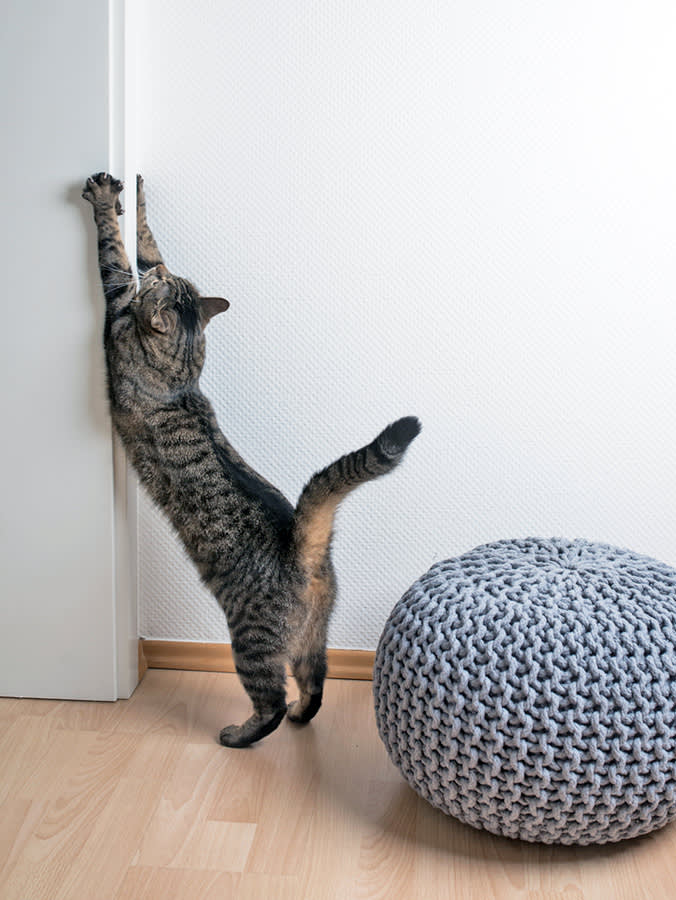
A cat destroying a couch at least makes sense. Couches are scratchable. A cat methodically shredding a flat painted wall, or the corner of a stair banister, seems less like a behavior and more like a glitch.
It’s neither. Wall-scratching is one of the most legible behaviors a cat has, because unlike almost anything else your cat does, it leaves a map. Where your cat scratches tells you exactly what they’re doing. The surface is beside the point. The location is the message.
Read the spot and the fix picks itself.
What scratching is actually for
Not sharpening claws. That’s the folk explanation and it’s the least important part.
It’s a signature. Cats have scent glands between their toes, and scratching deposits a pheromone mix known as feline interdigital semiochemical. It’s a chemical note left for other cats: I was here, this is mine. It also leaves a visible mark, so the message works twice, by nose and by eye.
It’s claw maintenance. A cat’s claw grows in layers, and scratching peels the worn husk away to expose the fresh point beneath it. Cats are equipped predators, and equipment needs servicing.
It’s a stretch. Watch a cat scratch a vertical post. The whole spine extends. It’s a full-body movement, not a hand gesture.
It’s an ask. Here’s the one people build themselves. When your cat scratches something forbidden, what do you do? You drop everything and go to the cat. Your cat has now discovered a reliable summoning device. If they scratch and then bolt, look pleased with themselves, or check whether you’re watching, this is a play invitation dressed up as vandalism.
It’s a release valve. Scratching can be a displacement behavior, an out-of-context action a cat performs under stress. Two cats have a tense moment, and one of them turns around and scratches something. It’s a way to discharge the energy of a conflict.
It’s pain. Last and most important to rule out. Discomfort, in the paws or anywhere, raises stress, and stress raises scratching. A cat with a sore claw bed, an ingrown nail, or arthritis may scratch more. New or escalating scratching in an adult cat deserves a vet’s hands on the cat.
Now read the map
This is where wall-scratching stops being random.
Corners and doorways. Corners sit on the highways of your home, the routes everyone uses. That is exactly where a territorial marker belongs. Your cat isn’t picking a corner because it’s a corner, they’re picking it because it’s a junction.
Next to the food bowl. This one confuses people the most. Your cat is trying to bury the food. Cats are predators and prey at once, and a wild cat covers leftover food so that neither competitors nor larger predators find it. If your bowls sit against a wall, you will watch your cat paw the floor and the wall around them after eating. It isn’t a complaint about the food. It’s caching behavior.
Next to the litter box. Same instinct, different output. Cats bury waste to erase evidence of themselves. If the box is too small or too shallow to dig properly, the digging spills over onto the floor and the wall beside it. This is not a behavior problem. This is a furniture problem.
At night, in the hall. Cats are most active at dawn and dusk, and a nocturnal patrol includes re-marking territory. And, again, if you have ever gotten up and reacted to it, you’ve paid for it. Worth an honest question: have you ever punished your cat for scratching in front of you? If so, you may have taught them to scratch only when you’re asleep or out.
The household factors that make it worse
Here’s the newest and most useful evidence, and it reframes a lot of the standard advice.
A 2024 study in Frontiers in Veterinary Science surveyed the caregivers of 1,211 cats, looking at daily routine, environment, personality, and scratching. The strongest predictors of undesired scratching weren’t the ones people expect. Undesirable scratching went up with the presence of children in the home, with high levels of play, and with high nocturnal activity.
That third one makes sense. The second is counterintuitive enough that it’s worth sitting with: the study links intense play and high arousal to more scratching, which suggests that not all “enrichment” is calming. Long, high-intensity, over-stimulating play sessions may wind a cat up rather than settle them. Several short, structured hunt-and-catch sessions that end in a catch and a meal look better than one frantic 40-minute laser marathon that ends with nothing caught and a cat vibrating with unspent energy.
The children finding isn’t an argument against having children. It’s a signal that a busy, unpredictable, noisy environment raises a cat’s arousal, and arousal comes out through the claws. The lever you can pull is giving the cat more control: escape routes, high perches, a room that’s theirs.
Scratching is not a bad habit that a cat needs to be broken of. It’s a need, like eating. You will never win by saying no. You win by making yes easy and putting it in the right place.
How to fix it
Put the scratcher on the crime scene. This is the single most common mistake. People buy a scratching post and put it in a corner, out of the way, where it looks least offensive. Your cat has told you exactly which spot they want to mark. Put the post there, against that wall, in that doorway. If it’s ugly, that’s a design problem, and there are genuinely good-looking scratchers now.
Match the surface to the behavior. A cat working a flat wall wants something rigid and vertical: a tall, sturdy sisal or wound-cardboard post, or bare wood. It has to be tall enough for a full stretch and heavy enough not to wobble. A post that tips is a post your cat abandons. Preferences vary, so offer more than one and let the cat vote.
Sweeten it. Catnip or silver vine on a new scratcher measurably increases use.
Make the wall unrewarding. Double-sided sticky tape or clear self-adhesive plastic panels protect the wall and make it unpleasant to scratch. Use them as a training aid and take them down once the habit has moved.
Pay every correct scratch. Praise, a treat, a scratch under the chin, a few seconds of play. A clicker is ideal because it marks the exact instant. What you must not do is pick your cat up and place their paws on the post. That creates a negative association with the object you need them to love.
Fix the underlying trigger. Bigger, deeper litter box with more litter if the scratching is post-elimination. Move the food bowls away from the wall if it’s post-meal. If it’s nocturnal, restructure the evening: play, then feed, then sleep, in that order.
And never punish it. A punished cat doesn’t stop scratching. A punished cat scratches when you’re not there.
References
- Salgırlı Demirbaş, Yasemin, et al. “Evaluating Undesired Scratching in Domestic Cats: A Multifactorial Approach to Understand Risk Factors.” Frontiers in Veterinary Science, vol. 11, 2024. https://www.frontiersin.org/journals/veterinary-science/articles/10.3389/fvets.2024.1403068/full
- Zhang, Lingna, and John J. McGlone. “Scratcher Preferences of Adult In-Home Cats and Effects of Olfactory Supplements on Cat Scratching.” Applied Animal Behaviour Science, vol. 227, 2020, p. 104997. https://doi.org/10.1016/j.applanim.2020.104997
- DePorter, Theresa L., and Ashley L. Elzerman. “Common Feline Problem Behaviors: Destructive Scratching.” Journal of Feline Medicine and Surgery, vol. 21, no. 3, 2019, pp. 235–243. https://doi.org/10.1177/1098612X19831205
- Cornell University College of Veterinary Medicine, Feline Health Center. “Feline Behavior Problems: Destructive Behavior.” https://www.vet.cornell.edu/departments-centers-and-institutes/cornell-feline-health-center/health-information/feline-health-topics/feline-behavior-problems-destructive-behavior
- American Association of Feline Practitioners. “Declawing Position Statement.” https://catvets.com/guidelines/position-statements/declawing
Common questions
How do I stop my cat scratching the couch?
Put a scratcher your cat actually likes directly against the part of the couch they're using, not across the room, and reward every use of it. Double-sided sticky tape on the couch itself makes the old surface unappealing while the new one earns its place.
Does declawing solve scratching?
No. Declawing is an amputation of the last bone of each toe, it's associated with long-term pain and behavior problems including biting and litter box avoidance, and it removes the cat's ability to perform a normal, needed behavior. It is not a solution and major veterinary bodies oppose it.
Why does my cat scratch the wall after using the litter box?
They're trying to bury, and the box isn't giving them enough room to do it. A larger, deeper box with more litter usually ends this overnight.
Dr. Solis is a board-certified veterinary dermatologist with over twelve years of clinical experience. She advises on skin conditions, allergies, and grooming practices that affect coat and skin health. All dermatology and allergy content at The Pet Times is reviewed by her team before publication.
Meet our experts ↗Keep reading
 TrainingToilet-Training Your Cat Means Throwing Away Their Health ChartDr. Ravi Mehta · 8 min
 TrainingYour Couch Isn't Losing to Your Cat. It's Losing to Bad Real Estate.Dr. Nina Kohl · 9 min
 Health & WellnessYour Cat vs. the Christmas Tree: The Climbing Isn't the Real DangerDr. Ravi Mehta · 6 min
 LivingThe Shoulder-Cat Photo Everyone Tried to Copy. Here's Why Yours Won't Work.Sara Lim · 6 min
 LivingYour Cat Isn't Judging You. It's Running a Threat Assessment.Dr. Nina Kohl · 7 min
 LivingYour Cat Has Been Asking for the Same 7 Things. You Keep Hearing 'More Cuddles.'Dr. Priya Nair · 8 min