


Your Couch Isn't Losing to Your Cat. It's Losing to Bad Real Estate.
You cannot train a cat out of scratching, and you should not try. What you can do is win the location fight, and most people lose it because they bought the wrong post and put it in the wrong room. A seven-part plan that treats the couch as competition, not crime.

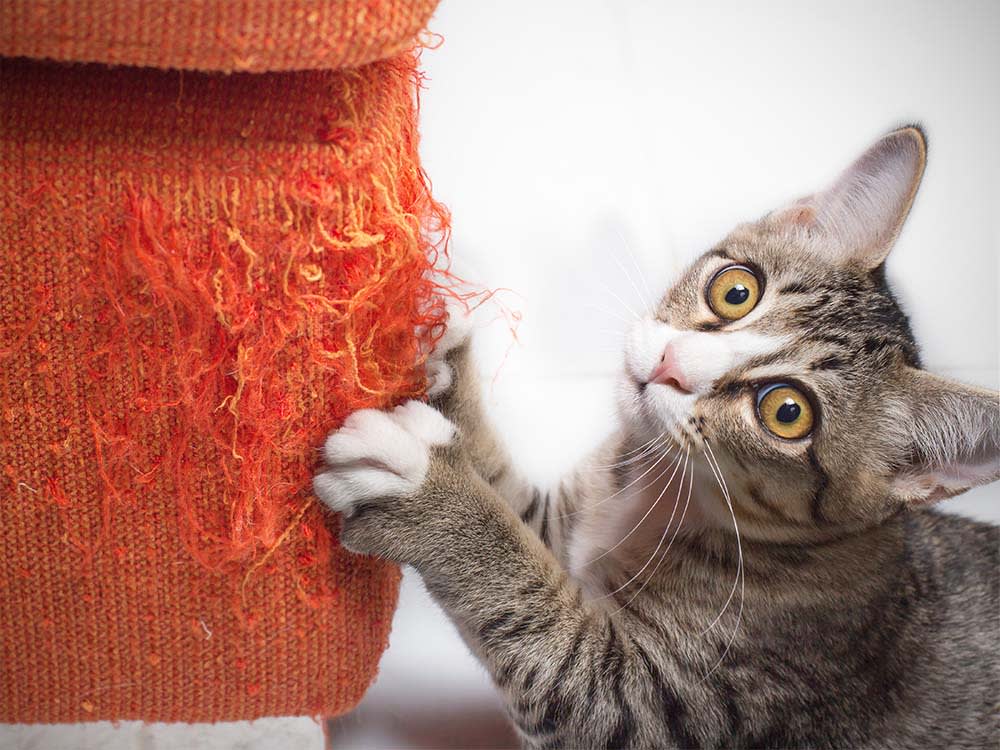
Every “stop your cat scratching” guide starts in the wrong place, which is with the word stop. You are not going to stop it. Scratching is not a behavior problem, a spite campaign, or a gap in your cat’s manners. It is maintenance, exercise, and signage, all at once, and a cat who cannot do it is a cat with a problem.
So here is the reframe that actually fixes couches: your cat is not choosing to destroy your furniture. Your cat is choosing the best available scratching surface in the house, and right now that is your couch. You are not in a discipline fight. You are in a real estate fight, and you are losing it because your competing product is bad and badly located.
Win the location and the material, and the couch stops being interesting. That is the whole game.
Why they do it (and why “no” will never work)
Scratching does four jobs at once.
It feels good. The full-body stretch and the drag of claws through a surface is the feline equivalent of a long yawn.
It maintains the claws. Cats grow crescent-shaped nail sheaths over each claw. Scratching sheds the worn outer layer so a fresh one can take over, and it heads off overgrown or ingrown nails.
It leaves a message. Cats have scent glands in their paws. A scratched surface is not just visually marked, it is chemically marked: I was here, and recently. This is why they keep going back to the same three inches of couch arm. Their own scent is already there, and it needs topping up.
It works on you. This is the one people miss. If your cat has ever scratched the couch at 6:58 p.m. and had dinner appear at 7:00, they did not learn “scratching is naughty.” They learned “scratching summons the staff.”
Notice that none of those four motives responds to being told off. Which brings us to the thing you should never do.
Punishment is the fastest way to make this worse
Yelling. Squirt bottles. Scruffing. All of it fails, and not in a neutral way.
Cats do not connect your reaction to their action the way you think they do. What they learn is that you are unpredictable and occasionally frightening. That raises baseline anxiety, and anxious cats scratch more, hide more, redirect aggression more, and start having litter box problems. You will have traded a shredded couch for a shredded relationship, and you will still have a shredded couch.
Punishment does not teach a cat where to scratch, it teaches them to be careful around you. The scratching does not stop. It just moves to the hours when you are not in the room.
The seven-part plan
1. Do the surveillance before the shopping
This is the step everybody skips, and it is the one that decides whether the rest works. For two or three days, note exactly what your cat is doing to your furniture.
Are they reaching up the arm of the couch, or raking across a flat cushion? Vertical scratchers and horizontal scratchers are different cats with different preferences. Are they going for tight woven fabric, or the rough underside, or the wooden leg? Some cats want sisal rope, some want carpet, and some want soft wood.
You now have a shopping list your cat wrote for you.
2. Buy to match, not to match the decor
Buy the orientation and material your cat already picked. A tall, sturdy vertical post if they stretch upward, a wide flat pad if they rake sideways. Sisal, carpet, cardboard, or soft wood depending on what they went for.
The post has to be tall enough for a full stretch and stable enough that it does not wobble. A post that tips once is a post that is never touched again. And if you are unsure of their preference, buy two or three cheap different ones and let the cat vote.
3. Put it exactly where the crime happens
Here is where most plans die. The scratching post goes in the spare room, or the corner, or wherever it is least ugly. Meanwhile the couch is still sitting there, in the good light, in the room where everyone hangs out.
Put the new scratcher directly next to the ruined spot. Touching it, if you can. You are not asking your cat to walk across the house to do the right thing, you are putting the right thing exactly where the urge strikes. You can drift it a few feet away later, slowly, once the habit is set.
4. Make the couch temporarily unpleasant
Now handicap the competition. Double-sided sticky tape over the target zone, aluminum foil, a fitted cover, or a plastic guard. Cats hate the tacky drag and the crinkle.
This is a scaffolding step, not the fix. On its own, a blocked couch just sends your cat to the next-best furniture. Blocked couch plus better post nearby is what redirects them.
5. Bring in pheromones
Cats return to the same spot because their scent is on it. Synthetic scratch pheromones exploit exactly that. Applied on and near the new scratcher, and around the furniture you are protecting, they signal that the marking has already been done, which reduces the urge to redo it.
Spray twice daily while you are actively retraining. Once the scratching has moved to the post, you can stop, and only pick it back up if there is a relapse.
6. Pay generously, then pay randomly
The moment your cat’s claws touch the post, mark it. Treat, praise, a burst of wand play, whatever they actually value. Better still, take a wand toy to the post and play at it, so their claws land there in the middle of the fun.
Once they are using it reliably, switch to rewarding sometimes rather than always. Intermittent reward is what makes a habit stubborn. It is the same reason slot machines are more compelling than vending machines.
7. Blunt the claws, and drain the tank
Two supporting habits, both easy to skip and both worth doing.
Trim the sharp tips every ten to fourteen days. You are not shortening the nail, you are taking the point off, and it dramatically reduces the damage from any scratching that does happen. Treat immediately afterward, every time, so the trim stays tolerable.
And add real play. Wand toys, chase games, puzzle feeders. A cat with an unmet hunting drive will find a job, and shredding the couch is a very satisfying job. Fifteen focused minutes twice a day beats a room full of ignored toys.
Start this on day one if you can
If you have a new cat or a kitten, none of the above is remediation, it is just setup. Put out several scratchers, in different orientations and materials, before you find out what they prefer the hard way. Reward every use. Pheromone the furniture. It costs almost nothing to prevent a habit that costs a great deal to undo.
What’s new since this was written
The legal ground under this topic has shifted, and fast. Declawing, once pitched as the last-resort answer to a scratched couch, is now banned statewide in New York (2019), Maryland (2022), Virginia (2024), Massachusetts and Rhode Island (2025), and the District of Columbia. California’s ban, signed as AB 867, took effect on January 1, 2026. A long list of cities, including Los Angeles, Denver, St. Louis, Pittsburgh, Austin, and Madison, have their own local prohibitions.
That matters for a practical reason, not just an ethical one. For a lot of people, “I’ll just get them declawed” was the silent backstop behind not doing the training. In much of the country, that backstop is gone.
If your cat’s scratching is genuinely unmanageable and you have worked the plan, the humane alternative your vet will raise is soft vinyl nail caps, glued over the claws and replaced as they shed. They are a real option. They are also, notably, not a substitute for giving your cat somewhere good to scratch.
References
- Alley Cat Allies. Declawing Cats.
- American Veterinary Medical Association. California Latest State to Ban Cat Declawing for Nonmedical Reasons.
- Animal Legal Defense Fund. Declawing Cats.
- American Association of Feline Practitioners. Feline Environmental Needs Guidelines.
Common questions
Should I declaw my cat?
No. Declawing is an amputation of the last bone of each toe, not a nail trim. It is associated with chronic pain, litter box avoidance, and biting, and it is now illegal statewide in several states. If nothing else works, ask your vet about soft vinyl nail caps.
Do plastic couch guards actually work?
They work the same way tape and foil work: as a temporary blocker while the real training happens. A guard alone, with no better option nearby, just moves the problem to the next armchair.
Is there a couch fabric cats won't scratch?
Not really. If a fabric feels satisfying to your hand, it will probably feel satisfying to their claws. Tightly woven, low-loop fabrics like microfiber give claws less to catch, which reduces damage. It does not remove the urge.
Does citrus spray keep cats off furniture?
Sometimes, briefly. Most cats dislike citrus. The catch is that you now live with a citrus-scented couch, and some cats will avoid the whole room rather than just the arm. It is a short-term tool, not a plan.
How often should I trim my cat's claws?
Every ten to fourteen days. You are blunting the sharp tips, not shortening the nail. Follow it with a treat every single time.
Dr. Kohl is a board-certified veterinary dentist with a particular interest in preventive oral care. She reviews all dental health content at The Pet Times and contributes practical guides on home dental routines, professional cleaning, and oral disease prevention.
Meet our experts ↗Keep reading
 Health & WellnessYour Cat vs. the Christmas Tree: The Climbing Isn't the Real DangerDr. Ravi Mehta · 6 min
 TrainingYour Cat Isn't Attacking the Wall. Read the Spot.Dr. Amara Solis · 7 min
 TrainingThe 'Let Them' Theory Works on Pets. Because It's Just Management With Better PR.Dr. Priya Nair · 7 min
 LivingThe Hours Aren't the Real Question When You Leave Your Cat AloneDr. Nina Kohl · 6 min
 LivingYour Cat Isn't Trying to Cuddle. They're Doing Math.Dr. Nina Kohl · 6 min
 LivingOne Cat Tree Isn't Enough. The Rule Is One Per Room.Dr. Amara Solis · 6 min