


The 'Let Them' Theory Works on Pets. Because It's Just Management With Better PR.
The self-help idea taking over group chats turns out to be sound animal behavior advice, mostly by accident. The catch is the half everyone forgets, and skipping it is how 'let them' becomes 'let the dog eat the sofa.'


The “Let Them” theory, popularized by Mel Robbins in a bestselling book of the same name, is a two-word instruction for the specific misery of trying to control other people. Your friend doesn’t invite you to brunch? Let them. The man you’re dating is determined to self-destruct? Let him. Stop policing behavior you cannot control, and get your evening back.
It has been enormously popular, and it has drawn the criticism that follows anything enormously popular, including a dispute over whether Robbins sufficiently credited an earlier viral poem that may have inspired the framing. None of that is our department.
What is our department is a claim that has been quietly making the rounds: that “Let Them” also works on pets.
It does. And the reason it does is not that Robbins discovered something about animals. It is that “Let Them,” applied to a dog or a cat, is a rebranding of the oldest, dullest, most effective idea in behavior work: you cannot argue an animal out of an instinct, so stop trying, and change the setup instead.
That is management. It has been the professional consensus for decades. It simply never had a catchphrase.
The half nobody remembers
Here is where most of the pet-adjacent takes go wrong, and it is the difference between good advice and a wrecked sofa.
The theory has two steps, not one.
Let them. Accept the thing you cannot control.
Let me. Ask what you can do, given that.
That second step is not decoration. It is the entire operative half. “Let them” on its own is not acceptance, it is abdication, and an abdicating pet owner ends up with a cat who screams at 4am forever and a dog who has eaten the arm of the couch, having concluded that this is simply who they are and there is nothing to be done.
There is a great deal to be done. It is just not the thing you were doing, which was saying “no” in an increasingly tense voice.
‘Let them’ is where the advice starts, and owners keep treating it as where it ends. The behavior is not the problem to solve. It is the information you use to solve the actual problem, which is almost always that the animal has a normal need and nowhere legitimate to put it.
Run it on the 4am cat
Take the most universally hated pet behavior there is. Your cat wakes you at dawn: paws at the bed, walks on your head, knocks something off a shelf.
Let her. She is crepuscular. Cats are built to be most active at dawn and dusk, which is when the birds and small mammals they evolved to hunt are moving. Her internal clock is doing precisely what it was designed to do. You are not going to talk her out of the last few million years, and every attempt to punish this teaches her nothing except that you are unpredictable in the morning.
Let me. Move the energy. Run a real hunting session about an hour before your bedtime, ten to fifteen minutes of wand toy that ends in an actual catch, and then feed her a meal. Hunt, catch, eat, groom, sleep is a complete predatory sequence, and completing it flips the switch that a cat is supposed to fall asleep on. An automatic feeder set for 5am helps too, because a great deal of the dawn performance is a request for breakfast, and a machine can answer it without teaching her that you will.
Notice what happened there. Nothing was suppressed. The need got met somewhere that suited both of you.
Run it on the sniffing dog
You wanted a dog partly for the walks. Then you got one, and the walk takes twenty minutes to cover a single block, because he stops every few steps to inhale a railing.
Let him. Sniffing is not dawdling and it is not disobedience. Dogs have somewhere between 100 million and 300 million olfactory receptors; humans have around five to six million. Smell is not a hobby for a dog, it is the primary channel through which the world arrives. Standing on a corner reading the news is exactly what he is doing.
Let me. Adjust what the walk is for. If you have been treating it as your cardio and his bathroom break, you have designed a walk that irritates both of you. Reframe it as a sniff walk, let it be slow and meandering and entirely his, and then get your own exercise separately, on your own legs, at your own pace. He gets a genuinely enriching outing. You get a heart rate. Nobody spends twenty minutes tugging on a lead.
Run it on the shredded couch
Your cat has destroyed one arm of the sofa. The seams are open, the stuffing is coming out, and you have not replaced it because you assume the new one is next.
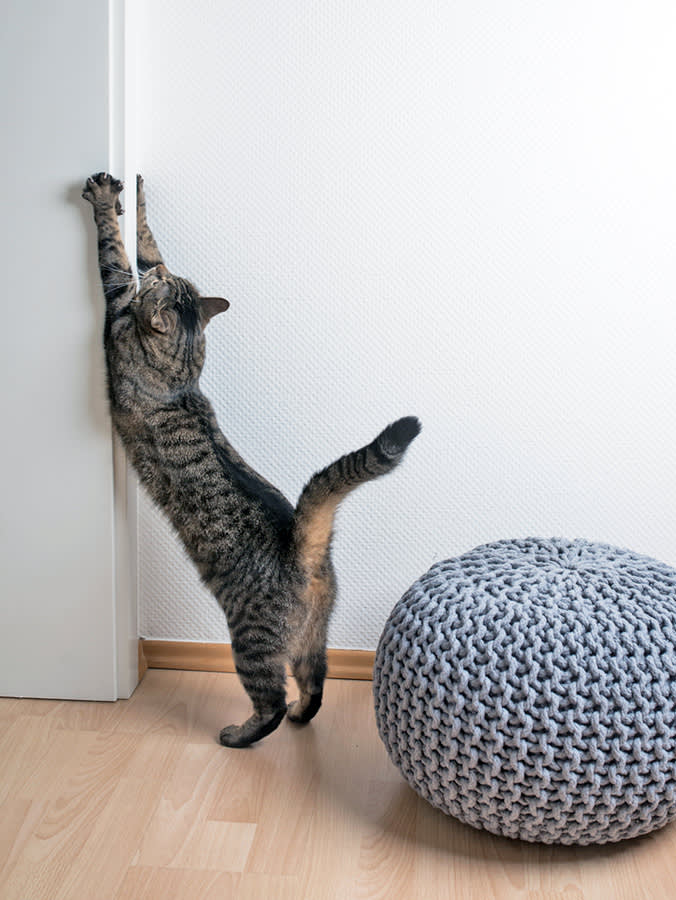
Let her. Scratching is not vandalism. It maintains her claws, it marks her territory both visually and with scent from the pads of her feet, and it stretches her whole body. A cat deprived of somewhere to scratch does not stop scratching. She scratches your furniture, because the arm of a sofa is upright, sturdy, textured, and located in the middle of the room, which is a precise description of a good scratching post.
Let me. Give her a better one and put it where she has already chosen. Not in the spare room. Directly beside the arm she has been using. Tall enough to stretch out on fully, sturdy enough not to wobble, plus a horizontal cardboard scratcher, because surface preferences vary and you do not yet know hers. Reward her when she uses it. Make the sofa arm temporarily unpleasant with double-sided tape while the new habit sets.
Where “Let Them” breaks
Here is the important caveat, and it is the one a self-help framework cannot supply, because a self-help framework is not a veterinarian.
“Let them” applies to normal behavior. It does not apply to symptoms.
A cat who has always woken you at dawn is a cat. A cat who has suddenly started yowling at night, at fifteen years old, may be hyperthyroid, hypertensive, in pain, or cognitively declining. A dog who sniffs everything is a dog. A dog who has started licking one spot on his leg raw is telling you about pain or allergy, not about a hobby.
The behaviors that respond to “let them” are the ones that have always been there, are normal for the species, and are simply landing somewhere inconvenient. The behaviors that need a vet are the ones that are new, escalating, or out of character. Applying serene acceptance to those is how a treatable illness gets a year’s head start.
That is the line, and it is not subtle once you know to look for it: has this always been who they are, or is this new?
Why it works at all
Strip the branding and what is left is the mainstream of modern animal behavior.
Punishment-based approaches fail for a specific reason: they suppress the visible behavior without addressing the need behind it, and the need does not go away. It resurfaces, usually somewhere worse and usually when you are not watching. Meanwhile the animal has learned to be a little afraid of you, which makes every subsequent problem harder to solve.
Management-and-redirection works for the mirror-image reason. It accepts the drive as non-negotiable, which it is, and it competes for where the drive gets expressed, which is the only part that was ever actually up for negotiation.
“Let them” is the acceptance. “Let me” is the redirection. It is the entire discipline, compressed into four words, and it is genuinely useful that a phrase this sticky is carrying it into households that would never open a behavior textbook.
Just don’t stop at the first two.
What newer guidance adds
Veterinary behavior organizations have moved, over the last several years, from treating environmental management as a supporting tactic to treating it as a primary intervention. The current feline guidance in particular frames a cat’s needs, somewhere to climb, somewhere to scratch, somewhere to hide, separated resources, opportunity to hunt and play, not as enrichment extras but as basic requirements of a home a cat can be well in. A behavior problem, on that reading, is very often a resource problem wearing a costume.
The same logic runs through the current thinking on dogs and sniffing. Scent work and free-sniffing walks have been studied for their effect on mood, and dogs given the chance to use their nose show measurably more optimistic judgment on standard behavioral tests. Letting a dog sniff is not indulging him. It is doing something for him that a brisk march around the block cannot.
Which means the pop-psychology framing arrived, more or less by accident, at where the evidence already was. Let them, because you cannot change what they are. Then let you, because you can absolutely change the room.
References
- Ellis, S.L.H., Rodan, I., Carney, H.C., et al. “AAFP and ISFM Feline Environmental Needs Guidelines.” Journal of Feline Medicine and Surgery, vol. 15, no. 3, 2013, pp. 219–230.
- Duranton, C., Horowitz, A. “Let me sniff! Nosework induces positive judgment bias in pet dogs.” Applied Animal Behaviour Science, vol. 211, 2019, pp. 61–66.
- American Veterinary Society of Animal Behavior. “Position Statement on the Use of Punishment for Behavior Modification in Animals.” AVSAB.
- Piccione, G., Marafioti, S., Giannetto, C., Panzera, M., Fazio, F. “Daily rhythm of total activity pattern in domestic cats maintained in two different housing conditions.” Journal of Veterinary Behavior, vol. 8, no. 4, 2013, pp. 189–194.
- Robbins, M. The Let Them Theory. Hay House, 2024.
Dr. Nair is a veterinarian focused on diet and feeding. She covers everyday nutrition, treats, and the many "can they eat this?" questions owners ask, grounding each answer in what is actually safe and sensible for dogs and cats.
Meet our experts ↗Keep reading
 TrainingYour Cat Isn't Attacking the Wall. Read the Spot.Dr. Amara Solis · 7 min
 TrainingYour Dog Digs Up Your Sheets. The Timing Tells You Whether to Worry.Dr. Nina Kohl · 7 min
 TrainingYour Dog's 'Emotional Support' Pumpkin Is Real Psychology, Not Just a Cute VideoDr. Nina Kohl · 5 min
 LivingThey Scheduled a Date Just So the Cat Could Meet the DogLeila Torres · 8 min
 LivingYour Cat Has a Hit List. It's Scorpio Season.Leila Torres · 6 min
 LivingMercury Isn't Making Your Cat Weird. You Are.Jordan Ellis · 7 min