


Your Cat Isn't Trying to Cuddle. They're Doing Math.
That warm little body pressed against your back every night isn't just affection. It's a running safety-and-warmth calculation, and your bed keeps winning it.

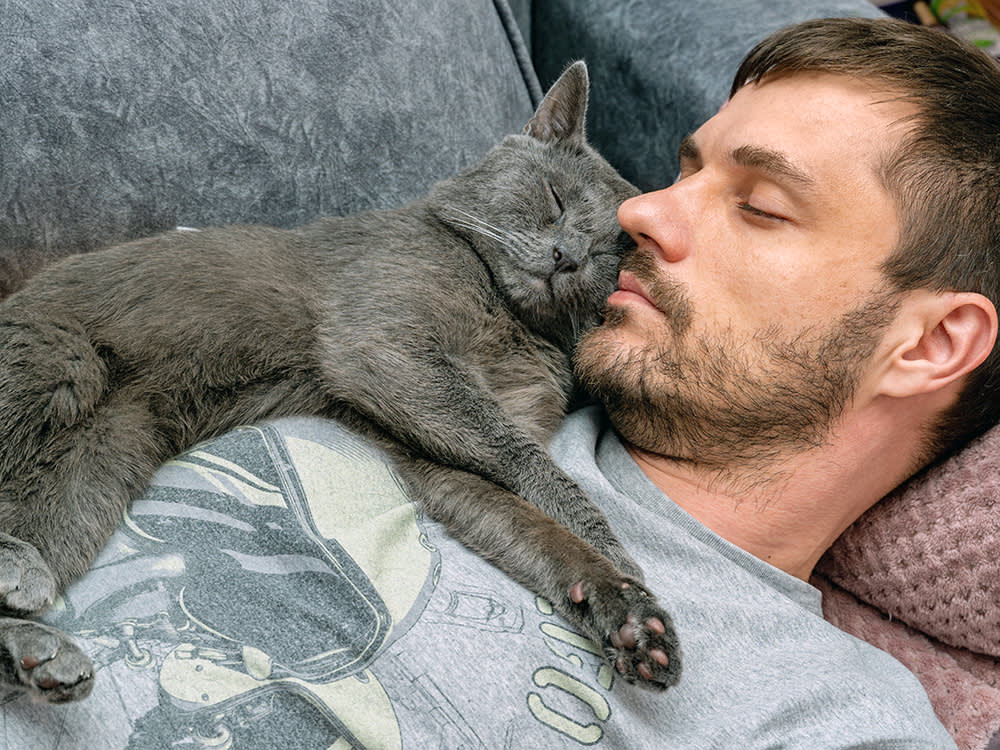
There is a specific kind of smugness that comes from a cat choosing your body as its bed. You feel selected. Trusted. Loved, even. And you are not entirely wrong. But the more honest story is that your cat is not a sentimental animal so much as an efficient one, and every night it runs a quick cost-benefit analysis of where in the house to be most secure, most warm, and most comfortable. Your bed, and specifically the warm loaf of you in it, tends to win that analysis.
That is not less flattering than “my cat loves me.” It is more flattering. You are not just tolerated company. You are the highest-scoring option in a survival calculation that a small predator has been refining for thousands of years. Here is what actually goes into that math.
You are the safest place in the house
Cats sit in a strange spot on the food chain. They hunt, but plenty of things would happily hunt them, and that double identity shapes everything about how they rest. Sleep is when any animal is most exposed, so a cat picks its sleeping spot the way you would pick a campsite in unfamiliar country: somewhere it can’t easily be crept up on.
A large, familiar, breathing body solves that problem beautifully. It is warm, it moves in predictable ways, and it doubles the odds of noticing a threat before the threat notices you. When your cat curls against you, it is outsourcing part of its night watch to you.
People read a cat pressed against them as pure sentiment, and there is real attachment there, but underneath it is a security decision. A cat that sleeps touching you is telling you it has stopped scanning the room. That is a bigger compliment than a head-bump.
You are, functionally, a radiator
Cats are comfortable at temperatures that would have most people reaching for a sweater. Their preferred warmth zone sits well above human room-temperature comfort, which is why you find them baking in window sun that you would call unpleasant. A sleeping human throws off steady heat all night, and a cat will migrate toward that heat the way water runs downhill.
Pay attention to the seasons and you will see the math change in real time. Cats that sleep politely at the foot of the bed in July often become burrowers in January, wedging under the covers the moment the house gets cold. Nothing about their feelings changed. The temperature did.
The bed wins on height and softness at the same time
Cats like to be up high. Elevation lets them survey a room and keeps them out of reach of anything patrolling the floor, which is why they colonize the tops of bookshelves and fridges. Most bedrooms are stingy with legal high perches, though, and a cluttered dresser is not a real option. That leaves the bed as the tallest comfortable surface available, and it happens to also be the softest thing in the room. It is rare for one spot to win on both counts. Yours does.
Pressure feels like being a kitten again
A lot of cats seek out the sensation of being pressed against something bigger than themselves. It is a callback to the first weeks of life, spent piled against a mother and littermates for warmth and safety. Recreating that contact as an adult is self-soothing, the feline equivalent of a weighted blanket. It does not mean your cat has confused you for its mother. It means your body delivers a feeling its nervous system learned to associate with “safe” before its eyes were even open.
The bond is real, and it runs on safety
Affection and security are not separate things for a cat; they are the same thing wearing two hats. Research on cat attachment has found that cats form the same kinds of secure and insecure bonds with their people that babies and dogs form with theirs, and that a securely attached cat treats its person as a base of safety in an uncertain world. Choosing to sleep on you is one of the clearest expressions of that secure bond there is. A cat that felt uneasy around you would simply sleep elsewhere.
Habit quietly stacks the deck
Cats are creatures of repetition, and repetition is self-reinforcing. Once a spot has been comfortable and uneventful a few nights running, it gets filed as “the good spot,” and the cat returns to it by default rather than re-evaluating every evening. So part of why your cat sleeps on you tonight is simply that it slept on you last night, and the night before, and nothing bad happened. Comfort compounds.
They may be syncing to you
Cats are famously flexible about their schedules, and a housecat living with a nine-to-five human often bends its rest to match. Bedtime becomes a shared cue: you go still, the lights go off, the household powers down, and your cat reads all of that as the signal to settle too. Sleeping against you is partly just the most convenient way to observe a routine you both now keep.
They’re building a shared scent
Cats that get along rub against each other and sleep in contact partly to blend their scents into a single group smell, a kind of chemical membership card that marks who belongs to the household. When your cat drapes itself over you all night, it is folding you into that shared scent. You are not a landlord to your cat. You are colony.
Where they land isn’t a ranking
If your cat sleeps on your head one night and your feet the next, resist the urge to read a hierarchy into it. Position is mostly logistics. Move your legs a lot in your sleep and a cat may relocate up to the pillow to avoid getting jostled. Hear a startling noise outside and it may press in tighter for reassurance. And to put the oldest myth to rest: none of this is a dominance display. Cats do not structure their social lives around dominance with humans, so a cat on your pillow is not staking a claim to the throne. It found the best seat in the house, which happens to be near your face.
If you would rather sleep alone
Plenty of people love a bed cat, and plenty do not, and both are allowed. The trick, if you want your cat off the mattress, is to out-compete yourself rather than to punish the cat. Offer a spot that beats you on the cat’s own scoring system: a tall perch or a covered, cave-style bed, ideally with a safe heat source, placed somewhere the cat already likes to be. Lure them to it with treats and let a new habit build the way the old one did.
What you want to avoid is turning the bedroom into a source of stress. Locking a cat out or hauling it off the bed night after night can chip away at the trust that made it want to be near you in the first place. The whole reason your cat is doing this math and landing on you is that you scored highest on safety. That is worth protecting, even if you would like your pillow back.
Common questions
Is my cat sleeping on me a sign of dominance?
No. Cats do not organize their relationships around dominance the way the old pop-behavior myths claimed. Where a cat chooses to sleep reflects safety, warmth, and comfort, not a power play over you.
Why does my cat sleep on my head or pillow specifically?
The pillow is high, soft, and close to your face, which is the part of you that smells most like you. Some cats also settle there to stay near you while avoiding the leg movement that disturbs them lower down the bed.
How do I get my cat to sleep somewhere other than my bed?
Give them a better offer rather than a punishment. A tall, warm alternative like a heated perch or a covered bed, paired with treats, helps them build a new habit. Locking them out or repeatedly moving them tends to backfire and strain the bond.
Dr. Kohl is a board-certified veterinary dentist with a particular interest in preventive oral care. She reviews all dental health content at The Pet Times and contributes practical guides on home dental routines, professional cleaning, and oral disease prevention.
Meet our experts ↗Keep reading
 LivingThey Scheduled a Date Just So the Cat Could Meet the DogLeila Torres · 8 min
 TrainingIntroducing Two Cats? Go Slower Than You ThinkDr. Nina Kohl · 7 min
 LivingYour Cat Has Been Asking for the Same 7 Things. You Keep Hearing 'More Cuddles.'Dr. Priya Nair · 8 min
 TrainingThe Neck Bite Is Never the Problem. The Body Around It Is.Dr. Nina Kohl · 8 min
 TrainingYour Cat Isn't Seeing Ghosts. They're Seeing What You Can't.Nina Vasquez · 5 min
 TrainingYour Cat Isn't Seeing Ghosts. They're Finishing a Hunt That Never Started.Dr. Lena Park · 6 min