


Your Cat Isn't Seeing Ghosts. They're Finishing a Hunt That Never Started.
The random 3am sprint isn't randomness. It's a predatory sequence that has nowhere to go, and the fix isn't exhausting your cat. It's letting them complete the sequence.

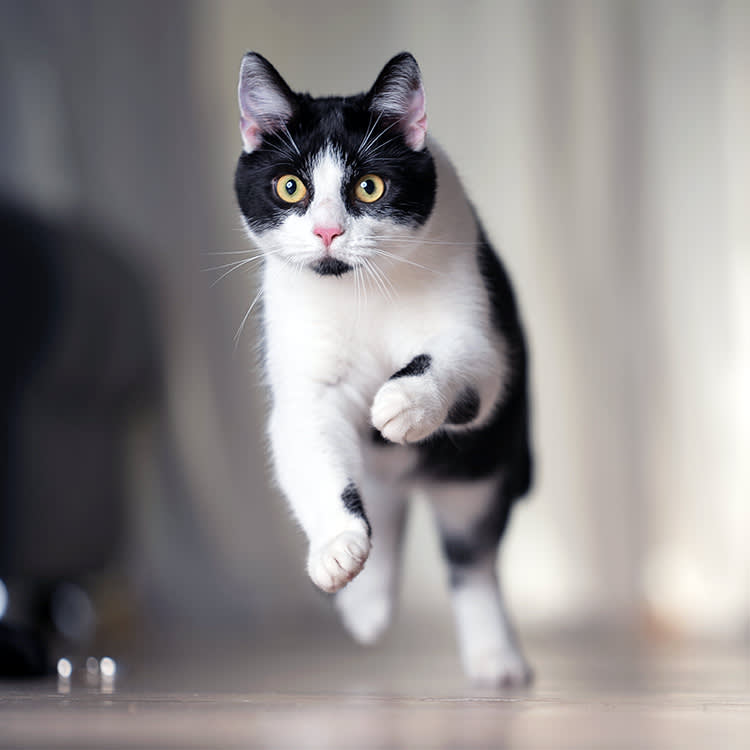
Your cat is asleep. Fully, boneless-ly asleep. Then, with no warning whatsoever, they explode off the couch, tear across the room, ricochet off the hallway wall, and stop dead. They sit. They lick a shoulder. It is over.
You look around for what caused it. There is nothing there.
The internet’s favourite explanation is that your cat saw a ghost. The vet’s explanation is duller and much more useful: your cat is running a hunting sequence with no prey in it, and the sequence had to go somewhere.
Once you understand that, the whole behavior stops being random, and, more importantly, you get an actual lever to pull.
The sequence
A cat’s predatory behavior isn’t a single act. It’s a chain, and it runs in a fixed order:
Stalk → chase → pounce → catch → kill-bite → eat → groom → sleep.
That chain is not learned. It’s hardwired, it’s why kittens ambush each other before they’ve ever seen prey, and, critically, it can fire without an external trigger. Motivation to hunt builds up in a cat the way hunger does. It accumulates. And a house cat with a full bowl and no prey has nowhere to spend it.
So the sequence starts anyway. Your cat launches into the “chase” phase against nothing at all, runs it for eight seconds, and then, having nothing to catch, aborts. That’s the sprint.
The formal name for it is a frenetic random activity period, or FRAP. Everyone else calls them the zoomies. Dogs get them, rabbits get them, and they’re entirely normal.
The other half of the explanation is the wild cat’s daily rhythm: long stretches of near-total rest, punctuated by brief, explosive bursts of speed. Cats sleep 12 to 16 hours a day, and everything they’ve got is built for a few seconds of sprint, not for endurance. That rhythm doesn’t care that your cat lives in an apartment. The nervous system runs the same schedule it always has.
Owners describe it as random, and I understand why, but there’s nothing random about it. The energy for hunting builds up whether or not anything is available to hunt, and it has to be discharged somehow. What you’re watching at eleven at night is a predator with a full stomach and an empty schedule.
Sometimes there IS a trigger. You just can’t perceive it.
Worth holding onto before you conclude your house is haunted.
Cats hear into the ultrasonic range, well above what humans can register. They can detect the ultrasonic squeaks that rodents and insects actually make. They see movement in far less light than we do, and their field of view for motion is wider than ours.
So a “trigger-less” sprint is often a sprint at something you couldn’t perceive: a mouse in the wall, a moth against a window, a fly, a shift in the airflow, an electrical hum, a neighbour’s door.
Your cat is not a medium. They just have better hardware.
The fix isn’t tiring them out. It’s finishing the sequence.
Here’s where nearly everyone goes wrong, and it’s the practical heart of this piece.
The instinct is to think of a zoomy cat as an over-caffeinated one who needs to be exhausted. So people wave a laser pointer around the room for ten minutes and consider the job done.
That is the wrong model, and the laser pointer is the perfect illustration of why.
A laser lets your cat stalk and chase. It never lets them catch. The sequence starts, builds, and then simply stops with nothing at the end of it, which is not satisfaction, it’s frustration. Some cats become genuinely obsessive about lights and reflections afterwards, hunting shadows on walls for months. The laser is not a toy that spends the motivation. It’s a toy that winds it up and then unplugs.
The fix is to run the whole sequence, and let it end in a kill and a meal. In practice:
- Use a wand toy, not a laser. Something on a string that moves like prey: erratic, low, darting away from your cat rather than towards them, disappearing behind furniture. Prey does not fly directly at a predator’s face.
- Let them catch it. Repeatedly. A cat that never gets to close its paws on something is a cat being teased.
- Let them do the kill-bite. The rabbit-kick, where they clutch the toy to their belly and pump with the back legs, is the finishing move. It is the most satisfying thing a toy can offer, and a small kicker-sized toy is what allows it.
- Then feed them. Immediately. A few treats, or better, their actual meal. This is the step nobody does and it’s the one that closes the loop: hunt, catch, kill, eat. After eating, a cat grooms, and after grooming, a cat sleeps. You have just run the entire chain to its natural conclusion.
Do this in the evening, before you want to sleep, and the 3am sprint often simply stops happening. Not because the cat is tired. Because the sequence is complete.
Duration matters more than you’d think. Research on cat play habits found that owners who played with their cat in five-minute bouts were less likely to report a behavior problem than those who played for a single minute. Five minutes is short. Most people are giving less than that.
Two of those a day, done properly with a wand and finished with food, is a genuinely different cat.
When the zoomies mean something else
Almost always this is normal. A few cases aren’t.
Sprinting straight out of the litter box, every time. A dash after a poop is common and usually harmless, and there are various theories for why (from vagal stimulation to simple relief). But a cat who consistently bolts from the box, especially with vocalising, straining, or repeated trips, may be associating the box with pain. Urinary tract disease, constipation, and blockages all present this way. In male cats, straining with little output is a medical emergency and cannot wait.
Sprinting with vocalising, dilated pupils, or biting. A sprint that looks less like play and more like escape, especially in an older cat, is worth a vet visit. Hyperthyroidism, high blood pressure, pain, and cognitive dysfunction can all produce frantic, agitated bursts of activity, often at night.
A sudden new pattern in a senior cat. Night-time yowling and disoriented pacing in an old cat is a different animal from a two-year-old’s happy sprint. Do not file it under zoomies.
Skin-rippling, sudden biting at the flank, frantic running away from their own back. This can be feline hyperesthesia syndrome, which is a genuine neurological condition and not a personality quirk.
The rule of thumb: a normal zoomy cat settles immediately afterwards. They stop, they groom, they lie down, they look completely fine. A cat who cannot settle after the sprint, who seems distressed rather than delighted, is telling you something different.
What newer research adds
The most useful recent work on this is not about zoomies at all. It’s about play, and it’s quietly damning.
Behavior researchers looking at why owners don’t play with their cats found that the barriers are mostly not knowledge, they’re energy, memory, and habit: people are too tired, they forget, they can’t make it stick, work gets in the way. The same body of work found that owners with more knowledge about play played more, and that longer play bouts were associated with fewer reported behavior problems.
That’s a rare thing in behavior advice: a lever that’s cheap, has an evidence base, and takes five minutes.
It also reframes the “frustrated predator” idea. An indoor cat who sprints at nothing isn’t broken and isn’t bored in a vague sense. They are a working animal with no work. Give them a wand, two five-minute sessions, a catch, a kill, and a meal, and much of what looks like eccentricity resolves itself.
FAQ
Why does my cat suddenly run around at night? Cats are crepuscular, most active at dawn and dusk, and an indoor cat with unspent hunting motivation will often discharge it in the evening. Play them properly before bed and feed afterwards.
Are zoomies bad for my cat? No, they’re normal. What matters is that your cat settles calmly straight afterwards. A cat who seems agitated rather than pleased is worth a vet’s attention.
Is a laser pointer bad? It’s an incomplete toy. It lets a cat chase but never catch, which can be frustrating and can lead to obsessive light-chasing. If you use one, always end the session by landing the dot on a real, physical toy or a few treats so your cat gets to catch and eat something.
My cat sprints out of the litter box every single time. Should I worry? An occasional dash is normal. A consistent, urgent bolt, especially with straining, vocalising, or frequent trips, needs a vet. In male cats, straining with little urine is an emergency.
How long should I play with my cat? Aim for at least five minutes at a time, twice a day, with a wand toy, and finish with food. The evidence suggests five-minute bouts do considerably more than one-minute ones.
References
- Delgado, M., et al. “Identifying barriers to providing daily playtime for cats: A survey-based approach using COM-B analysis.” Applied Animal Behaviour Science, 2024. https://www.sciencedirect.com/science/article/pii/S0168159124002685
- “Assessing the impact of a human behaviour change intervention to reduce owner-related barriers to interactive cat play.” Applied Animal Behaviour Science, 2024. https://www.sciencedirect.com/science/article/pii/S0168159124003277
- “Play and welfare in domestic cats: Current knowledge and future directions.” Animal Welfare, Cambridge University Press. https://www.cambridge.org/core/journals/animal-welfare/article/play-and-welfare-in-domestic-cats-current-knowledge-and-future-directions/6266B8053099D0BB3F8D441F1ADF5CDA
- “Feline Hyperesthesia Syndrome.” Cornell Feline Health Center. https://www.vet.cornell.edu/departments-centers-and-institutes/cornell-feline-health-center
- “Feline Lower Urinary Tract Disease.” American Veterinary Medical Association. https://www.avma.org/resources/pet-owners/petcare/feline-lower-urinary-tract-disease
Dr. Park is a board-certified emergency and critical care specialist. She reviews our health and safety content for clinical accuracy and contributes guides on recognising urgent conditions. Her focus is helping owners act quickly and correctly when it matters most.
Meet our experts ↗Keep reading
 LivingYour Cat's Eight Nap Spots Are a Map. The Cat Who Stops Moving Is the Worry.Sara Lim · 7 min
 LivingYour Cat Isn't Trying to Cuddle. They're Doing Math.Dr. Nina Kohl · 6 min
 TrainingYour Cat Isn't Guarding You in the Bathroom. They Hate the Door.Dr. Nina Kohl · 6 min
 TrainingThat 'Come Here' Cat Video Works. Your Own Voice Works Better.Dr. Lena Park · 7 min
 TrainingYour Cats Don't Hate Each Other. They Just Don't Smell Like a Family Yet.Dr. Amara Solis · 9 min
 LivingThe Shoulder-Cat Photo Everyone Tried to Copy. Here's Why Yours Won't Work.Sara Lim · 6 min