


Your Cat's Eight Nap Spots Are a Map. The Cat Who Stops Moving Is the Worry.
The nap rotation looks random and isn't. It's your cat reading the temperature, the sightlines, and the traffic in your home, hour by hour. Learn to read it back, and notice the one change that matters.

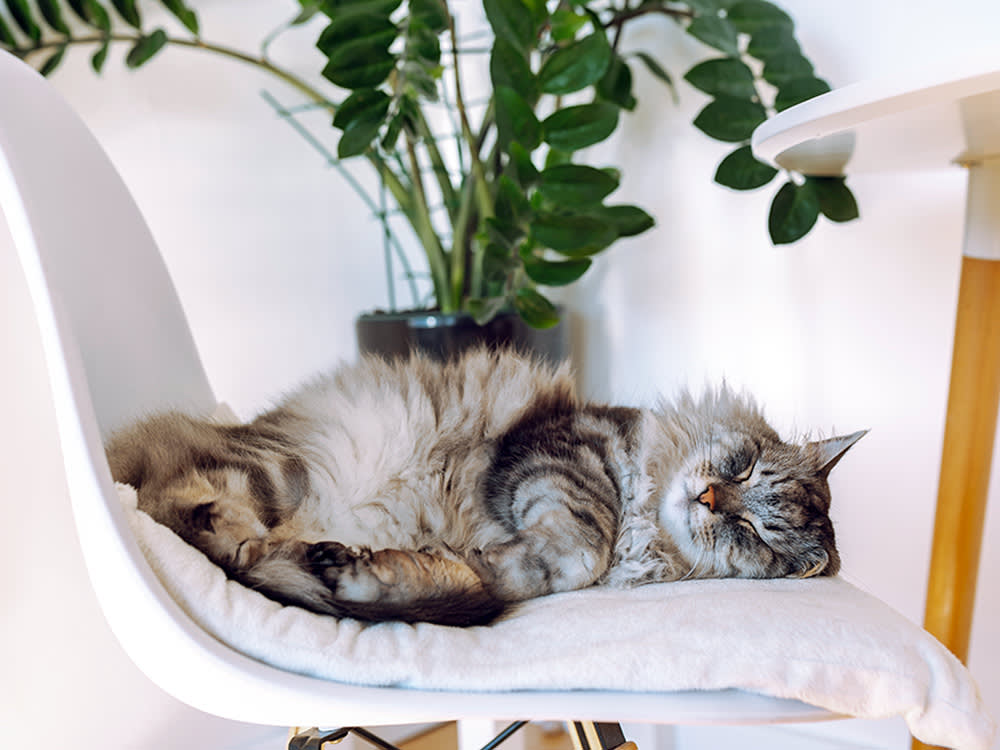
Count your cat’s sleeping spots. Not the bed you bought them. The actual ones.
The left end of the sofa in the morning. The desk chair once you leave it. A patch of carpet that only exists between two and four in the afternoon. The top of the bookshelf. A cardboard box that has been “about to be recycled” for five weeks. If you have a cat, you probably have six or eight of these, and the rotation between them looks like pure caprice.
It isn’t. Each one of those spots is a solution to a specific problem, and the problems change through the day. Your cat is not being random. Your cat is continuously re-solving an equation, and the variables are temperature, sightlines, traffic, and other animals.
Which means the rotation is readable. And, more usefully, it means that a cat who stops rotating has told you something you should probably act on.
The variables your cat is actually solving for
Temperature, which beats everything
This is the biggest single driver and it’s boring, which is why people skip past it in favour of more romantic explanations.
A cat is looking for a spot a few degrees warmer or cooler than they currently are. That’s why the nap spot moves across the room with the sun over the course of an afternoon, why the laundry pile is irresistible the moment it comes out of the dryer, and why in August the same cat abandons every soft surface in the house for the bathroom tiles.
Before you interpret a change of spot as a change of mood, check whether it’s a change of weather. Most “why has she suddenly started sleeping there?” mysteries end with the heating coming on.
Safety, in two flavours
Cats are both predator and prey, and sleep is when a prey animal is most exposed. So they pick spots that solve for that in one of two opposite ways:
Enclosure. A box, under the bed, behind the sofa, inside a bag. Nothing can approach from behind or above. This is the choice of a cat who wants to be unfindable.
Elevation. The top of the wardrobe, the back of the sofa, the cat tree. Nothing can approach without being seen coming. This is the choice of a cat who wants to be unsurprisable.
Both are legitimate. Cats differ, and the same cat will choose differently depending on what’s going on in the house. Which is why the actual instruction here is: provide both, in every room your cat spends time in. A house that offers only floor-level open beds is a house that has answered only one of your cat’s two questions.
Pressure
A lot of cats want to be squeezed. Wedged into a box that is visibly too small, jammed between a cushion and an arm, pressed into the gap between your back and the duvet.
The plausible explanation is early life: a queen gathers her kittens in and lies over them, and the associated sensation is warmth plus contact plus containment. A too-small box reproduces that. It’s the same principle as a weighted blanket, and it’s why the cat ignores the plush donut bed and sleeps in the packaging it came in.
Noise
Cats hear vastly better than we do, and into frequencies we can’t reach at all. A spot that seems perfectly quiet to you may be sitting on top of a fridge compressor, a pipe, or a hum from a device.
If your cat has inexplicably abandoned a formerly beloved spot, this is worth checking. Something in that corner may have started making a noise you cannot hear.
Proximity, which cuts both ways
Many cats sleep near their person because a group is harder to sneak up on than an individual, and because you’re warm and you smell right. That’s why the spot moves when you move: not because your cat needs to be on you, but because their optimal spot happens to be wherever you are.
The reverse is equally informative. A cat who moves away when you start something loud, cooking, exercising, running the vacuum, is not sulking. They’re re-solving the equation with a new noise variable in it.
And when you’re gone for a while, many cats will sleep on your clothes. That one is exactly as sentimental as it sounds. Your scent is a resource.
Time-sharing, in multi-cat homes
This is the one most owners never notice, and it’s the most interesting.
In a home with several cats, the good spots are a resource, exactly like food and litter boxes. And cats, who are generally not keen on open conflict, resolve competition over them by taking turns.
If you actually watch, you can often find the schedule. One cat has the tree from mid-morning; a second takes it at lunchtime, at which point the first moves to the windowsill. Nothing is negotiated out loud. It’s a rota, and it works.
Which produces the single most practical rule in this article: in a multi-cat home, the number of good sleeping spots should exceed the number of cats, and they should be spread across different rooms and heights. Scarcity of prime real estate is a quiet, chronic source of tension between cats, and it produces a lot of the low-grade hostility that owners assume is a personality clash.
Novelty
And sometimes, honestly, they just fancy a change. A cat’s day has limited variety in it. Cycling the nap spots is one of the few things they get to decide.
Reading it back
Once you know the variables, the map tells you things.
- Cat sleeps almost exclusively enclosed and low, in the dark, at the back of things. This is a cat solving hard for safety. Fine in a new home or after a change. Worth thinking about if it’s the permanent setting: is there something in the house they’re avoiding? Another pet? A child? A noise?
- Cat sleeps exclusively high. Often a cat managing another animal. Look at who’s on the floor.
- Cat has abandoned a favourite spot abruptly. Something changed there. A noise, a smell, a draught, an encounter with another pet. Or, occasionally, you improved it. (Cats do not always want their spots improved. A blanket added to a beloved bare-plastic bag is a solved problem becoming an unsolved one.)
- Cat has started sleeping somewhere new and hard to reach. Cats in pain, or cats feeling unwell, frequently withdraw to somewhere quiet, dark, and defensible. This is one of the classic and most-missed signs of feline illness.
The change that actually matters
Here it is, and it’s the reason to read the rotation at all.
A cat who stops rotating is a cat to look at closely.
The variety is the healthy state. A cat who used to cycle through eight spots and now sleeps in one, all day, every day, has usually stopped because moving costs them something it didn’t used to.
That could be:
- Pain. Arthritis is enormously common in older cats and enormously underdiagnosed. A cat who can no longer jump to the top of the wardrobe doesn’t tell you they’re sore; they just stop going up there and start sleeping on the sofa. The lost spot is the symptom. If your cat’s favourite places have all quietly become the low-altitude ones, that’s an orthopaedic finding, not a preference.
- Illness. Withdrawing to a single hidden spot and staying there is a very common way for a sick cat to present.
- Old age and cognitive change. A senior cat who seems disoriented about where they are, or who sleeps in a new, strange place and vocalises at night, is worth a vet visit.
Cats are exceptional at concealing pain and illness. Their sleeping map is one of the few places it shows before anything else does, because it’s a behavior they can’t easily suppress: they simply route around whatever hurts.
So: know your cat’s spots. Notice when the list gets shorter.
Should you try to change where your cat sleeps?
Mostly, no. If your cat is safe, let them sleep wherever they’ve decided is good, however insulting that is to the expensive bed you bought.
The exceptions are the genuinely unsafe ones: places that get very hot or very cold, places you couldn’t reach them in an emergency, places where something could fall on them, and anywhere they can get shut in. Block those off, and add better options rather than only subtracting bad ones.
If you want a cat to use a bed you’ve bought, the trick is not the bed. It’s the location. Move it to a spot that already scores well on the variables above: sunny, quiet, elevated or enclosed, near you, away from another pet. Then leave treats or a pinch of catnip in it and walk away. Cats do not take instructions, but they do take bribes, and they will absolutely re-evaluate a spot with food in it.
And if they still prefer the box the bed came in, they aren’t being difficult. As far as they’re concerned, they simply found a better answer than the one you paid for.
FAQ
Why does my cat keep changing where they sleep? Mostly temperature, safety, noise, and proximity to you, all of which shift through the day. The rotation is your cat continuously re-optimising, not being fickle.
How many beds does my cat need? More than you’d think, and in a multi-cat home, more than you have cats. Offer both enclosed options and elevated ones, in different rooms.
My cat suddenly stopped using their favourite spot. Should I worry? Not necessarily; something about that spot probably changed. But if your cat has stopped using several spots, particularly high ones, think about joint pain and book a vet visit.
Why does my cat sleep in a box instead of the bed I bought? Enclosure and pressure. A box solves for safety and gives the contained feeling many cats find comforting. The expensive open bed solves for softness, which your cat cares about less than you do.
Should I make my cat’s odd sleeping spot more comfortable? Usually not. If a cat is sleeping somewhere, they’ve already judged it comfortable. Adding a blanket sometimes changes the smell and texture enough that they abandon it entirely.
References
- “Feline Behavior Guidelines.” American Association of Feline Practitioners. https://catvets.com/guidelines/practice-guidelines/feline-behavior-guidelines
- Ellis, S.L.H., et al. “AAFP and ISFM Feline Environmental Needs Guidelines.” Journal of Feline Medicine and Surgery, 2013. https://journals.sagepub.com/doi/10.1177/1098612X13477537
- “Degenerative Joint Disease in Cats.” Cornell Feline Health Center. https://www.vet.cornell.edu/departments-centers-and-institutes/cornell-feline-health-center/health-information/feline-health-topics/arthritis-cats
- “Cognitive Dysfunction Syndrome in Cats.” VCA Animal Hospitals. https://vcahospitals.com/know-your-pet/cognitive-dysfunction-syndrome-in-cats
Sara Lim leads our Product Picks coverage, testing and comparing the things pets and their owners actually use. From everyday essentials to home-and-style finds, she focuses on honest, useful recommendations rather than hype.
Meet our experts ↗Keep reading
 LivingMy Cat Has Never Once Felt Awkward. I'm Taking Notes.Sasha Ford · 5 min
 LivingYour Cat Isn't Trying to Cuddle. They're Doing Math.Dr. Nina Kohl · 6 min
 LivingYour Cat Isn't Judging You. It's Running a Threat Assessment.Dr. Nina Kohl · 7 min
 LivingYour Cat Isn't Embarrassed. Misreading That Scramble Is How People Make Cats Anxious.Dr. Nina Kohl · 6 min
 TrainingYour Cat Doesn't Care About the Bathroom. They Care That You Finally Sat Down.Dr. Priya Nair · 8 min
 TrainingYour Cat Can Fake a Purr. They Can't Fake This.Dr. Nina Kohl · 6 min