


Your Cat Isn't Embarrassed. Misreading That Scramble Is How People Make Cats Anxious.
Cats slink off after a clumsy moment and we call it embarrassment. The science says it's probably something else, and the story we tell ourselves about it can quietly push a cat toward real stress. Here's what's actually happening.

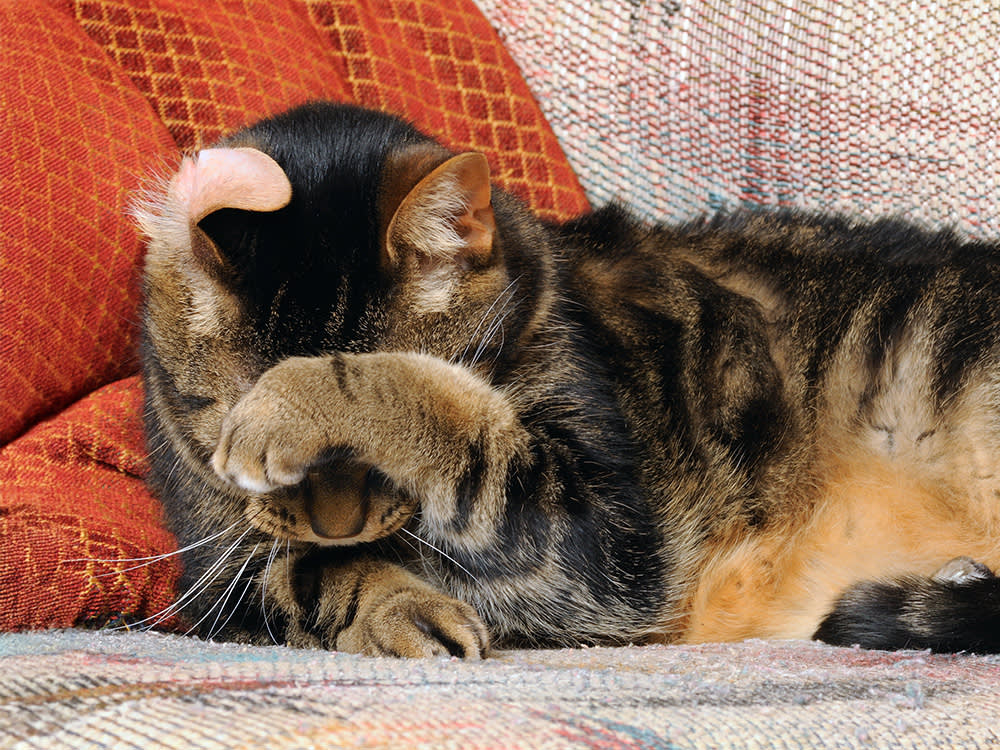
Even the most angelic cat has off moments. You come home to a shredded couch arm, a paw print trail across the counter, or a litter box catastrophe. And unlike dogs, who can sell a guilty look convincingly enough to make us believe in canine shame, cats tend to meet their own disasters with pure nonchalance. That blankness is part of why cats feel harder to read, and harder to train, than dogs.
But sometimes they do the other thing. They knock a glass off the table and bolt. They slip mid-leap and stalk off without looking at you. It looks, unmistakably, like embarrassment. Here’s the argument this piece is really making, though: that reading is almost certainly wrong, and it’s not a harmless mistake. The story we tell ourselves, “my cat is embarrassed,” shapes how we respond, and the wrong response can nudge a perfectly fine cat toward genuine anxiety. So it’s worth getting right.
What embarrassment actually is
Embarrassment is slippery to define, but you know it the instant it hits. It’s a complicated, self-conscious emotion that surfaces when we feel we’ve done something wrong, either by our own internal judgment or under the judgment of others. It comes with a physical signature, blushing, stammering, sweating, struggling to speak, and it’s often way out of proportion to the actual mistake. Crucially, feeling it requires two things: self-awareness, and an understanding of how you’re being perceived by someone else.
Hold onto those two requirements, because they’re the whole reason the cat question is genuinely open rather than obvious.
What cats definitely do feel
Start with what’s not in doubt. Cats, like most animals, absolutely feel emotions. Research is clear that nonhuman animals, dogs, cats, pigs, sheep, rats, cows, and plenty more, experience real feelings. Cats can feel a wide range of big, familiar states: fear, happiness, anxiety, relief, depression, and frustration. The way cats bond with and treat the people they trust even suggests they can feel something like love, though the research isn’t conclusive there yet.
So this is not a “cats are unfeeling” argument. It’s a narrower and more interesting question.
The line between primary and secondary emotions
Emotions researchers draw a rough line between primary and secondary emotions. Primary emotions have clear evolutionary jobs and show up widely across animals, joy, anger, fear, surprise. Cats clearly have these. Secondary emotions, pride, jealousy, embarrassment, are the more self-conscious, cognitively demanding ones, and it’s an open question whether cats experience them at all.
Some animals, apes among them, do appear to feel embarrassment. For other mammals like dogs and cats, researchers genuinely disagree. Some think they feel shame or embarrassment; others argue we’re anthropomorphizing, projecting onto them what we’d feel in the same spot. On cats specifically, the honest answer is: we don’t know yet. That’s not a dodge, it’s the current state of the evidence, and it may well change as research continues.
So what is that scramble, then?
If it isn’t embarrassment, what are you actually watching when your cat knocks something over and flees? Almost certainly a simpler, more practical response, and there are a few good candidates.
A cat who slips or falls and then scurries off avoiding your eyes may just be startled and resetting. A cat who bolts after knocking something over may be reacting to the sudden noise, or trying to avoid your negative reaction, which is a learned response, not a guilty conscience. They might even be scanning for a threat, since a loud crash is exactly the kind of thing that says “predator” to a small animal. Cat behavior is layered, and we tend to fill the gaps with how we’d feel in the moment.
The grooming freeze is a perfect example. Your cat is mid-bath, you walk in, and they abruptly stop and look caught out, embarrassed, surely? More likely, you simply interrupted them. Cats are hypervigilant and often won’t keep grooming while they feel watched. Same behavior, completely different, non-embarrassed explanation. Worth noting how common the projection is: somewhere between four and five owners in ten are convinced their animal experiences the secondary emotions, which tells you more about us than about the cats.
The behavior itself is real and worth paying attention to, I just want people to be careful about the label they slap on it. If you decide your cat is ‘embarrassed and knows they were bad,’ the next move is often scolding, and now you’ve added fear to a cat who was only startled. Read it as ‘my cat got spooked,’ and you respond with calm instead. Same cat, very different outcome.
Why the misread matters
This is the practical heart of it. If your cat looks embarrassed, there’s honestly not much to do, and that’s fine, minor stuff passes, same as it does for us. The important part is what you don’t do. Don’t shout at them over a perceived mistake, and don’t laugh at them, both can genuinely distress a cat. If you see real signs of distress, flattened ears, a hunched body, help by lowering the temperature of the moment: a calm environment, soft music, a calming pheromone plug-in, a gentle distraction. And if a cat shows serious distress on a chronic basis, that’s a conversation with your vet about adjusting their environment, not something to wait out.
The bottom line
Whatever a cat is doing after a botched jump, it probably isn’t the thing you’d feel in their place. That is not a demotion. The emotional life is there, and it is not thin. As research advances, we may even learn that cats do experience secondary emotions after all. For now, the kindest and most accurate move is to hold the “embarrassment” story loosely. When your cat scrambles off after a clumsy moment, read it as a startle, not a confession, respond with calm rather than correction, and you’ll be closer to the truth and easier on your cat at the same time.
References
- Pickersgill, Olivia, et al. “Owners’ beliefs regarding the emotional capabilities of their dogs and cats.” Animals, vol. 13, no. 5, 2023, p. 820. https://doi.org/10.3390/ani13050820
- “Researchers assess whether animals feel emotion.” Cornell University College of Arts & Sciences, 2024. https://as.cornell.edu/news/researchers-assess-whether-animals-feel-emotion
Common questions
What are the signs a cat might look embarrassed?
After an awkward moment, like knocking something off a shelf or slipping mid-jump, a cat may slink away, hide, freeze, or avoid eye contact. It reads exactly like embarrassment to us. But these are also ordinary responses to being startled, interrupted, or wanting to avoid your reaction, which is why it's hard to say the cat is actually feeling embarrassed.
Do cats feel embarrassment the way people do?
Almost certainly not. Human embarrassment depends on self-awareness and a sense of how others perceive us, and we don't yet have evidence cats have those things. Cats clearly feel primary emotions like fear, joy, and frustration, but embarrassment is a more complex secondary emotion, and the jury is still out on whether cats experience those at all.
Dr. Kohl is a board-certified veterinary dentist with a particular interest in preventive oral care. She reviews all dental health content at The Pet Times and contributes practical guides on home dental routines, professional cleaning, and oral disease prevention.
Meet our experts ↗Keep reading
 TrainingYour Cat Isn't Seeing Ghosts. They're Finishing a Hunt That Never Started.Dr. Lena Park · 6 min
 TrainingPaper Is the Best Cat Toy in Your House. It's Also a Trap.Dr. Ravi Mehta · 7 min
 TrainingYour Cats Don't Hate Each Other. They Just Don't Smell Like a Family Yet.Dr. Amara Solis · 9 min
 LivingYour Cat Isn't Trying to Cuddle. They're Doing Math.Dr. Nina Kohl · 6 min
 TrainingYour Cat Isn't Being a Jerk When They Swat Things Off the Table. They're Running an Experiment.Dr. Nina Kohl · 5 min
 TrainingThat Old Sweater Isn't Comforting Your Cat. It's Just Soft.Dr. Mara Chen · 8 min