


Paper Is the Best Cat Toy in Your House. It's Also a Trap.
A crumpled receipt beats a $40 toy because it does the one thing a toy can't: it behaves like something alive. That's exactly why leaning on it as a substitute for real play backfires.

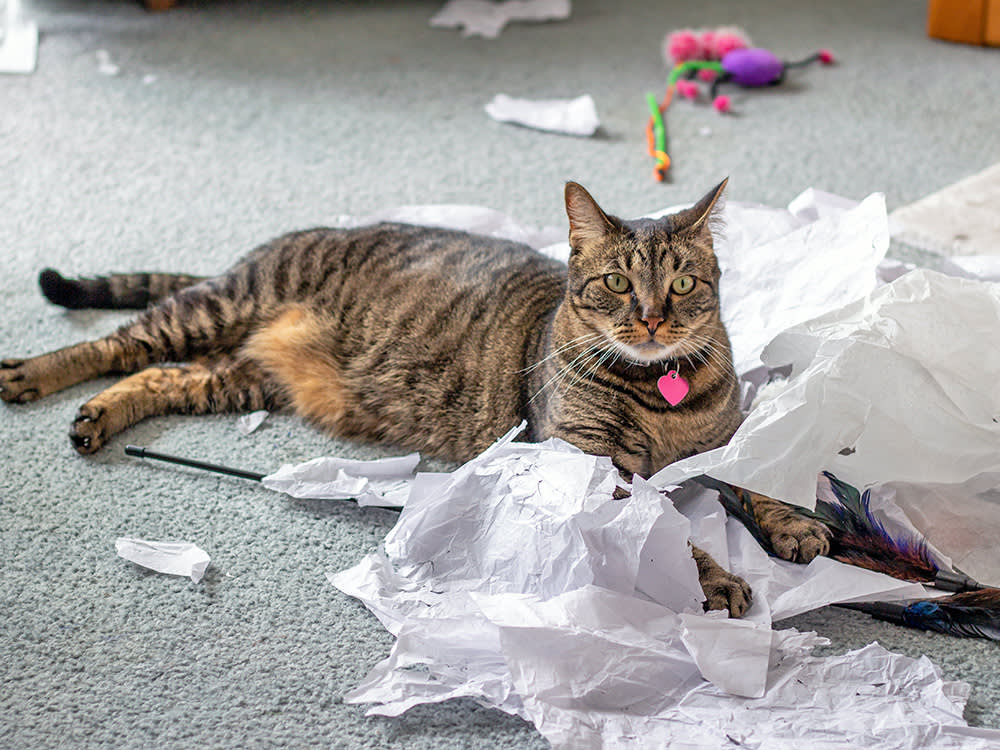
Every cat owner discovers this by accident, usually under deadline. You are trying to work, the cat is trying to prevent that, and in a moment of desperation you ball up a Post-It, flick it across the floor, and buy yourself five minutes of peace.
Then you do it again. And again. And at some point you notice that the $40 electronic toy you bought is under the couch and the cat is disemboweling a shipping envelope.
It is tempting to file this as a joke about how cats are ungrateful. It is more useful to file it as information. Paper is not winning because cats are contrarians. Paper is winning because it does one thing almost no manufactured toy does, and understanding what that thing is tells you both why paper works and where it quietly stops working.
Paper is not a toy. It is a prey simulator.
A cat with a full bowl is still a predator with all the software running, and the hunting sequence they are built for does not fire on command. It fires in response to specific triggers: unpredictable movement, small size, and a sound like something rustling in dry leaves.
Paper hits all three, by accident, in a way that a plush mouse never will. Crumple it and it crackles. Bat it and it skitters unpredictably, because a light irregular object does not roll along a predictable line the way a ball does. Pounce on it and it collapses and crunches under the paws, which is a response, and prey gives responses. It stalks like grass, it sounds like leaves, and it dies convincingly.
Compare that to a static toy sitting on the rug. A cat looks at it once and their nervous system correctly identifies it as furniture.
There is also a territorial angle. A sheet of paper that lands on the floor is new information in a space the cat has already surveyed and catalogued. Investigating it is not optional. Claiming it, by sitting on it, is barely optional either.
Paper is genuinely good enrichment, and I do not want to talk anyone out of it. What I want people to notice is that they usually reach for it at the exact moment they do not want to interact with their cat. That is the reason it becomes a problem. The paper is fine. The delegation is the issue.
Where the trap is
1. It is a substitute for you, and it is not a good one
Here is the finding that ought to change how people think about this. When researchers formally tested what cats actually prefer, offering them a choice between food, toys, scent, and human social interaction, social interaction with people was the most preferred category for the largest share of cats. Food came second. Toys, the thing we buy compulsively, did not win.
So when you toss paper across the room instead of playing, you are substituting the least-preferred category for the most-preferred one. It works, in the sense that the cat is occupied. It does not do the thing your cat wanted, which was you.
That is fine as an emergency measure on a deadline. It is not fine as a system. A cat who gets paper instead of play, day after day, is a cat who will start finding their own enrichment, and you will not like their choices.
2. It can be a symptom
Playing with paper is harmless. Eating paper is a different conversation.
Small amounts of paper are usually not a crisis, but a cat who has become a serious paper-eater is telling you something. Chewing and consuming non-food items can be a boredom behavior, an anxiety behavior, or a self-soothing behavior in a cat who is in pain. The question is not “is paper toxic” but “what need is this filling.”
And volume matters medically. Enough ingested paper can cause an intestinal obstruction, which is a surgical emergency. Watch for vomiting, not eating, lethargy, or straining, and go in if you see them.
If the paper habit arrives alongside other changes, eating less, withdrawing, hiding, that is a vet visit, not a training project.
3. Not all paper is the same paper
This is the part almost nobody thinks about.
Fine: plain, uncoated paper. Printer paper, plain brown wrapping paper, paper bags with the handles cut off. These are excellent, free, and boring in the best possible way.
Limit: heavily printed paper, where there is a lot of ink.
Avoid: glossy and chemically treated paper. And specifically, avoid thermal paper, which is what most receipts are printed on. Thermal receipt paper is coated with bisphenols (BPA or its replacement BPS) as part of the printing chemistry, and those coatings transfer readily. A receipt is the single most likely piece of paper to end up on the floor in your house, and it is the one piece you should be taking away from your cat rather than crumpling for them.
Check for hardware. Staples, tape, adhesive, and paper clips. Anything swallowed that is sharp or stringy is a much bigger problem than paper.
Shredded paper is great, supervised. It is soft, satisfying to dig into, and cats will nest in it. Just be present, because small pieces can be a choking hazard.
Holiday season, red alert. If your cat is helping you wrap gifts, the paper is the least dangerous thing on that table. Ribbon, string, and tinsel are linear foreign bodies, and they are one of the most serious emergencies in feline medicine, because a swallowed string can anchor at the base of the tongue and then saw through the intestine as it tries to move. Shiny wrapping paper, ribbon, and curling string do not belong in a cat’s play pile.
The version of this that actually works
Do not stop using paper. Use it correctly, which means using it as a supplement rather than a replacement.
Two to three sessions of real, wand-toy play per day, five minutes each. That is the baseline most cats are missing. Five minutes is nothing. Set a timer if you have to. This is the part paper cannot do, because the thing that makes a wand toy powerful is that a human is on the other end of it making decisions.
Then let the paper be paper. A crumpled ball, a paper bag on its side, a sheet of packing paper from a delivery: all excellent, all free, all fine to leave out.
Rotate it. The magic of paper is novelty, and novelty is consumable. The same paper bag in the same corner for three weeks is furniture again.
Finish the hunt. After a play session, feed. The predatory sequence is stalk, chase, catch, kill, eat, and cats find the sequence unsatisfying when it stops halfway. This is the single easiest upgrade to your cat’s day and it costs you nothing.
What newer research adds
The most useful recent thread in feline behavior research is that play is not a luxury, it is a need with health consequences. Studies of indoor cats keep linking insufficient play and low environmental enrichment to obesity, to stress-related urinary disease, and to the behavior problems that get cats surrendered.
At the same time, work on what cats actually prefer keeps pointing back at the same answer: cats value interaction with their people highly, and they value it more than most of the things we buy to avoid providing it.
Put those together and the paper question resolves itself. The problem was never that paper is a cheap toy. It is that “cheap toy” was the wrong category. Paper is a good solo activity for a cat who is also getting the interactive play they need. It is a poor substitute for a cat who is not.
Keep the Post-Its. Just play with your cat first.
References
- Vitale Shreve, K.R., Mehrkam, L.R., and Udell, M.A.R. “Social interaction, food, scent or toys? A formal assessment of domestic pet and shelter cat (Felis silvestris catus) preferences.” Behavioural Processes, 2017. https://pubmed.ncbi.nlm.nih.gov/28343989/
- Ellis, S.L.H., Rodan, I., Carney, H.C., et al. “AAFP and ISFM Feline Environmental Needs Guidelines.” Journal of Feline Medicine and Surgery, 2013. https://journals.sagepub.com/doi/10.1177/1098612X13477537
- Cornell Feline Health Center. “Gastrointestinal Foreign Bodies and Linear Foreign Bodies.” https://www.vet.cornell.edu/departments-centers-and-institutes/cornell-feline-health-center/health-information/feline-health-topics/gastrointestinal-obstruction
- Björnsdotter, A., et al. “Bisphenol A in thermal paper receipts and dermal transfer.” Environmental Science & Technology, 2017. https://pubs.acs.org/doi/10.1021/acs.est.6b05623
Dr. Mehta is a board-certified veterinary nutritionist who evaluates pet food formulations, ingredient quality, and the science behind dietary trends. He writes and reviews all nutrition content at The Pet Times, including our food rankings and feeding guides.
Meet our experts ↗Keep reading
 LivingYour Cat Has Been Asking for the Same 7 Things. You Keep Hearing 'More Cuddles.'Dr. Priya Nair · 8 min
 TrainingYour Cat Is Not Judging You. Your Cat Cannot Judge You.Dr. Mara Chen · 9 min
 LivingYour Cat Isn't Watching You Cook. He's Reading the Room.Dr. Mara Chen · 7 min
 TrainingYour Cat Isn't Begging at Dinner. They're Waiting for You to Sit Still.Dr. Nina Kohl · 7 min
 LivingYour Cat Isn't Trying to Cuddle. They're Doing Math.Dr. Nina Kohl · 6 min
 LivingYou Bought the Bed. She Sleeps in the Drawer. She's Not Being Rude.Dr. Nina Kohl · 6 min