


Your Cat Isn't Begging at Dinner. They're Waiting for You to Sit Still.
The table is not about the food. It is the one predictable window in the day when you stop moving, and your cat has been tracking it more carefully than you have.

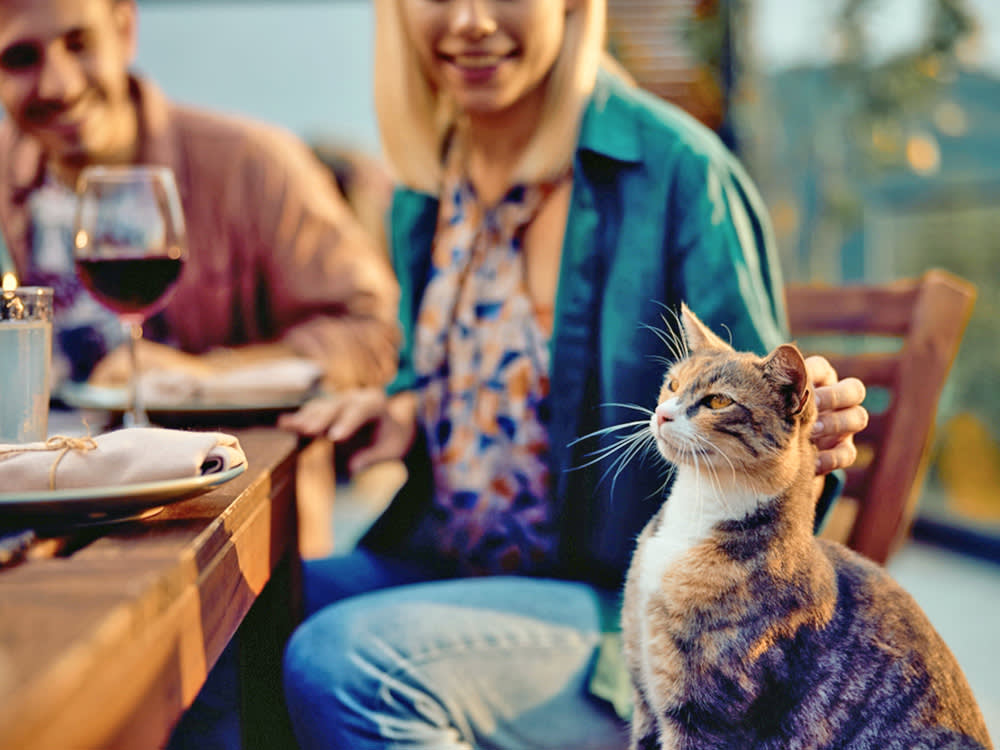
The tail comes first, laid across the edge of your plate. Then the cat, arranging themselves on the chair beside you like a guest who did not RSVP but clearly expects a place setting.
The obvious explanation is food. It is also mostly wrong, and you can tell because the behavior does not change when the food does. Cats who do this will do it when you are eating something they have no interest in. They will do it without begging, without a paw on your arm, without a sound. They will sometimes wander off, eat their own dinner, and come back.
So if it is not the chicken, what is it?
It is the sitting still. Dinner is very likely the longest uninterrupted stretch in your entire day during which you occupy one location, at a predictable time, and do not get up. Your cat has noticed this. Your cat has been waiting for it. And once you understand that the table is a stillness event rather than a food event, both the behavior and the fix stop being mysterious.
First, kill the pack theory
The instinct is to reach for dogs: pack animals, communal eating, the family meal. Cats are not that.
Cats can live happily alone or in groups, but they evolved to hunt and eat alone. A cat’s natural feeding pattern is a lot of small kills spread across the day, each consumed solo. There is no ancestral group dinner. Whatever is happening at your table, it did not come from a wolf.
What cats are is social in a way we consistently underestimate. Not a pack, and not the aloof loner of the stereotype either. They form real attachments, and the people they like get folded into the small circle of creatures they consider theirs. The evidence for that has gotten quite hard to argue with, and we will get to it.
The stillness argument
Think about your cat’s day from a foot off the ground.
You get up and move. You leave. You come back and move some more. You are in the kitchen for four minutes, the bedroom for two, on your feet, going somewhere, carrying something. From a cat’s perspective, you are a mostly unavailable, mostly moving object.
Then you sit down to eat. And for twenty or thirty minutes, you are stationary, at a known time, in a known place, in a good mood, with both hands occupied.
That is the single most reliable opportunity your cat has all day, and cats are exceptionally good at learning what is reliable. They thrive on predictable patterns. A dinner hour that lands in the same window most nights gets logged on their internal calendar with more precision than it holds on yours.
The tell that this is really about stillness and not food: the cat who sits with you through a meal they have no interest in. Not begging. Not vocalizing. Just present, occasionally looking at whoever is talking, holding a spot.
People describe this to me as their cat begging, and then when I ask what the cat actually does, it turns out the cat just sits there. That is not begging. That is a cat taking the only appointment you offer.
The finding that settles it
If you want the strongest evidence that a cat sitting next to you is not merely angling for chicken, it comes from an experiment that put the two options in direct competition.
In a 2017 study in Behavioural Processes, researchers presented cats, both pets and shelter cats, with stimuli from four categories: human social interaction, food, toys, and scent. Then they let the cats choose.
Human social interaction was the most-preferred category for the majority of cats. Food came second. That held for the pet cats and for the shelter cats.
There is real individual variation in there, and the honest reading is not “cats love you more than food,” which overstates it. The honest reading is that social contact with a person is a genuine, competitive reward for a cat, on par with dinner and ahead of toys. Which means “my cat only comes over because I have food” was never a safe assumption. Sometimes the person is the payoff.
Why some cats eat when you eat
The other half of the phenomenon: the cat who ignores their bowl all afternoon, then suddenly discovers it the moment you sit down with your own plate.
Two explanations, both plausible, and they can both be true of the same cat.
The cue explanation. Your dinner is a large, obvious, repeating signal, and your cat has associated it with theirs. You sitting down is the bell.
The company explanation, which is more interesting. For a small predator who is also potential prey, a meal is a bad time to be caught. Head down, jaws busy, attention on the bowl, senses committed to something other than the room. A cat who eats more readily with a trusted companion nearby may be doing exactly what that description suggests: outsourcing the watch.
The behavior is common enough to have a name in the behavior world, social eating, and it turns up especially in cats who have some history that makes eating feel risky, resource guarding, competition in a previous home, or generalized anxiety. But it is also just a personality quirk in plenty of cats with no history at all. Not everything is a wound.
Curiosity, briefly
The dull, un-poetic third factor. Cats sleep for most of the day. When plates clink and a warm, complicated smell moves through the apartment, the natural response of an animal built to investigate movement and scent is to come and investigate. Some of your dinner guest is bonding. Some of it is a cat who was asleep and now is not.
What to actually do about the tail in your food
You are not going to extinguish this, and you would not enjoy the result if you did. What you can do is relocate it, because the underlying motivation, be near you while you are still, does not require your cat to be on the table.
- Give them a designated seat. A stool, a chair, a cat tree beside the table. The key is height: your cat wants to be at your level and see the room, and a spot on the floor does not deliver that. Meeting the height requirement is most of the battle.
- Make that spot pay. A treat delivered there when they use it, especially early on. You are not fighting an instinct, you are giving it somewhere better to go.
- Feed them at the same time. If your cat is a social eater, put their bowl down as you sit. Two animals eating in companionable proximity is the outcome everyone wanted anyway.
- Do not feed from the plate. This is the one hard line, and it is where a companionable cat turns into a genuinely obnoxious one. Human food from your hand converts stillness-seeking into begging, and begging is a much worse habit to live with. It is also how a lot of cats end up overweight, one bite at a time.
What newer research adds
The field has spent the last decade dismantling the “cats are solitary and indifferent” story, and the dinner table is one of the places you can watch it fall apart in your own home.
A 2023 review in the Journal of Veterinary Behavior went through the most persistent myths about domestic cat social behavior and made the case that these misconceptions have real costs for feline health, welfare, and management. The framing that cats do not need or want social contact has led to cats being left alone too long, housed without enrichment, and having their attachment behaviors misread as manipulation. Cats are, in the current understanding, facultatively social: capable of living alone, and fully capable of forming and valuing real relationships.
The preference research points the same way. When you give a cat a straight choice between a person and a bowl, the person wins as often as not.
So the next time your cat installs themselves on the chair beside you and drapes their tail into the mashed potatoes, resist the urge to read it as a con. They are not working you. They found the twenty minutes a day when you hold still, and they took them.
References
- Vitale Shreve, K. R., Mehrkam, L. R., & Udell, M. A. R. (2017). Social interaction, food, scent or toys? A formal assessment of domestic pet and shelter cat (Felis silvestris catus) preferences. Behavioural Processes.
- Delgado, M., & Dantas, L. M. S. (2020). Feeding Cats for Optimal Mental and Behavioral Well-Being. Veterinary Clinics of North America: Small Animal Practice.
- Vitale, K. R., Behnke, A. C., & Udell, M. A. R. (2019). Attachment bonds between domestic cats and humans. Current Biology.
- Delgado, M., et al. (2023). CATastrophic myths part 1: Common misconceptions about the social behavior of domestic cats and implications for their health, welfare, and management. The Veterinary Journal.
Common questions
Is my cat joining me at dinner because they want my food?
Sometimes, but usually not primarily. A cat who is genuinely begging is loud about it and will not let up. A cat who simply parks nearby without pressing for the plate is there for the company, and for the fact that you have finally stopped moving.
Is this pack behavior?
No. Cats are not pack animals and do not naturally hunt or eat in groups. Whatever is happening at your table, it is not a wolf instinct.
Why does my cat suddenly eat when I do?
Eating is a vulnerable, head-down moment for a small predator. Many cats are more comfortable eating with a trusted companion nearby. For others, your mealtime is simply a reliable cue that it is dinner time.
How do I stop my cat from getting on the table?
Give them somewhere better. A stool or chair beside you, at the same height, positioned so they can see you and the room. Reward them there. You are not removing the behavior, you are relocating it.
Dr. Kohl is a board-certified veterinary dentist with a particular interest in preventive oral care. She reviews all dental health content at The Pet Times and contributes practical guides on home dental routines, professional cleaning, and oral disease prevention.
Meet our experts ↗Keep reading
 TrainingYour Cat Isn't Seeing Ghosts. They're Seeing What You Can't.Nina Vasquez · 5 min
 TrainingYour Cat Is Not Judging You. Your Cat Cannot Judge You.Dr. Mara Chen · 9 min
 TrainingPaper Is the Best Cat Toy in Your House. It's Also a Trap.Dr. Ravi Mehta · 7 min
 TrainingYour Cats Don't Hate Each Other. They Just Don't Smell Like a Family Yet.Dr. Amara Solis · 9 min
 TrainingWhy a Cat Will Nurse a Duckling, and Why You Should Still Watch CloselyDr. Amara Solis · 6 min
 TrainingYour Cat Doesn't Care About the Bathroom. They Care That You Finally Sat Down.Dr. Priya Nair · 8 min