


Your Cat Doesn't Care About the Bathroom. They Care That You Finally Sat Down.
The bathroom isn't a magic room. It's the one place in the house where you're still, quiet, at their eye level, and not looking at a screen. Here's what your cat is actually responding to, and the one version of this that isn't cute.

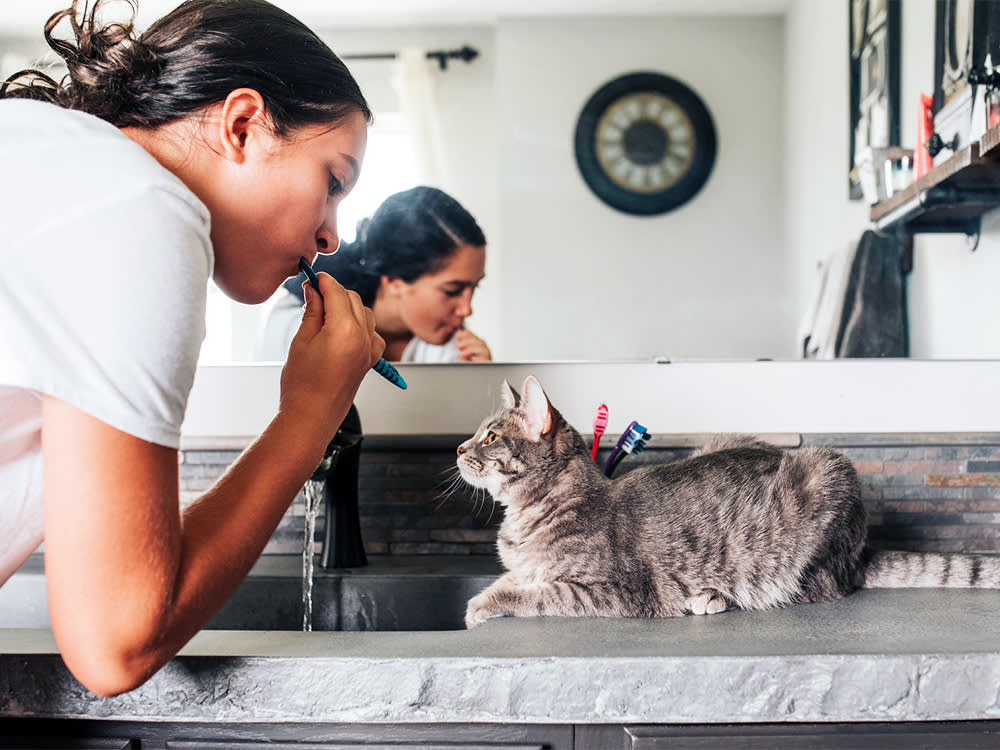
You close the bathroom door and something small and furry threads through the gap before it shuts. Now there is a cat on the bath mat, looking at you with an air of mild expectation, and neither of you is going to acknowledge how strange this is.
The usual explanations are that cats are weird, or nosy, or that they are guarding you at a vulnerable moment. There is a simpler one, and once you see it you cannot unsee it.
The bathroom is not special to your cat. You are. The bathroom is just the only room in the house where you become a good social partner: seated, still, quiet, at roughly their eye level, hands empty, not looking at a screen, and going nowhere for several minutes.
Your cat has not developed an interest in plumbing. Your cat has found the one predictable window in your day when you are actually available, and they have booked it.
What the room is actually offering
Run through what a bathroom looks like from about eleven inches off the floor, and the appeal stops being mysterious.
You stop moving. For most of the day you are a large, fast, distracted animal crossing rooms with purpose. In the bathroom you sit down and hold still. That is the single biggest thing on this list.
You come down to their height. Cats do a lot of their social negotiating at floor level, and you spend almost none of your day there. Suddenly your face is reachable.
Your attention has nowhere to go. No laptop, usually no phone, no dinner to make. From the cat’s side, this is the highest-quality attention available anywhere in the house, and they know precisely when it happens, because cats read routine extremely well. They know what time you shower. They know what the toothbrush means.
The door is usually shut. A room that is normally closed is, by definition, the most interesting room in the house. Cats want access to everything, and a door that is only sometimes open is a standing invitation to investigate.
It is full of good material. Running water they can drink, drip, and play with. A bathtub with cool, smooth sides and high walls, which is exactly the sort of container a small ambush predator likes to sit inside: hidden, protected, and able to spring out. Noisy shower curtains. A toilet roll that unspools when batted. Warmth and steam.
It smells like you. Overwhelmingly, comprehensively like you. For an animal that navigates the world by scent, this is the room where your signal is strongest.
And if the litter box lives in there, the bathroom is also their room, and they may simply be checking on their own territory, or pointing out that the box needs attention.
The thing your cat is really asking for
There is a second layer, and the science on it has moved a long way in the last few years.
Cats have a stubborn reputation as aloof animals who tolerate us for food. That reputation is, at this point, just wrong. In 2019, researchers at Oregon State ran cats through the Secure Base Test, the same protocol used to measure attachment in human infants and in dogs. A cat goes into an unfamiliar room with their person, the person leaves, the person comes back, and you watch what the cat does on the reunion.
About 65% of the cats were classified as securely attached: they used their person as a base, explored while that person was there, showed some distress at the departure, and settled back down on their return. That is very close to the figure found in human infants.
Which reframes the bathroom entirely. A securely attached animal wanting to be near their person during the one calm, predictable, undistracted stretch of the day is not eccentric behavior. It is the most normal thing in this article.
“People describe this as their cat being nosy, and then feel a bit silly for finding it sweet,” says Dr. Lena Park. “They should not. A cat choosing to sit with you in a quiet room and wait is a cat showing you an attachment behavior. The odd part isn’t that they follow you in. It’s that the bathroom is often the only slot we give them.”
There is also a strictly practical possibility worth keeping in mind. Some cats are not following you for company at all: they are using a moment when they know they have your attention to make a request. Watch what happens when you stand up. If your cat consistently leads you out of the bathroom and toward the food bowl, or toward the litter box, they were not there for the bonding. They were there because it is the one place they can reliably get you to follow them somewhere.
Devotion or distress: the line that actually matters
For most cats this is charming and needs no intervention. But there is one version that is not charming, and it is worth being able to name.
Bathroom-following on its own is normal. Bathroom-following as part of a cluster of behaviors around your absence is a different animal.
We have a real number for this now. A 2020 questionnaire study of Brazilian cat households found that 13.5% of cats showed at least one behavior consistent with a separation-related problem. The behaviors the researchers counted were specific:
- Destructive behavior
- Excessive vocalization
- Urinating in inappropriate places
- Defecating in inappropriate places
- Depression or apathy
- Aggressiveness
- Agitation or anxiety
The useful thing about that list is that it turns a vague worry into a check you can actually run. Ask what your cat does when you are not there, not what they do when you are.
A cat who follows you into the bathroom, sits pleasantly, and then gets on with their day when you leave the house is a well-attached cat with a routine. A cat who follows you into the bathroom, cries at the door when it closes, shadows you room to room, and then vocalizes, soils, or destroys things when you leave for work is telling you something else, and that cat deserves a conversation with your vet rather than a shrug.
What to do about it
If it doesn’t bother you, do nothing. This is a genuinely harmless habit and it is one of the few things a cat does that is unambiguously about wanting your company.
If it has tipped into something you want to dial back, work with the cause rather than the door.
Give the attention somewhere else, deliberately. This is the whole game. If the bathroom is the only reliable undistracted window in your cat’s day, the fix is to stop making it the only one. Set aside real time, ideally 30 to 60 minutes across the day in a few chunks, for play and contact where you are not also doing something else. Most cats who are frantic about the bathroom get noticeably calmer about it once they are being paid elsewhere.
Try leaving the door open. Counterintuitive, and often effective. A permanently closed door is a mystery to be solved. A door that is just open, in a room that is just a room, loses most of its pull.
Build them somewhere better to be. A bed, a perch, or a covered spot of their own near where you tend to be, stocked with things worth having. You are not evicting them, you are competing for their attention with a better offer.
Do not punish the following. Shouting at, spraying, or shutting out a cat who is seeking you is a good way to make an anxious cat more anxious, and it does nothing about the reason they came.
Take the hint on the litter box. If the box is in the bathroom and your cat is escorting you in there and then making a point of it, look in the box. Cats are extremely particular, and a cat who has to interrupt you to file a complaint is a cat whose complaint has been outstanding for a while.
Do they know what’s going on in there?
Slightly more than you would like.
Cats have excellent hearing and a formidable sense of smell, and they are watching. Behaviorists routinely report cats who, after enough observation, start experimenting with toileting in the bathtub or the toilet themselves. Cats imitate. It is not a coincidence that the animal watching you use a bathroom is the animal most likely to try it.
Which is either delightful or unsettling, depending on which of your cats it happens to be.
What newer research adds
The biggest change is that the “cats are aloof” story has quietly collapsed. The attachment work from 2019 showed that most cats form the same kind of secure bond with their person that infants and dogs do, and later work has kept pointing the same way: cats recognize their own names, they read our emotional signals, and they prefer human interaction over food more often than people expect. Following you around is not a quirk to be explained away. It is what an attached animal does.
The second change is that we now take feline separation problems seriously, which is new. Because the destructive, vocal, house-soiling version of this looked so different from the dog version, it went largely unexamined for years. The 2020 work put a number on it, roughly one cat in seven, and gave clinicians a concrete list of behaviors to ask about.
So the practical takeaway has flipped. The cat on your bath mat is not being weird, and you do not need to fix them. The only question worth asking is what that same cat does when you are not home.
References
- Vitale, Kristyn R., Alexandra C. Behnke, and Monique A. R. Udell. “Attachment Bonds Between Domestic Cats and Humans.” Current Biology, vol. 29, no. 18, 2019, pp. R864-R865. https://doi.org/10.1016/j.cub.2019.08.036
- de Souza Machado, Daiana, et al. “Identification of Separation-Related Problems in Domestic Cats: A Questionnaire Survey.” PLOS ONE, vol. 15, no. 4, 2020, e0230999. https://doi.org/10.1371/journal.pone.0230999
- Turner, Dennis C. “A Review of Over Three Decades of Research on Cat-Human and Human-Cat Interactions and Relationships.” Behavioural Processes, vol. 141, 2017, pp. 297-304. https://doi.org/10.1016/j.beproc.2017.01.008
- Turner, Dennis C. “Unanswered Questions and Hypotheses About Domestic Cat Behavior, Ecology, and the Cat-Human Relationship.” Animals, vol. 11, no. 10, 2021, p. 2823. https://doi.org/10.3390/ani11102823
- “Social Behavior of Cats.” Merck Veterinary Manual. https://www.merckvetmanual.com/behavior/normal-social-behavior-and-behavioral-problems-of-domestic-animals/social-behavior-of-cats
Common questions
Does it mean anything that my cat is female, or male?
No. There is no meaningful link between a cat's sex and whether they follow you into the bathroom. People ask this constantly and the honest answer is that it is not a sex difference, it is an attention difference. Look at how much undistracted time that cat gets from you during the rest of the day.
Why does my cat stare at me or guard the door while I'm in there?
Some of it is protectiveness, in the loose sense that you are a resource they are invested in. Most of it is simpler: you are stationary, you are at their height, and they are waiting for the part where you notice them. A cat sitting on the bath mat facing the door is not standing guard so much as parking themselves in a room where the good thing is about to happen.
Is it bad to just shut the door?
It is not cruel, but on its own it usually backfires. A closed door is more interesting than an open one, and a cat who is scratching and yowling at it is now practicing exactly the behavior you want less of. If you are going to close the door, pair it with real, scheduled attention elsewhere in the day, so you are not simply cutting off their only reliable window.
My cat tries to get into the shower or drink from the tap. Why?
Running water is fresh water, and cats are built to prefer it over standing water, which in the wild is more likely to be stale. It is also cool, it moves, and it makes noise, which makes it a toy as much as a drink. If your cat is genuinely obsessed with the tap, a water fountain is a reasonable buy and often improves their overall water intake.
Dr. Nair is a veterinarian focused on diet and feeding. She covers everyday nutrition, treats, and the many "can they eat this?" questions owners ask, grounding each answer in what is actually safe and sensible for dogs and cats.
Meet our experts ↗Keep reading
 TrainingYour Cat Isn't Guarding You in the Bathroom. They Hate the Door.Dr. Nina Kohl · 6 min
 LivingYour Cat Isn't Embarrassed. Misreading That Scramble Is How People Make Cats Anxious.Dr. Nina Kohl · 6 min
 LivingThe Shoulder-Cat Photo Everyone Tried to Copy. Here's Why Yours Won't Work.Sara Lim · 6 min
 TrainingYour Cat Isn't Being a Jerk When They Swat Things Off the Table. They're Running an Experiment.Dr. Nina Kohl · 5 min
 LivingYour Cat Isn't Jealous of Your Sex Life. It's Mad About the Door.Dr. Priya Nair · 5 min
 TrainingYour Cat Isn't Seeing Ghosts. They're Seeing What You Can't.Nina Vasquez · 5 min