


Your Cat Isn't Seeing Ghosts. They're Seeing What You Can't.
That spooky stare at the empty corner isn't a spirit. It's a cat picking up a real, physical world your senses miss entirely, and here's what's actually out there.

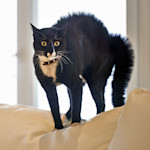
It’s late, the house is quiet, and your cat is locked onto a spot on the wall where there is absolutely nothing. Their ears swivel. Their pupils go wide. And a small, irrational part of you thinks: what do they see that I don’t?
Here’s the honest answer, and it’s more interesting than a ghost. Your cat almost certainly isn’t watching a spirit drift across the room. They’re doing something arguably stranger: perceiving a real, physical layer of the world that your body isn’t built to detect. The haunted-house feeling isn’t coming from the cat. It’s coming from you, filling the silence with a story. Cats have been tangled up with the supernatural for thousands of years, and it says a lot more about us than about them.
We’ve always wanted cats to be magic
The instinct to read something spooky into a cat’s behavior is ancient. The Egyptians treated cats as vessels of divine energy. Sailors brought them aboard ships for luck. And the association has stuck: roughly 41 percent of people say they believe in ghosts, and if you’re one of them, it’s easy to hang an eerie meaning on your cat’s odder moments.
Cats don’t speak our language, but they’re deeply tuned in to other cats and to the world around them. Whether any of that tips into the supernatural is, generously, up for debate. What’s not up for debate is that their hardware is genuinely better than ours in ways that produce exactly the “seeing something invisible” effect.
The senses that leave ours in the dust
Cats evolved as small, crepuscular hunters, and their bodies are optimized to catch signals we lose entirely.
They see in near-darkness. A cat’s eyes gather far more usable light than ours, so a room that reads as pitch black to you can still hold visible movement for them, the flick of a moth, a mouse’s shadow.
They hear a wider world. Feline hearing runs several times more sensitive than a human’s, and it reaches frequencies both far above and far below our range. The faint electronic whine of a device, a rodent scratching inside a wall, the ultrasonic squeak of prey, your cat catches all of it while you hear a quiet room.
They feel the air. Whiskers aren’t decoration. They register subtle shifts in air current and temperature, essentially letting a cat “touch” a space without contact. A door opening two rooms away can move enough air to register.
They read light differently. Cats don’t see the rich color spectrum we do, but their vision is sharper in other ways: they detect the subtle flicker of fluorescent bulbs that we perceive as steady light, and they judge distance with real precision.
They pick up UV. There’s evidence cats can perceive some ultraviolet light, which means surfaces and marks that look blank to us may not be blank to them at all.
The stuff that isn’t even one of the five senses
It goes further than sight, sound, and touch. Cats appear able to detect seismic vibrations, shifts in the atmosphere, and possibly electromagnetic fields. One of the best-documented examples: cats sense changes in barometric pressure, which is why a cat may seem to “predict” a storm, going restless or hiding an hour before the sky turns. They’re not psychic. They’re reading a pressure drop your inner ear ignores.
We still don’t fully understand how a cat’s brain assembles all this input, and we can’t just ask them what they noticed. So when your cat reacts to “nothing,” the most likely explanation is that something in their environment shifted, and they’re deciding whether it’s safe or worth bolting from.
Why the empty-corner stare feels so creepy
You’ve seen the classic scene: your cat fixes on a stairway, a blank wall, or you, and holds it. Or they hide for no reason, or hiss at thin air, while you ask out loud, “What are you doing?”
Two things are true at once. First, cats do plenty of things that make no sense to us, and staring into space or spooking at nothing is squarely in the normal range. Second, “we can’t see the cause” is not the same as “there is no cause.” Often there’s a real trigger, a sound, a scent, a flicker, that’s simply below your threshold. And sometimes, like us, cats just misread a situation and react with alarm to something harmless. A jumpy cat isn’t a haunted cat.
The breeds people call “psychic”
Folklore loves to tie black and tortoiseshell cats to the spirit world. Science hasn’t handed any cat supernatural powers, but some breeds are notably more alert and switched-on, quicker to clock anything unusual in their surroundings. A few of the ones often called the most perceptive:
- Abyssinian
- Bengal
- Cornish Rex
- Siamese
- Burmese
- Scottish Fold
These cats aren’t sensing the beyond. They’re just paying closer attention than the average nap-forward housecat, which makes their reactions more dramatic and easier to romanticize.
What science will actually commit to
On ghosts, science is agnostic at best, and it certainly hasn’t shown that cats perceive them. What research does support is more grounded and, frankly, more useful: cats notice subtle environmental changes we miss, they respond instinctively and without ulterior motive (so their reactions can look abrupt or startling), and they’re genuinely good at reading us. Cats can pick up on their humans’ emotions and even detect when we’re stressed, reading our non-verbal cues much the way dogs do.
So, do any animals see ghosts?
There’s no way to prove it either way, which is exactly the gap our imaginations rush to fill. When we spend our lives beside an animal, we anthropomorphize them, we hand them our meanings. If you believe in ghosts, it’s natural to project that onto the cat frozen at the wall, because it makes the moment mean something. Strip the projection away and you’re left with the real marvel: an animal sharing your living room while quietly living in a bigger sensory world than you’ll ever experience. No spirits required.
References
- Ballard, R. “Are Ghosts Real? A Social Psychologist Examines the Evidence.” The Conversation, University of South Carolina.
- Cornell Feline Health Center. “Feline Behavior Problems and Senses.” vet.cornell.edu
- Quervel-Chaumette, M., et al. “Emotion recognition in cats.” Animal Cognition.
- BBC Science Focus. “How can my cat know that a thunderstorm is on its way an hour before I do?” sciencefocus.com
Common questions
Can cats really see ghosts?
Science can't even confirm ghosts exist, let alone that cats perceive them. What's well established is that cats have far sharper senses than we do, so they routinely react to real stimuli, sounds, movements, pressure changes, that we simply can't detect.
What can cats sense that humans can't?
Quite a lot: near-total darkness, a much wider range of sound frequencies, tiny air currents and temperature shifts through their whiskers, some ultraviolet light, and changes in barometric pressure. What looks like a reaction to nothing is usually a reaction to something you can't perceive.
Can cats sense a bad person?
Cats are good at reading emotional cues and detecting threat, so they may pick up on tension, fear, or unusual body language faster than you do. That's perception and instinct, not a moral judgment or a sixth sense.
Nina Vasquez writes about life at home with pets and the relationships at the heart of it. Her work covers day-to-day living, people-and-pet stories, and the products that fit into a real household, with a warm, grounded take on everyday pet ownership.
Meet our experts ↗Keep reading
 TrainingYour Cat Doesn't Care About the Bathroom. They Care That You Finally Sat Down.Dr. Priya Nair · 8 min
 TrainingYour Cat Isn't Attacking the Wall. Read the Spot.Dr. Amara Solis · 7 min
 TrainingThat Old Sweater Isn't Comforting Your Cat. It's Just Soft.Dr. Mara Chen · 8 min
 LivingYour Cat's Eight Nap Spots Are a Map. The Cat Who Stops Moving Is the Worry.Sara Lim · 7 min
 TrainingWhy a Cat Will Nurse a Duckling, and Why You Should Still Watch CloselyDr. Amara Solis · 6 min
 TrainingThat 'Come Here' Cat Video Works. Your Own Voice Works Better.Dr. Lena Park · 7 min