


That 'Come Here' Cat Video Works. Your Own Voice Works Better.
People play recordings of cat calls to lure a hiding cat out. It is not cruel, and it is not useless. But the research on how cats actually listen says you already own the more powerful tool, and you are underusing it.

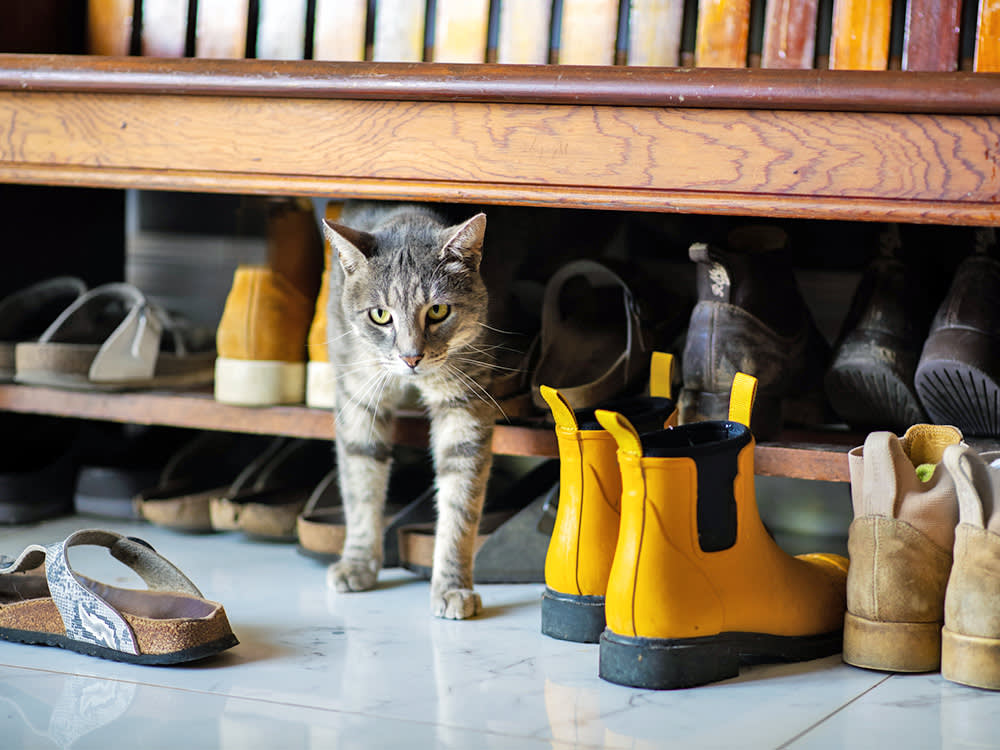
There is a small, slightly guilty ritual happening in living rooms everywhere. You are on the couch. You are warm. You would like the cat, and the cat is somewhere else. So you open your phone, find one of those videos of a cat making the chirpy trill that seems to mean come here, and press play.
The cat appears. You feel like a wizard, and also like a fraud.
The internet is genuinely uneasy about this. Reddit threads circle the same worry: is it unkind to summon a cat with recorded meows, and does the cat come away feeling conned? One popular reply reaches for an unsettling analogy, imagining that from the cat’s side it might be like hearing an intruder break in and then discovering someone you love who wants a cuddle. Alarming, and corrosive to trust.
That is a vivid image, and it is almost certainly wrong. But the instinct underneath it is right, just aimed at the wrong thing. The problem with the trick is not that it is cruel. The problem is that it is weak, and you are ignoring a much stronger tool that is already in your throat.
First, the vets: it is not cruel
Let us dispose of the guilt.
The veterinary consensus is unbothered. Cats are curious, communicative animals, and a recording that imitates another cat is a fairly benign way to get their attention, so long as you are thoughtful about it and not stressing the animal out. The more relaxed reading is that the videos simply do no damage: your cat might find the noise soothing, or might just wonder why on earth you are producing it. Cats vary wildly in what draws them out from under the bed, and a can opening, a treat bag rattling, or their own name being called will very often do the same job.
So: not cruel. Fine occasionally. Not a betrayal.
But notice what is buried in that answer. Their own name works just as well. Hold onto that, because the science has quite a lot to say about it.
The research says your voice is the special one
Here is what makes the recording trick a strange choice, once you know how cats actually process sound.
Cats can recognize their own names. In a 2019 study published in Scientific Reports, researchers played cats a recording of their owner’s voice reciting a list of four nouns or other cats’ names, followed by the cat’s own name. Using a habituation method, they first bored the cats with similar-sounding words until the animals stopped responding, then dropped in the real name. The cats reacted more to their own names, moving their ears, heads, or tails, than to the decoys.
More striking is the follow-up work on who is talking. A 2022 study in Animal Cognition found that cats discriminate speech directed at them from speech directed at humans, and respond to that high-pitched, sing-song cat-directed voice, but they do it only when it is their own person speaking. The same baby-talk from a stranger did not move them.
Sit with the implication. Your cat has, over years, built a specific model of you: your voice, your cadence, the particular ridiculous register you drop into when you are talking to them. That signal is unique, it is loaded with history, and it predicts good things. It is the strongest audio channel you will ever have with this animal.
A stock recording of an unfamiliar cat trilling on YouTube has none of that. It is a novelty. It works the way a can opener works: it grabs attention, once, because it is interesting.
People reach for the video because their own voice stopped working, and their own voice stopped working because they burned it. If you call your cat’s name twenty times a day and nothing ever happens afterward, you have taught them that their name means nothing. The recording is a workaround for a problem you can just fix.
Which is the actual failure mode
Now the Reddit worry can be restated correctly.
The risk is not that your cat feels deceived by a foreign sound. Cats are not running a betrayal calculus. The risk is habituation, and it is the same mechanism the 2019 study used deliberately: a signal that predicts nothing stops being a signal.
Every time you play the trill and the cat arrives to find no cat, no food, no game, nothing, you have devalued the trill. Every time you call their name for no reason, you have devalued their name. Cats are exquisitely good at learning which of your noises are load-bearing and which are ambient.
So use the trick sparingly, if at all. And when your cat responds to anything you have called, pay it off. A treat, a scratch, a game, a lap. That is not spoiling the cat. That is maintaining the channel.
Context is the whole rule
There is one situation where the recordings are genuinely a bad idea, and it is exactly the situation people most want to use them in.
A shy cat, or one who is simply tucked somewhere secure and perfectly calm, can be coaxed out with these sounds and be none the worse for it. Flip the context, though, and the same recording becomes a liability. A cat who is frightened, or sitting in the wreckage of a stressful event, a house move, a party, a fight, is a cat for whom one more unexplained noise is one more thing to be alarmed by. Fear, stress, and illness are the three reasons cats hide in the first place, and dragging one out against their will tends to raise the anxiety rather than lower it.
That is worth pausing on, because it inverts the intuition. The moment when you most want the cat out from under the bed, when they are frightened and you want to comfort them, is the moment when adding a strange, disembodied cat sound to the room is least helpful. You are pouring more unpredictability into an environment the cat has already flagged as unpredictable.
Respect the hiding place. A cat who can disappear is a cat who can calm down.
What actually works, in order
The methods below are ranked by strength, which is roughly the reverse of the order most people try them in.
1. Your voice, in your usual register, using the words and sounds they associate with you. This is the tool the research says is genuinely special. Use it, and make sure it means something.
2. Food, treats, or the favourite toy. Shaking a treat bag or producing the one toy works for a reason that is not luck. Those are signals your cat has already learned to trust, which makes them clearer, not just louder, than a stranger’s meow.
3. Catnip or a calming pheromone, if your cat is one of the ones who responds. These work on anxiety rather than on curiosity, which is the correct lever when fear is what put the cat under the sofa.
4. Patience. The veterinary recommendation here is unglamorous and entirely right: make the room quiet and safe, then stop trying. A cat who feels secure will emerge on their own schedule, and they always do.
And if you do use the cat sounds, watch the response rather than the result. Curious, ears forward, ambling out? Fine. Confused, frozen, wide-eyed, backing further in? Stop, and switch to food or soft talking.
The one time to stop guessing and call the vet
Hiding is a behavior with three causes, and only two of them are about mood.
Cats hide when they are scared. Cats hide when they are stressed. And cats hide when they are unwell, which is the one people misread as sulking.
If the hiding is new and you cannot explain it, or if it comes alongside a cat who is not eating, not drinking, not using the litter box, or has stopped keeping themselves groomed, do not spend the afternoon experimenting with YouTube. Call your veterinarian and rule out an underlying medical problem. A cat who feels terrible does exactly what a cat who feels frightened does, and they are counting on you not to be able to tell the difference.
References
- Saito, A., Shinozuka, K., Ito, Y., & Hasegawa, T. “Domestic cats (Felis catus) discriminate their names from other words.” Scientific Reports, 2019. https://www.nature.com/articles/s41598-019-40616-4
- de Mouzon, C., Gonthier, M., & Leboucher, G. “Discrimination of cat-directed speech from human-directed speech in a population of indoor companion cats (Felis catus).” Animal Cognition, 2022. https://link.springer.com/article/10.1007/s10071-022-01674-w
- Saito, A., & Shinozuka, K. “Vocal recognition of owners by domestic cats (Felis catus).” Animal Cognition, 2013. https://pubmed.ncbi.nlm.nih.gov/23525707/
- AAFP and ISFM. “Feline Environmental Needs Guidelines.” Journal of Feline Medicine and Surgery. https://journals.sagepub.com/doi/10.1177/1098612X13477537
- Cornell Feline Health Center. “Recognizing signs of illness and pain in cats.” https://www.vet.cornell.edu/departments-centers-and-institutes/cornell-feline-health-center
Common questions
Will it damage my cat's trust in me?
There is no evidence that it does lasting harm, and vets consider it harmless. But the honest answer is that if your cat comes running for a sound and finds nothing, you have spent a small amount of credibility for nothing. The same is true of calling their name and offering no reason. Pay the call off.
My cat is hiding and won't come out. When should I worry?
Hiding is normal after a move, a loud event, or a change in the household. It becomes a medical question when it is new and unexplained, or when it comes with not eating, not drinking, not using the litter box, or not grooming. Cats hide when they are scared, stressed, or unwell, and the third one is easy to miss. Call your vet.
Dr. Park is a board-certified emergency and critical care specialist. She reviews our health and safety content for clinical accuracy and contributes guides on recognising urgent conditions. Her focus is helping owners act quickly and correctly when it matters most.
Meet our experts ↗Keep reading
 TrainingYour Cat Is Not Judging You. Your Cat Cannot Judge You.Dr. Mara Chen · 9 min
 LivingYour Cat Has Been Asking for the Same 7 Things. You Keep Hearing 'More Cuddles.'Dr. Priya Nair · 8 min
 LivingYour Cat Isn't Watching You Cook. He's Reading the Room.Dr. Mara Chen · 7 min
 LivingYour Cat's 5 A.M. Screaming, Translated (and Why It Really Happens)Tom Hadley · 4 min
 LivingThe Shoulder-Cat Photo Everyone Tried to Copy. Here's Why Yours Won't Work.Sara Lim · 6 min
 TrainingYour Cat Isn't Begging at Dinner. They're Waiting for You to Sit Still.Dr. Nina Kohl · 7 min