


Why a Cat Will Nurse a Duckling, and Why You Should Still Watch Closely
Cats adopt orphaned puppies, bunnies, even ducklings, and nurse them as their own. The instinct behind it is real and powerful. So is the reason it can flip without warning.

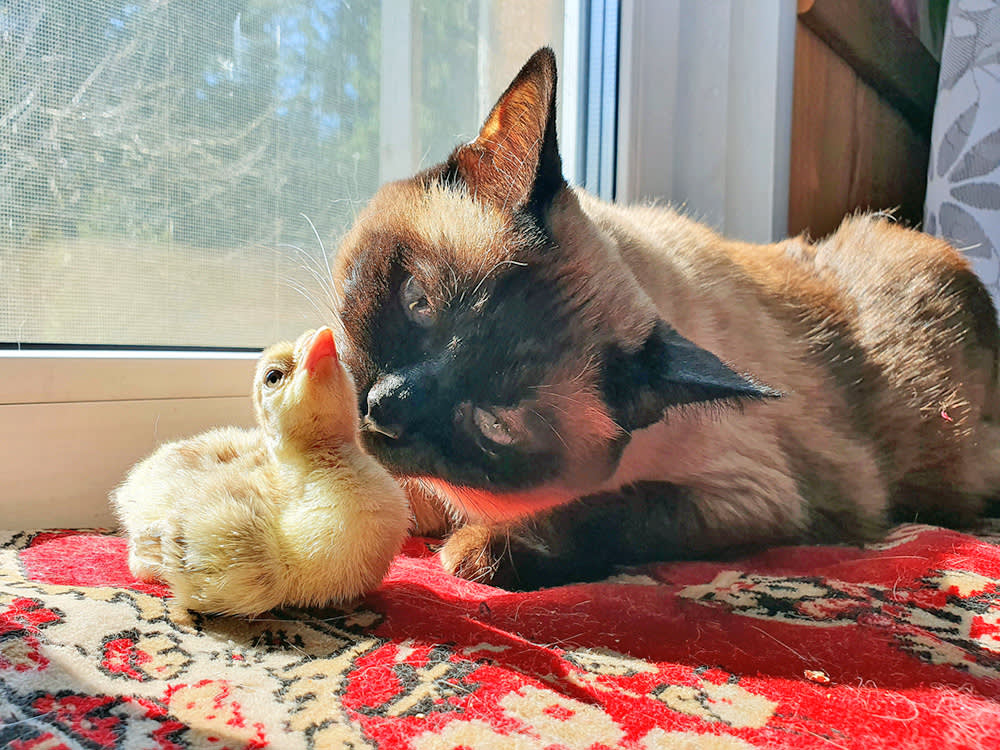
Search “cat adopts” on any video platform and you will fall into a well of the internet’s most disarming footage: a cat curled around a litter of orphaned puppies, a cat grooming a baby squirrel, a cat letting a duckling burrow into her fur. These clips go viral with the reliability of a metronome, and for good reason. There is something about care that crosses the line between species that feels purer, deeper, more moving than the ordinary kind.
The instinct behind it is genuinely remarkable. It is also worth understanding clearly, because the same drive that makes those videos so tender is one you have to respect rather than trust blindly.
The instinct that overrides everything
When a cat gives birth, something switches on that is close to a program running. “It’s almost like giving birth causes these mother cats to run a software program of things they need to do,” says Stephen Quandt, a certified cat behaviorist. “It’s all programmed in. And those instincts are so strong that it overrides any other feelings that might exist.”
Strong enough, often, to override the question of whether the babies are even hers. Shelters lean on this constantly. “We often put orphaned kittens in with lactating moms, who then begin nursing and providing for them right away,” Quandt notes. A cat in full maternal mode does not run a paternity check. She responds to something small, warm, and crying, and her body and behavior take over.
That drive does not always stop at kittens. Veterinarian Dr. Kathryn Dench, chief scientific advisor at Paw Origins, has seen it reach further. “In clinic and rescue settings, I’ve also seen cats ‘adopt’ orphaned puppies, baby squirrels, and even ducklings. Grooming, protecting, and even attempting to nurse them,” she says.
The stereotype gets the truth backwards
There is an old insult, some version of “a cat would make a better mother,” aimed at inattentive human parents. It rests on the idea that cats are careless mothers. The idea is simply wrong.
“Most cats are instinctively excellent mothers,” says Dr. Dench. “Good maternal behavior in felines includes grooming, nursing, guarding, and teaching kittens survival behaviors. Even in a domestic setting, where hunting and predation risks are removed, these instincts remain hardwired. Mother cats will often reposition their young, respond to cries, and may even restrict access to their litter to protect them.”
There is a simple evolutionary logic to this. If cats were generally bad mothers, the species would either have evolved kittens that could fend for themselves from birth, or it would not have persisted at all. Helpless newborns and a thriving species only coexist when the mothering is good. The weaning that comes later, when a mother pushes her growing kittens toward independence, is not evidence of coldness. Pushing a child to stand on its own is part of good parenting too.
Sometimes it isn’t mothering at all, just friendship
Not every cross-species bond runs on maternal instinct. Cats also form ordinary, deep friendships with other animals, no nursing involved.
“When I was a child, I had a rabbit who was extremely close with one of our cats,” Dr. Dench recalls. “They slept side by side, snuggled up together, and shared food, their bowls lined up in a row like equals at the dinner table.” The cat and rabbit coexisted peacefully for years, a companionship that ignored the fact that, in another context, one of those animals is prey and the other is a hunter.
These bonds are real. They are also, as that framing hints, the exact place where caution has to enter the story.
The part the feel-good videos leave out
Here is the distinction that matters most, and it is the reason this article exists rather than just another montage of sweet clips: a cat’s predatory instinct is suppressed in these bonds, not deleted.
The gentlest cat in the world is still a predator with the safety off, not the trigger removed. A bond with a rabbit or a bird can be completely genuine and still end badly in a single startled second. That is not a reason to fear your cat. It is a reason to never leave that pairing alone unsupervised, no matter how long they have gotten along.
Dr. Dench has seen the failure mode firsthand. “While true affection can exist between a cat and a prey animal, a cat’s predatory instincts may still be triggered by fast movement, high-pitched squeaks, or vulnerability due to illness. I’ve seen rare but heartbreaking cases of cats that peacefully coexisted with small pets for months, only to suddenly attack them during a moment of stress, hunger, or overstimulation.”
Two more warnings follow from this. A cat that bonds with your pet rabbit has not made peace with rabbits in general; it may treat the next one as prey. And a cat that is sweet with you and every human guest is telling you nothing about how it will treat another animal. Gentleness toward people does not transfer. As Quandt puts it bluntly: “Food is food.”
If you want to try an introduction
None of this means cross-species households are off limits. It means doing them with your eyes open.
The best odds come early. “The best time to do it is probably when your cat is still a very young kitten,” Quandt says, “before they learn the predatory skills that would otherwise put that animal at risk.” A bond formed before those hunting patterns lock in has the best chance of holding as the cat grows.
For an adult cat, start by reading your cat honestly. “Confident, well-socialized, and easygoing cats are more likely to accept other animals,” Dr. Dench says. “If your cat is fearful, territorial, or predatory by nature, introductions must be especially cautious.” Go slow: scent-swapping before any face-to-face meeting, then gradual, barriered visual introductions using baby gates or carriers. Watch for stalking, fixation, or a hard predatory stare. Those are not quirks to push through. They are stop signs.
Marvel at your cat’s capacity to love across the usual lines. It is one of the genuinely beautiful things they do. Just never forget the animal underneath the tenderness is, and always will be, a cat.
This article covers safety around predatory behavior, which is a sensitive area for anyone with both a cat and a small prey-species pet. When in doubt about a specific pairing, your veterinarian or a certified behaviorist can assess your individual animals.
References
- “Interspecies relationships in cats.” Expert commentary from Stephen Quandt (Cat Behavior Help) and Dr. Kathryn Dench (Paw Origins).
- American Society for the Prevention of Cruelty to Animals (ASPCA), guidance on introducing cats to other animals. aspca.org
Common questions
Why do mother cats adopt other animals?
A nursing cat's maternal instincts are so strong that they can override her sense of who does and does not belong to her. Shelters use this deliberately, placing orphaned kittens with a lactating mother who starts nursing them right away. That same drive sometimes extends to puppies, squirrels, or other small animals.
Are cats actually good mothers?
Most are, despite the old stereotype. Typical feline mothering includes grooming, nursing, guarding, repositioning kittens, responding to cries, and teaching survival skills. If cats were generally poor mothers, the species could not have survived as it has.
Is it safe to let my cat bond with a small pet like a rabbit or bird?
It can happen, but it requires constant supervision and caution. A cat's predatory instinct can resurface suddenly, triggered by fast movement, a high-pitched squeak, or the small animal being ill or vulnerable. Never leave a cat unsupervised with a prey-species pet, even if they have gotten along for months.
Dr. Solis is a board-certified veterinary dermatologist with over twelve years of clinical experience. She advises on skin conditions, allergies, and grooming practices that affect coat and skin health. All dermatology and allergy content at The Pet Times is reviewed by her team before publication.
Meet our experts ↗Keep reading
 LivingYour Cat Isn't Jealous of Your Sex Life. It's Mad About the Door.Dr. Priya Nair · 5 min
 TrainingThat Old Sweater Isn't Comforting Your Cat. It's Just Soft.Dr. Mara Chen · 8 min
 LivingYour Cat's Eight Nap Spots Are a Map. The Cat Who Stops Moving Is the Worry.Sara Lim · 7 min
 LivingMy Cat Has Never Once Felt Awkward. I'm Taking Notes.Sasha Ford · 5 min
 TrainingYour Cat Isn't Getting 'Brain Rot' From That Video. It Thinks It's HuntingDr. Ravi Mehta · 5 min
 LivingYour Cat Isn't Trying to Cuddle. They're Doing Math.Dr. Nina Kohl · 6 min