


Your Cat Isn't Getting 'Brain Rot' From That Video. It Thinks It's Hunting
The viral clips of cats hypnotized by a spinning green blob aren't the feline version of doomscrolling. A behaviorist explains what a cat is really doing when it locks onto the screen, and whether screen time is fine.

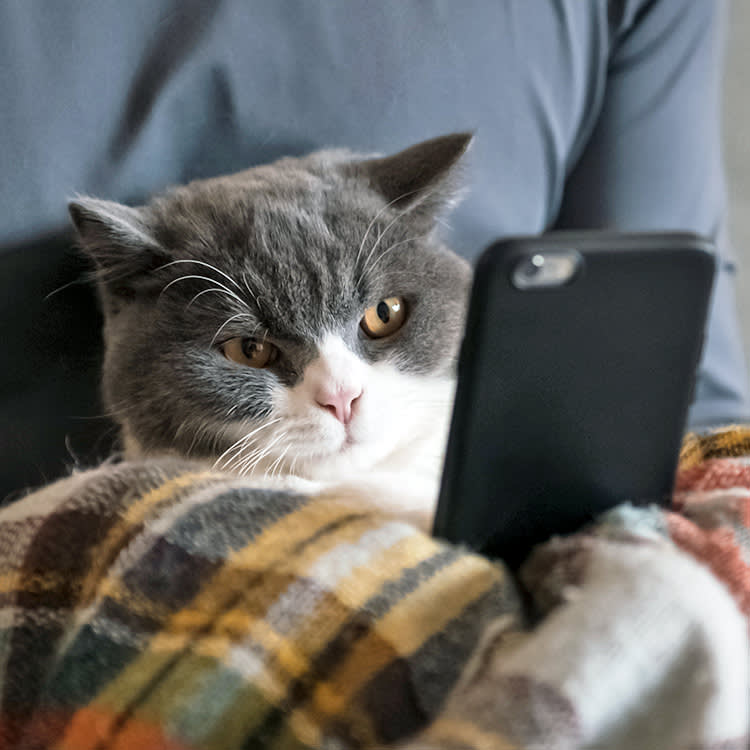
For a stretch of the internet, the funniest thing going was a cat sitting slack-jawed in front of a phone, apparently hypnotized by a spinning neon-green blob, captioned as the feline version of “brain rot.” The joke writes itself: we lose hours to mindless scrolling, so surely our cats do too. It is a charming idea and it is completely wrong, in a way that is more interesting than the joke. What the cat is doing on that screen is closer to the reverse of brain rot, and understanding the difference tells you something real about how your cat’s mind works.
What “brain rot” even means, and why it doesn’t fit a cat
“Brain rot” had a genuine cultural moment, crowned word of the year by Oxford’s lexicographers after its usage spiked, and defined roughly as the mental fog that comes from overconsuming trivial online content. Anyone who has surfaced from three unplanned hours in a feed knows the feeling: passive, dull, a little numb.
Now picture the cat in the viral clip. Its eyes are wide, pupils dilated, body still and coiled, attention nailed to the screen. That is not numbness. That is arousal. Which is the first clue that we are projecting a human experience onto an animal that is having a fundamentally different one.
What the cat is really doing: hunting a screen
The behavior has a straightforward explanation, and it is not mental deterioration.
When I watch these clips, I see a cat in predatory mode, not a cat zoning out. Motion is the trigger. A cat’s whole hunting system is built to lock onto things that move, and those dilated pupils mean the cat is pulling in as much visual information as it can. You see the same wide eyes when a cat is curious or gearing up to pounce. It is engagement, not decay.
Two features of these videos make them especially good at hijacking that system. The first is contrast. Cats see color only in muted blues, yellows, and grays, so the lime-green background is not vivid to them the way it is to us. What it does instead is act like a blank backdrop that throws the spinning subject into sharp relief, the way a moth is impossible to ignore against a bare wall but vanishes against a leafy hedge. Drop that same subject onto a cluttered, realistic scene and it would sink into the noise. The second is that the movement comes wrapped in sound, and a moving-plus-noisy target is exactly the signature of live prey a cat is wired to chase.
Sound, in fact, may do as much of the work as the picture. Cats hear far more than we do, especially up in the high frequencies, and the thin, tinny audio these clips are full of can be genuinely rousing to a cat. Individual cats lock onto specific pitches, too. A cat who ignores the television may still snap to attention at the reedy, compressed sound of a person’s voice leaking out of a phone speaker and go looking for its source.
Is letting a cat watch screens actually fine?
Here is the reassuring part. While screen time is a real worry for human kids, it is not much of a concern for cats, as long as you are not using a tablet as a substitute for real play. In behavior terms, a stimulating video is enrichment, and cats can generally use all the enrichment they can get, provided it entertains rather than stresses them. If your cat enjoys the clip and stays relaxed, it is fine.
There is also a natural ceiling that keeps it from becoming a problem. Cats have short attention spans, so even a cat with a screen running all day is unlikely to stare for hours, let alone develop anything resembling brain rot. The video is a snack, not a meal, and cats treat it that way on their own.
When zoning out is worth a second look
One honest caveat. Human brain rot looks like listlessness and disinterest, and a cat can genuinely zone out, staring at nothing for long stretches. That is different from the keyed-up screen-watching, and usually it is normal cat behavior. But if you notice real, persistent lethargy or a clear drop from your cat’s usual activity level, that is not a meme, it can point to an underlying health issue, and it is worth a vet check. Watching a bright video with big eyes is play. Checking out from everything is a symptom.
The bottom line
Calling it “cat brain rot” is a fun bit of anthropomorphizing, assigning our own habits to an animal whose experience we can only observe from the outside. But the label gets the behavior backwards. A cat glued to a spinning green video is not rotting its brain; it is running a predatory program on a moving, noisy target that its eyes and ears are built to chase. Enjoy the clips with your cat, keep them as a supplement to real play rather than a replacement, and save your worry for the day the cat stops engaging with anything at all.
References
- Oxford University Press. “‘Brain Rot’ Named Oxford Word of the Year 2024.” https://corp.oup.com/news/brain-rot-named-oxford-word-of-the-year-2024/
- Loop, Matthew, et al. “Color Vision in the Cat.” Journal of the Optical Society of America. https://opg.optica.org/
- Ellis, Sarah L. H. “Environmental Enrichment: Practical Strategies for Improving Feline Welfare.” Journal of Feline Medicine and Surgery. https://journals.sagepub.com/home/jfm
- Heffner, Rickye S., and Henry E. Heffner. “Hearing Range of the Domestic Cat.” Hearing Research. https://www.sciencedirect.com/
Common questions
Do cats actually get brain rot from videos?
No. Human brain rot means a zoned-out, listless state from overconsuming low-value content. The cats in these videos are the opposite: alert, dilated pupils, locked on. What looks like hypnosis is a predatory response to movement and sound, not mental mush.
Why are cats so drawn to the bright green cat video?
Mostly the motion and sound. A moving object plus interesting audio reads to a cat like prey through a window. The lime-green background mainly serves to make the spinning shape pop, since cats do not see color vividly.
Is screen time bad for my cat?
In moderation, no. Videos are a form of enrichment, and cats generally cannot get too much enrichment as long as it does not stress them. Just do not use screens to replace real interactive play with you.
Should I worry if my cat zones out a lot?
Watching a screen briefly is normal. But genuine, persistent lethargy or a change in your cat's usual activity can signal an underlying health issue and is worth a vet visit.
Dr. Mehta is a board-certified veterinary nutritionist who evaluates pet food formulations, ingredient quality, and the science behind dietary trends. He writes and reviews all nutrition content at The Pet Times, including our food rankings and feeding guides.
Meet our experts ↗Keep reading
 TrainingYour Cat Isn't Being a Jerk When They Swat Things Off the Table. They're Running an Experiment.Dr. Nina Kohl · 5 min
 LivingYour Cat Isn't Judging You. It's Running a Threat Assessment.Dr. Nina Kohl · 7 min
 LivingYour Cat Isn't Jealous of Your Sex Life. It's Mad About the Door.Dr. Priya Nair · 5 min
 LivingYour Cat's 5 A.M. Screaming, Translated (and Why It Really Happens)Tom Hadley · 4 min
 TrainingYour Cat Isn't Attacking the Wall. Read the Spot.Dr. Amara Solis · 7 min
 TrainingYour Cat Isn't Seeing Ghosts. They're Seeing What You Can't.Nina Vasquez · 5 min