


Your Cat Isn't Being a Jerk When They Swat Things Off the Table. They're Running an Experiment.
That 2 a.m. crash isn't spite. It's instinct, boredom, and a genuine curiosity about how the world falls. Here's what's really going on, and how to save your stuff without a spray bottle.

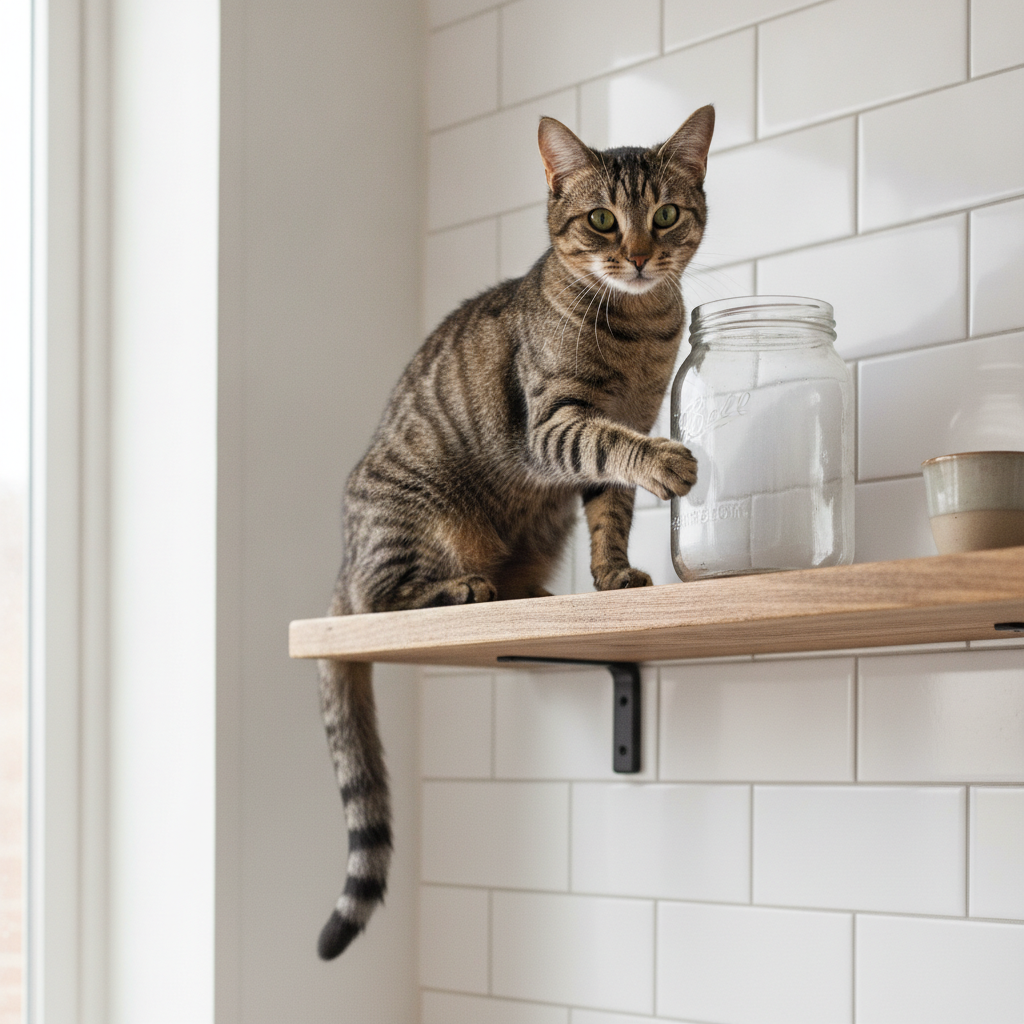
You know the sound. The deliberate pause, the paw, the slow push, and then the crash, your glass, your plant, your grandmother’s figurine, meeting the floor while your cat watches with what looks a lot like satisfaction. It is easy to take personally. It is almost never personal.
Cats do not knock things over to spite you, punish you, or start a fight. The behavior is a tidy little bundle of instinct, curiosity, and learning, and once you can see what is actually driving it, you can redirect it without turning your home into a battleground or reaching for a spray bottle (which, for the record, does not work and can make things worse).
What’s really going on
Almost everything a cat does traces back to instinct, and knocking things over is no exception. Their playfulness, their caution, their curiosity, and their need to understand their surroundings all feed into it. Underneath the specific triggers, this is a hunter’s brain testing its environment.
Here are the usual reasons, most of them perfectly ordinary:
- Boredom. Cats need mental and physical stimulation, and if you do not supply enough, they generate their own. Pushing objects around and watching them fall is entertainment, full stop.
- Learning what works. Cats are quick studies. If knocking something off the mantle reliably makes you drop everything and come running, they file that away. If tipping a glass gives them something to drink, that seems like a reasonable plan too.
- Exploring with their paws. Cats investigate the world by touch. A paw reaches out, the object moves, and the moving is interesting enough to justify the push that sends it over the edge.
- Checking out anything new. As both predator and prey, a cat has good reason to know exactly what is in their space. Bring home a new object, or move an old one, and your cat will want to inspect it, often by batting it off its perch.
- Genuine accidents. Cats squeeze through tight spots and rarely reroute around your stuff. Sometimes things simply get knocked off as they pass through.
- Play. There is no rule that a toy has to be marketed as a toy. To a curious, high-energy cat, anything reachable is fair game, and anything unreachable becomes a puzzle to solve.
Owners tell me their cat is doing it ‘to get back at them,’ and I always gently push on that. There’s no revenge in it. There’s a bored, clever predator who has learned that a crash produces a reaction. Change the payoff and you change the behavior.
How to save your stuff (without a spray bottle)
Two things solve this in tandem: protect the objects, and meet the need behind the behavior. Do only the first and your cat finds new targets. Do only the second and they still knock things over on the good days.
Manage the environment. Assume any surface is reachable, because your last cat’s habits do not predict this one’s. Tuck delicate items into glass-front cabinets, secure things you want to display with museum putty, and move valuables to wall shelves and hooks out of paw range. This is less about winning a fight and more about not staging one.
Meet the boredom head-on. The best antidote to attention-seeking and understimulation is giving your cat better outlets. You do not need big blocks of time; cats prefer frequent, short interactions. Toss a toy a few times while the microwave runs, set up a food puzzle when you refill your water, rotate what is available so it stays novel. Add mental enrichment, too, not just physical play, cats need to problem-solve, sniff, and use those sharp eyes, and a puzzle feeder does more for a restless cat than another hour of couch time.
Skip the punishment. This matters. Anything that works by making your cat uncomfortable or scared, spiked or electric mats, motion-triggered air blasts, and yes, the water bottle, tends to breed anxiety rather than teach a better choice. Stick with neutral deterrents that just make a surface less appealing, double-sided tape made for cats or a strip of crumpled foil, which are not painful but give your cat a reason to choose elsewhere. You usually will not need them forever.
Redirect without rewarding the crash. If your cat is winding up to knock something over for attention, do not come sprinting with a toy, that teaches them the plan worked. Interrupt neutrally instead: calmly pick them up and set them on the floor without a word, or call them over casually. Then wait a minute or two before offering play or a puzzle, so the good thing is not linked to the knocking. Positive reinforcement for the behavior you want, like sitting calmly next to the glass instead of swatting it, is what actually sticks.
What newer research adds
If it comforts you at all, your cat may be conducting something closer to physics than vandalism. In a 2016 study out of Kyoto University, published in the journal Animal Cognition, researchers led by Saho Takagi tested how cats respond to containers that rattle and objects that do, or do not, fall out as expected. The cats seemed to predict, from the sound, whether something should drop, and they reacted with confusion when the outcome broke the rules. The researchers suggested this hints at a rudimentary grasp of cause and effect, and even of gravity, an ability that would make evolutionary sense for a hunter who needs to locate unseen prey by sound.
The study has its critics, and no one is claiming your cat is doing homework. But it fits everything else we know. When your cat noses a pen to the edge of the desk and watches it fall, they are not being spiteful and they are not being random. They are a small predator gathering information about how their world behaves, and your coffee table just happens to be the lab. Give that brain better things to investigate, and the crashes get a lot rarer.
References
- Takagi S, et al. “There’s no ball without noise: cats’ prediction of an object from noise.” Animal Cognition, 2016. https://www.sciencedaily.com/releases/2016/06/160614114410.htm
- International Cat Care. “Environmental enrichment for indoor cats.” https://icatcare.org/advice/environmental-enrichment-for-indoor-cats/
- ASPCA. “Common Cat Behavior Issues.” https://www.aspca.org/pet-care/cat-care/common-cat-behavior-issues
Common questions
Do cats knock things over out of spite?
No. 'Spite' gives cats a grudge they don't hold. It's much more basic: instinct, curiosity, boredom, and learning. If knocking something over gets your attention or gets them what they want, they simply learn it works.
How do I stop my cat from knocking things off surfaces?
Manage the environment (museum putty, glass-front cabinets, wall shelves, moving valuables out of reach) and, just as importantly, meet the underlying need with more short play sessions, food puzzles, and mental enrichment. Avoid punishment-based deterrents like spray bottles.
Why does my cat knock things over at night?
Nighttime is when many cats are most active and least entertained. A bored cat looking for stimulation, or one who has learned that a crash brings you running, will find your countertop objects. More evening play and enrichment usually helps.
Dr. Kohl is a board-certified veterinary dentist with a particular interest in preventive oral care. She reviews all dental health content at The Pet Times and contributes practical guides on home dental routines, professional cleaning, and oral disease prevention.
Meet our experts ↗Keep reading
 TrainingYour Cat Isn't Seeing Ghosts. They're Finishing a Hunt That Never Started.Dr. Lena Park · 6 min
 TrainingYour Cat Isn't Seeing Ghosts. They're Seeing What You Can't.Nina Vasquez · 5 min
 TrainingYour Cats Don't Hate Each Other. They Just Don't Smell Like a Family Yet.Dr. Amara Solis · 9 min
 LivingYour Cat's 5 A.M. Screaming, Translated (and Why It Really Happens)Tom Hadley · 4 min
 LivingYou Bought the Bed. She Sleeps in the Drawer. She's Not Being Rude.Dr. Nina Kohl · 6 min
 LivingYour Cat Isn't Jealous of Your Sex Life. It's Mad About the Door.Dr. Priya Nair · 5 min