


Your Cat Can Fake a Purr. They Can't Fake This.
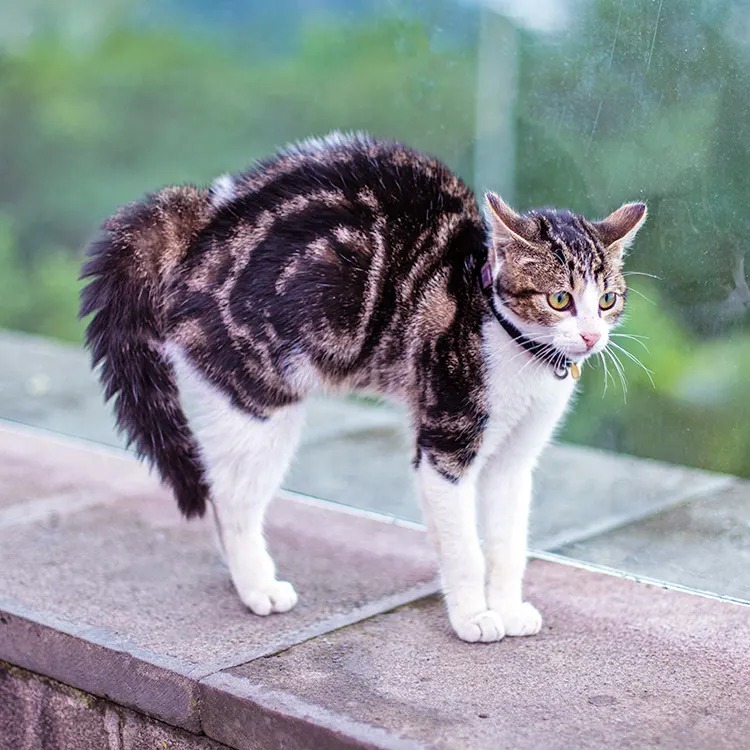
The puffed tail is one of the only signals a cat has no control over. That makes it the most honest thing on the animal, and also the most misread, because on its own it doesn't tell you a single thing about how they feel.

Cats are, let’s be honest, unreliable narrators. The slow blink can be genuine or a cat doing a thing that has worked before. A purr is not proof of contentment; cats purr when they are anxious, injured, and dying. Ears and eyes and posture can all be composed.
There is one signal your cat cannot compose, and it is the one everyone finds funny.
The puffed tail — that Halloween-cat, bottlebrush, feather-duster tail — is called piloerection, and it is involuntary. Tiny muscles at the base of each hair contract and stand the hair on end. Your cat does not decide to do it, any more than you decide to get goosebumps. Which means that unlike almost everything else in their repertoire, the puffed tail is a direct, unfiltered readout of the cat’s nervous system firing.
That makes it worth reading properly. And reading it properly starts with accepting what it does not tell you.
The tail is a volume knob, not a word
Here’s the trap. People see the puffed tail and conclude “scared cat.” So they go looking for the frightening thing, and sometimes there isn’t one, and they end up baffled.
Piloerection is an arousal response, not an emotion. It fires when the sympathetic nervous system spikes. That happens with fear, yes, but it happens with any strong sudden activation, and the cat has one hair-raising mechanism to serve all of them.
So the tail tells you the intensity. Everything else on the cat tells you the emotion. Read them together or you’ll get it wrong.
The puffed tail is the cat’s exclamation mark. It tells you the sentence is loud. It doesn’t tell you what the sentence says. For that you have to look at the ears, the eyes, and the mouth, and people almost never do, because the tail is the funny bit.
The five things that turn it on
Defense. This is the classic. A cat facing a threat they’d rather not fight makes themselves as large as possible — puffed tail, arched back, fur up along the spine, turned side-on to present maximum surface. The whole display is a bluff, and it is a good-faith one. Cats do not want to fight. A fight risks injury, and an injured wild cat is a dead one. So they buy the biggest silhouette they can and hope you leave.
Fear. Most feline aggression is fear wearing a costume. A cat who is frightened for their safety or their resources puffs up and typically brings along the rest of the kit: hissing, growling, flattened “airplane” ears, dilated pupils, a body coiled to leave.
Surprise. Pure startle, no threat assessment required. You drop a pan. The other cat comes around the corner at speed. The body says become large, ask questions later, and it’s over in three seconds. This one is often followed by the cat pretending nothing happened, which is the most cat behavior there is.
Play. Very common, especially in kittens, and it’s the one people misread as distress. Play is rehearsal for hunting and fighting, complete with ambushes and sudden reversals, and it recruits exactly the same circuitry. A puffed tail plus the sideways crab-hop plus a cat who immediately re-engages is a cat having the time of their life. If you interrupt that because you thought they were terrified, you’ve taken away the fun.
The body, not the mind. Two often-forgotten causes. Piloerection helps with insulation by trapping a layer of air near the skin, so a cold cat may puff up. And pain or physical discomfort can do it — a cat with skin allergies or irritation along the tail base may raise the fur there. If you’re seeing a puffed tail with no plausible emotional trigger, especially a persistent one, that’s a vet question rather than a behavior question.
How to read the rest of the cat
Because the tail only gives you volume, run this quick scan:
Ears. Forward and relaxed means engaged or playful. Rotated out sideways and flattened means frightened or defensive, and this is the single most reliable tell on the animal. Ears pinned flat back to the skull means it is about to escalate.
Eyes. Wide with dilated pupils means high arousal, which pairs with fear or with an intense play sequence. Narrowed and hard means aggression rather than fear. Soft and blinky means you’re fine.
Mouth and voice. Hissing, spitting, or a low growl is unambiguous. Silence with a chirp or a trill during a chase is play.
What happens next. This is the cheapest test of all. A cat who puffs and then instantly resumes stalking their toy was playing. A cat who puffs and then backs into a corner, freezes, or bolts for under the bed was not.
What to do about it
If it’s play, do nothing. Enjoy it.
If it’s a startle, do nothing dramatic. Soft voice, unhurried movement, maybe toss a treat to change the subject. Making a big fuss confirms to the cat that something worth making a fuss about just happened.
If it’s fear or defense, your job is the trigger, not the cat. Was it the doorbell? The vacuum? The neighborhood tom sitting on your windowsill staring in? That last one is enormously common and enormously fixable: block the sightline. Frosted window film, a closed blind, moving the cat tree away from that window. You cannot negotiate with the cat about the other cat, but you can take away the view.
And then give them room. This is the part people get wrong out of pure affection. A frightened, aroused cat is a cat with a loaded nervous system, and cats redirect. The person who leans in to scoop up a puffed, hissing cat to comfort them is the person who gets bitten, and then the cat, having bitten someone they love, is now in an even worse state. Let them come down. It takes minutes, sometimes longer than you’d expect, and it works far better than reassurance.
The frequency is the thing to actually watch
One puffed tail is not information. A pattern is.
A cat who puffs up several times a week is telling you their environment is producing more sudden, intense events than they can comfortably absorb. That is worth chasing down. It might be a dog whose play style is too fast, a household with a lot of unpredictable noise, a resource conflict with another cat, or an outdoor cat parked outside the window every evening.
If you can’t find a trigger and the puffing is frequent, or if it comes with hiding, appetite changes, litter box problems, or a change in how much they’re grooming, take it to the vet before you take it to a behaviorist. Pain and illness raise a cat’s baseline arousal, and a cat who hurts is a cat who startles.
The bottlebrush tail is funny. It’s also the only completely honest thing your cat does. Worth listening to.
References
- Cat Behavior: Communication and Social Behavior — Cornell Feline Health Center.
- AAFP and ISFM Feline Environmental Needs Guidelines — American Association of Feline Practitioners / International Society of Feline Medicine.
- Bennett, V., et al. “Facial correlates of emotional behaviour in the domestic cat,” Behavioural Processes — 2017.
- Redirected Aggression in Cats — ASPCA.
Common questions
Does a puffed tail always mean my cat is scared?
No. It means their body just fired an involuntary arousal response. Fear is the most common cause, but surprise, defensiveness, hard play, cold, and even pain can all produce the same puffed tail. The tail tells you the intensity, not the emotion.
Can a cat puff up while playing?
Yes, and it's common, especially in kittens. Play is full of ambushes and startles, and it exercises the same predatory and defensive circuits as a real confrontation. A cat who puffs up mid-chase, does the sideways hop, and then goes straight back to playing is having a good time.
What should I do when my cat's tail puffs up?
Read the rest of the cat first. If the ears are flattened out to the side, the pupils are huge, and they're hissing or backing away, find what triggered it and remove it or block their view of it. Then give them space. A frightened cat can redirect aggression onto the nearest person, including the one trying to comfort them.
Do some cats puff up more than others?
Yes, though it tracks temperament and environment far more than breed. A naturally skittish cat in a loud house will puff up frequently. A confident cat in a quiet one may almost never do it. Kittens do it constantly, because everything is new and most of it is a game.
Do dogs and humans do this too?
They do. It's called piloerection, and it is the same mechanism as goosebumps on your arm or the hair rising on the back of your neck. In humans, we've lost enough body hair for it to be a vestigial shiver. In a cat, it makes the animal visibly twice the size.
Dr. Kohl is a board-certified veterinary dentist with a particular interest in preventive oral care. She reviews all dental health content at The Pet Times and contributes practical guides on home dental routines, professional cleaning, and oral disease prevention.
Meet our experts ↗Keep reading
 LivingThe Shoulder-Cat Photo Everyone Tried to Copy. Here's Why Yours Won't Work.Sara Lim · 6 min
 TrainingScience Gave Your 'Unknowable' Cat Five Personality Traits. Here's How to Read Yours.Dr. Mara Chen · 6 min
 LivingMy Cat Has Never Once Felt Awkward. I'm Taking Notes.Sasha Ford · 5 min
 LivingYour Cat's 5 A.M. Screaming, Translated (and Why It Really Happens)Tom Hadley · 4 min
 TrainingThe Neck Bite Is Never the Problem. The Body Around It Is.Dr. Nina Kohl · 8 min
 TrainingYour Cat Isn't Seeing Ghosts. They're Finishing a Hunt That Never Started.Dr. Lena Park · 6 min