


Science Gave Your 'Unknowable' Cat Five Personality Traits. Here's How to Read Yours.
We know far more about dog minds than cat minds, but one big study cracked feline personality into five measurable traits. Where your cat lands on the Feline Five isn't just fun, it tells you what your cat actually needs.

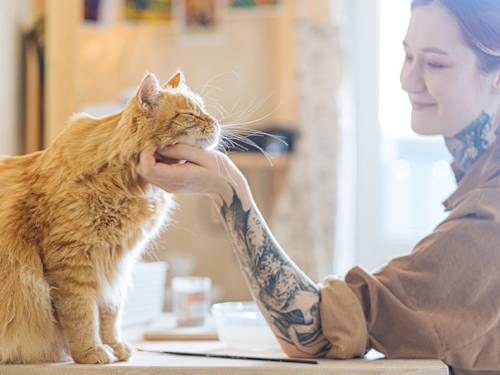
Cats have a public-relations problem: the reputation for being aloof, unknowable, faintly disdainful. Any cat owner currently swatting away a paw that’s very much demanding attention knows how incomplete that picture is. Cats are bursting with personality. The strange part is how little science has formally studied it. Compared with what researchers have mapped about dogs, or even apes, feline psychology has been a near-blank space, most of what we knew coming from shelters, feral colonies, and, unhappily, laboratories.
That gap is exactly why one study is worth knowing about. It took a swing at making cat personality measurable, and the payoff isn’t just a fun label for your cat. Figuring out where your cat lands on these traits tells you, concretely, what your particular cat needs to feel safe and content, which is the whole point. This isn’t a personality quiz for its own sake; it’s a translation key.
Where the Feline Five came from
The framework is called the Feline Five, and it comes out of a 2017 study headed by Dr. Carla Litchfield, a conservation psychologist whose broader research asks how people and the living world shape one another. The data came from owners: 2,291 of them across South Australia and New Zealand, reporting on 2,802 adult cats. Each owner worked through a 52-item vocabulary of personality descriptors — “shy,” “reckless,” “defiant,” “curious,” “jealous,” “vocal,” “aimless” — and rated on a seven-point scale how strongly each word fit their cat. The scoring design assumes what any owner already suspects: no cat is a single label, and every cat carries some measure of every trait.
When the researchers crunched those 52 descriptors, five stable personality factors emerged, drawing directly on the five-factor model long used for human personality. Here’s what each one means, and, more usefully, what a cat who scores high on it tends to need.
The five traits, and what each one is asking you for
Neuroticism is the anxiety axis. A high scorer collects the study’s descriptors “insecure,” “anxious,” “suspicious,” “shy,” and “fearful of people.” The care lever is cover plus predictability: give this cat reliable ways to vanish — a covered bed on a closet shelf, a perch in a room guests never enter — and keep the household routine boring. Somewhere to disappear to isn’t a luxury for an anxious cat; it’s the treatment.
Extraversion is the smart, curious, inventive cat, the one who figures out how to open the cupboard and how to summit the tallest shelf in the house. That intelligence needs an outlet. Extraverted cats do best with real stimulation, toys, sensory enrichment, space to blow off steam, and genuine interaction, or boredom turns into shredded furniture. A bright cat with nothing to do will invent a job, and you won’t like it.
Dominance shows up as a cat who bullies other cats, often springing from a hardwired instinct to fight for resources. The practical read is that a high-dominance cat frequently does best as the household’s sole animal. Forcing a multi-cat setup on a dominant cat tends to make everyone miserable, so respecting this trait can be the single kindest thing you do.
Impulsiveness looks like erratic, reckless behavior, the 3 a.m. howling concerts, the furniture-scaling sprint that ends with a lamp on the floor. Here the trait is often a signal rather than just a quirk: high impulsiveness can indicate that a cat feels stressed. The useful move is to treat it as information, hunt for the source of the stress, and if you can’t pin it down, bring in a behavior professional.
Agreeableness is the well-adjusted, friendly cat whose body language just says “happy.” These are the cuddlers, the ones who stroll confidently up to strangers demanding head-scratches. What they want is social time. An agreeable cat left alone during long work hours may get lonely, and for that cat, a second cat companion can genuinely help.
What I love about a framework like this is that it turns a vague sense of ‘my cat is just like that’ into something you can act on. If I know a cat scores high on neuroticism, I stop telling the owner to ‘socialize it more’ and start talking about vertical hiding spots and a quiet room. The trait tells you which lever to pull. That’s the difference between guessing at your cat and actually meeting it where it is.
Why this is more than a party trick
It’s tempting to treat this like the personality quizzes you burned hours on in the early internet days, and yes, it’s entertaining. But the reason researchers bother is practical. Understanding where a cat falls on these traits helps owners meet real needs: the dominant cat that should stay an only pet, the agreeable cat that wants a companion, the impulsive cat whose chaos is a stress flag, the anxious cat that needs cover. Done well, it could even help shelters match adoptable cats to the right humans, pairing a needy, social cat with someone home all day, or a self-possessed one with a quieter household. The frustrating question every cat owner asks, “why does my cat do that?”, gets a lot less frustrating when you have a map of the temperament underneath the behavior.
What newer research adds
The Feline Five opened a door, and researchers have kept walking through it. Most notably, a large University of Helsinki study led by Salla Mikkola, Milla Salonen, and colleagues, drawing on data from more than 4,300 cats across 26 breed groups, proposed a somewhat different structure of seven personality and behavior traits: fearfulness, activity/playfulness, aggression toward humans, sociability toward humans, sociability toward cats, excessive grooming, and litterbox issues. Published in 2021, it used a comprehensive owner questionnaire and found the traits reliable and reproducible, and it flagged meaningful differences between breeds.
The two frameworks don’t cancel each other out; they’re complementary attempts to carve up the same rich, understudied thing. The Feline Five leans on the human five-factor tradition, while the Helsinki work casts a wider net that includes practical problem behaviors owners care about, like litterbox trouble. Taken together, the message is encouraging: the science of cat personality is finally catching up to the science of dog personality, and the more precisely researchers can describe what makes an individual cat tick, the better all of us can care for the specific, opinionated animal actually living in our homes.
References
Common questions
What is the Feline Five?
The Feline Five is a set of five personality traits, Neuroticism, Extraversion, Dominance, Impulsiveness, and Agreeableness, identified in a 2017 study of over 2,800 pet cats. It adapts the human five-factor personality model to cats and gives owners a framework for understanding their cat's temperament.
How can knowing my cat's personality help?
It translates into practical care. A dominant cat may do best as an only pet, an anxious (neurotic) cat needs hiding spots and quiet, an extraverted cat needs enrichment to fight boredom, an impulsive cat may signal stress you can address, and an agreeable cat wants more social time.
Is the Feline Five the only cat personality research?
No. It's a landmark 2017 study, but newer research, including a large University of Helsinki project, has since proposed additional trait frameworks. Together they're steadily closing the gap between how well we understand dogs and how well we understand cats.
Dr. Chen is a small-animal veterinarian who leads health and safety coverage at The Pet Times. She writes and reviews the bulk of our illness, condition, and safety content, translating clinical guidance into clear, practical advice owners can act on at home.
Meet our experts ↗Keep reading
 TrainingYour Cat Isn't Getting 'Brain Rot' From That Video. It Thinks It's HuntingDr. Ravi Mehta · 5 min
 LivingYour Cat's 5 A.M. Screaming, Translated (and Why It Really Happens)Tom Hadley · 4 min
 TrainingYour Cat Isn't Begging at Dinner. They're Waiting for You to Sit Still.Dr. Nina Kohl · 7 min
 TrainingYour Cat Isn't Being a Jerk When They Swat Things Off the Table. They're Running an Experiment.Dr. Nina Kohl · 5 min
 TrainingThe Neck Bite Is Never the Problem. The Body Around It Is.Dr. Nina Kohl · 8 min
 TrainingYour Cat Isn't Seeing Ghosts. They're Finishing a Hunt That Never Started.Dr. Lena Park · 6 min