


Toilet-Training Your Cat Means Throwing Away Their Health Chart
Yes, it can be done. But the litter box is the single best early-warning system you own for kidney disease, diabetes, and a blockage that can kill a male cat in 48 hours. Flushing it away is the actual cost.

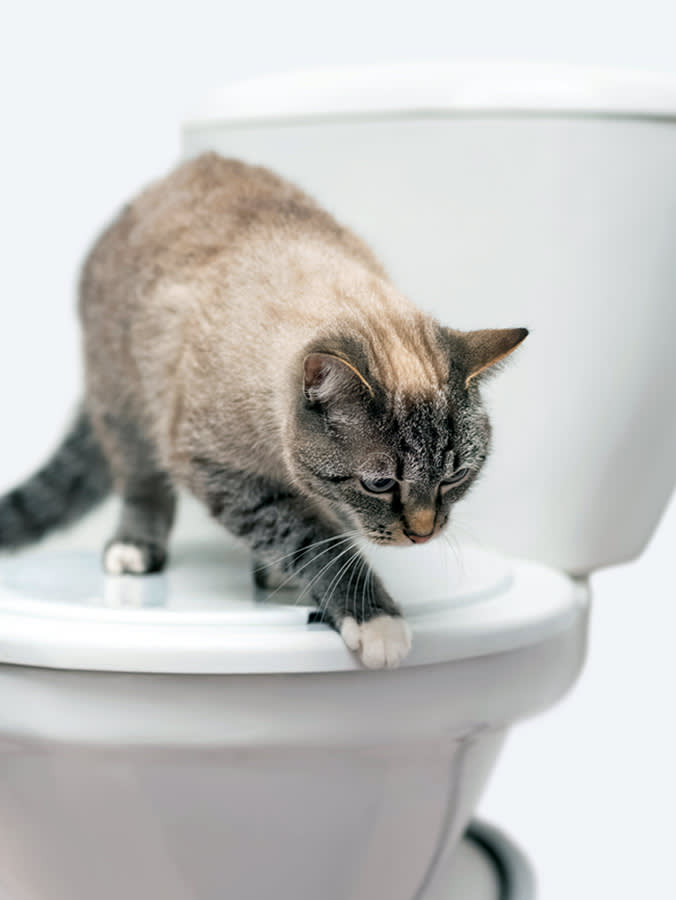
Let’s concede the fun part immediately: yes, you can toilet-train a cat. People do it. Kits exist. It works, sometimes, for a while.
Now the part nobody puts in the pitch. Your cat’s litter box is not just a container for waste. It is a daily diagnostic readout, and it is very often the first place a serious illness announces itself, weeks before your cat looks sick.
Toilet-training doesn’t just move where your cat goes. It deletes the data.
That’s the real trade you’re being offered: no more scooping, in exchange for giving up the single most useful early-warning system you have. And for most cats, that’s a bad trade.
What the litter box actually tells you
This is the argument, and everything else is secondary.
Cats hide illness. It’s not a quirk, it’s a survival strategy, and it’s the reason so many feline diagnoses arrive late. A cat can be well into kidney disease and still be, from across the room, a cat.
What they can’t hide is what they leave in the box. And a box lets you see things a toilet simply cannot:
Urine volume. In a clumping litter, urine is a countable, measurable object. You know roughly how many clumps a normal week produces, and how big they are. A sudden increase in clump size and number is one of the earliest signs of kidney disease, diabetes, and hyperthyroidism, all three of which cause a cat to drink and urinate more. You would not notice any of this in a toilet. Urine in water is just water.
Urine frequency. Now the emergency. A male cat with a urinary obstruction — a blockage of the urethra — will make repeated trips to the box and produce little or nothing. This is the classic presentation, and owners catch it precisely because they notice the trips and the empty box.
An obstructed male cat can die within roughly 24 to 48 hours without treatment. It is one of the true emergencies in feline medicine. And the single most reliable way it gets caught in time is an owner who notices their cat straining in the litter box and producing nothing.
In a toilet, you would not see this at all. You would see a cat visiting the bathroom, which cats do.
Blood, and where it is. Blood in urine, blood on the surface of stool, mucus. All visible in litter. All invisible in a bowl of water.
Stool quality. Yes, you can see poop in a toilet, briefly. But you can’t easily assess consistency, and you certainly can’t see it after a flush.
The number of cats I’ve diagnosed early because an owner said ‘the clumps got huge this month’ is not small. And I have never once had an owner catch a blocked cat because of something they saw in a toilet. The box is a chart. People just don’t realise they’re reading one.
And it takes away something the cat needs
The second argument is about the cat rather than about you.
Digging and burying are hardwired. Cats cover their waste as a way of concealing themselves, and while your indoor cat has no predators, the instinct doesn’t know that. Removing the ability to perform it doesn’t remove the drive to perform it. It just leaves it unsatisfied, which is a low-grade, permanent stressor.
And the box is a scent anchor. Cats orient themselves in territory by smell, and their own scent in their own space is part of what makes a home feel secure. (This is not a licence for a filthy box. Cats detect their own scent perfectly well in an immaculate one.) Eliminating into water removes that scent source entirely, which can subtly increase territorial insecurity in a cat who already feels precarious.
The failure modes, which are not hypothetical
Toilet-training is a system with a lot of single points of failure, and every one of them ends the same way: a cat urinating somewhere you very much don’t want.
Someone closes the door. A guest, a housemate, a cleaner, you at 2 a.m.
Someone leaves the seat up, or closes the lid.
Your cat falls in. Once is enough. A cat who has gone into the bowl may never approach it again, and now has nowhere to go.
Your cat gets arthritic. This is the big one, and it is not a maybe, it’s a when. Degenerative joint disease is extremely common in older cats, and a large majority of senior cats have radiographic evidence of it. Jumping onto a toilet seat and then balancing on the rim in a squat is a demanding piece of athletics. An arthritic cat will eventually be unable to do it, or unwilling to, and they will not file a written notice.
Your cat just… stops. Some do. They decide it isn’t for them, and they’re not obliged to explain.
Or your cat gets sick. A cat with cystitis, an obstruction, or diarrhoea needs to go urgently and often, and the toilet is the worst possible place for a cat in distress.
In every single one of those scenarios, if there is no litter box in the house, your cat will choose somewhere. You will not enjoy their choice.
So if you toilet-train anyway, the non-negotiable rule is: keep an accessible litter box, permanently. Which, you may notice, deletes most of the convenience you were doing this for.
What toilet-training kits are, honestly
They’re a set of nested bowls with progressively larger holes in the middle, seated inside the toilet rim.
The first has no hole and holds litter, so your cat learns the box now lives on the toilet. Each subsequent bowl has a bigger hole. The cat can still dig and bury in the remaining ring while the hole grows, until eventually most of what they produce goes into the water. Then the ring comes out.
That’s the theory. It works often enough that the kits sell.
Two things they don’t advertise. Cats cannot lift the lid or flush, so the human infrastructure has to stay perfect forever. And kittens should not be toilet-trained, since they’re still developing balance and coordination and a fall into a toilet is a genuinely bad first experience.
The honest case for it
There is one, and it’s fair to state it.
Scooping is nobody’s favourite chore. With a toilet-trained cat you flush and you’re done. No litter tracked across the floor, no bag of clay to haul home, no litter box smell, no litter box furniture pretending to be a side table.
If your cat is young, athletic, healthy, confident, and lives in a stable household where the bathroom door is never closed, and you keep a backup box, it can work.
The question is what you’re trading, and whether the person offering the trade has been straight with you about it.
What newer guidance adds
The direction of travel in feline medicine runs directly against toilet-training, and it’s worth knowing why.
Litter box monitoring is being formalised as preventive care. Current feline practice guidance treats changes in litter box output as a core early-detection tool, especially for chronic kidney disease, diabetes, and hyperthyroidism, the three most common serious illnesses of older cats and all three of which alter urine volume before they alter behaviour. Some clinics now specifically ask owners to track clump size and count. That entire approach requires a litter box.
Feline degenerative joint disease is far more common than owners think. Radiographic studies have found signs of it in the large majority of senior cats, and in a substantial share of middle-aged ones, and cats mask the pain almost completely. A cat is not going to tell you the toilet has become hard to use. They will simply stop using it.
And accessibility is now central to litter box guidance. Environmental-needs guidance for cats emphasises low entry, large boxes, and easy access precisely because the alternative is a cat who quietly gives up. A toilet is the least accessible option in the house.
Put those three together and toilet-training a cat looks less like a clever hack and more like removing a diagnostic instrument from a patient who is very good at hiding symptoms.
Bottom line
Can you toilet-train a cat? Yes.
Should you? For most cats, no. You’d be trading your best early-warning system for kidney disease, diabetes, and a fatal urinary blockage, plus your cat’s ability to dig and bury, in exchange for not scooping. And you’d still need to keep a box, because the day your cat’s joints or nerves or mood decide otherwise, the alternative is your rug.
The litter box is a chart. Read it.
FAQs
Can cats be toilet-trained? Yes, using kits with progressively larger holes seated in the toilet. Whether it’s a good idea is a different question, and for most cats the answer is no.
Why shouldn’t you toilet-train a cat? Because you lose the ability to monitor urine volume and frequency, which is often the first sign of kidney disease, diabetes, hyperthyroidism, or a urinary blockage. You also remove their instinct to dig and bury, add stress, and set up a system that fails the moment someone shuts the bathroom door or your cat’s joints stiffen.
How do you potty-train a new cat? There’s very little to it. Show them the box and instinct handles the rest. Kittens begin using a litter box at around three weeks old, and a small box with low sides placed near them after meals, plus a little positive reinforcement, is essentially the whole method.
My cat has stopped using the litter box. Now what? See your vet first, to rule out a medical cause, then look at the setup. Cats have opinions about box location, box size (bigger is better), litter type, sharing a box with other cats, and how clean it is.
What’s the best cat litter? The one your cat will actually use. Most cats prefer a fine-grained, unscented, clumping clay litter that gets scooped regularly.
Is it ever too late to litter-train a cat? No. Cats come from all sorts of backgrounds and some were never taught. There are several approaches, and a qualified behaviour professional can help if you’re stuck.
References
- “Feline Behavior Problems: House Soiling.” Cornell Feline Health Center, Cornell University College of Veterinary Medicine. https://www.vet.cornell.edu/departments-centers-and-institutes/cornell-feline-health-center/health-information/feline-health-topics/feline-behavior-problems-house-soiling
- Ellis, Sarah L. H., et al. “AAFP and ISFM Feline Environmental Needs Guidelines.” Journal of Feline Medicine and Surgery, vol. 15, no. 3, 2013, pp. 219–230. https://doi.org/10.1177/1098612X13477537
- Carney, Hazel C., et al. “AAFP and ISFM Guidelines for Diagnosing and Solving House-Soiling Behavior in Cats.” Journal of Feline Medicine and Surgery, vol. 16, no. 7, 2014, pp. 579–598. https://doi.org/10.1177/1098612X14539092
- Slingerland, L. I., et al. “Cross-Sectional Study of the Prevalence and Clinical Features of Osteoarthritis in 100 Cats.” The Veterinary Journal, vol. 187, no. 3, 2011, pp. 304–309. https://doi.org/10.1016/j.tvjl.2009.12.014
- “Feline Lower Urinary Tract Disease.” Cornell Feline Health Center. https://www.vet.cornell.edu/departments-centers-and-institutes/cornell-feline-health-center/health-information/feline-health-topics/feline-lower-urinary-tract-disease
- “Chronic Kidney Disease in Cats.” International Renal Interest Society (IRIS). http://www.iris-kidney.com/
Dr. Mehta is a board-certified veterinary nutritionist who evaluates pet food formulations, ingredient quality, and the science behind dietary trends. He writes and reviews all nutrition content at The Pet Times, including our food rankings and feeding guides.
Meet our experts ↗Keep reading
 TrainingYour Cat Isn't Attacking the Wall. Read the Spot.Dr. Amara Solis · 7 min
 TrainingYour Cats Don't Hate Each Other. They Just Don't Smell Like a Family Yet.Dr. Amara Solis · 9 min
 TrainingYour Couch Isn't Losing to Your Cat. It's Losing to Bad Real Estate.Dr. Nina Kohl · 9 min
 Health & WellnessYour Cat's Lifespan Isn't Fixed. Here's What Moves It.Dr. Mara Chen · 6 min
 LivingScience Finally Cracked Orange Cats. The Gene Pulls a Trick No Other Animal Does.Claire Sutton · 5 min
 Health & WellnessA Blind, Paralyzed Cat Isn't a Tragedy. It's a Setup Problem.Dr. Nina Kohl · 7 min