


Your House Is Too Cold for Your Cat. Your Laptop Isn't.
A cat on your keyboard is solving two problems at once: your home runs about 20 degrees below her comfort zone, and your screen is where all your attention went. Out-compete both and the laptop stops being the best seat in the house.

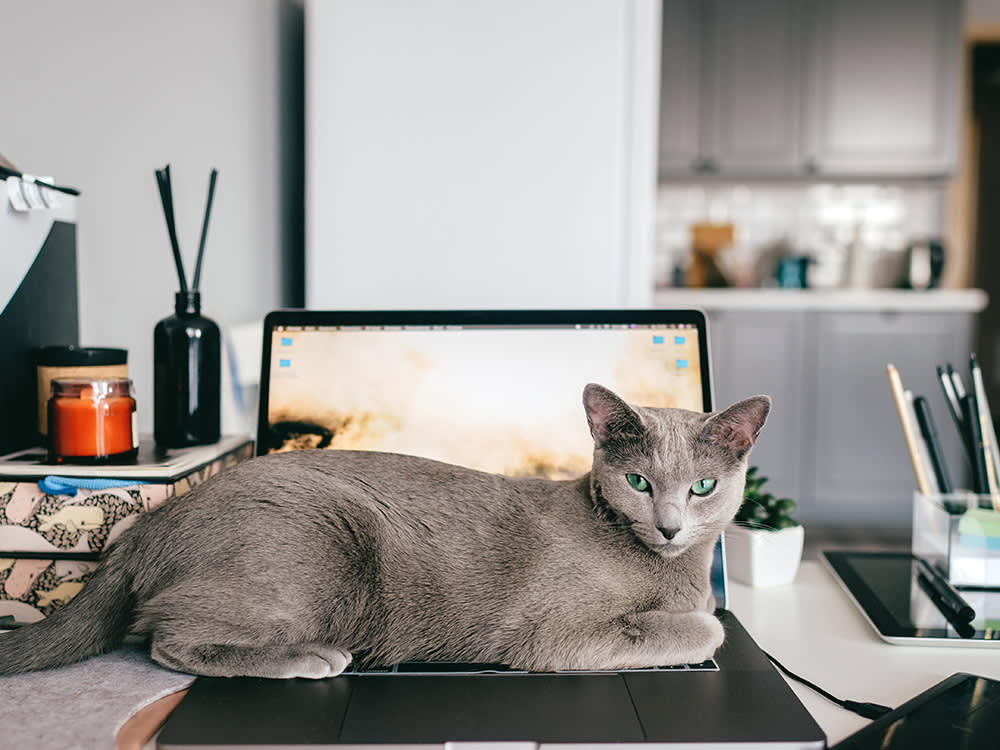
You get up for coffee. You come back to a cat draped across your keyboard like she has been assigned there. You move her, gently. Ninety seconds later she is back.
The standard explanation is that cats are attention-seeking and laptops are warm, which is true and also not very useful, because it does not tell you what to do. The useful version is that your cat is not being difficult. She is making an entirely rational choice between the options you have given her, and right now the laptop wins on both axes she cares about. Give her something that wins instead.
Your thermostat is the first half of the problem
Here is the number that reframes this whole thing. A cat’s thermoneutral zone, the temperature range where her body does not have to spend any energy warming up or cooling down, sits somewhere around 86 to 101°F. Yours is roughly 64 to 72°F.
So the room you have set to a comfortable 70 degrees is, from where she is sitting, about twenty degrees too cold. Not dangerous. Just permanently, mildly chilly. And in that room, a running laptop is a heated slab held at the exact temperature she would pick if you let her pick.
She is not on the keyboard because she is nosy about your spreadsheet. She is on the only correctly heated surface in the room, and it happens to be under your hands.
Once you see it this way, the fix stops being about discouragement and starts being about competition. You cannot make the laptop colder. You can make something else warmer.
- Put a self-warming or plug-in heated cat bed within arm’s reach of your desk, not across the room. The bed is the offer; proximity is what makes it a real offer.
- A folded fleece blanket on the corner of the desk works surprisingly well and costs nothing.
- Sun tracks across a room. If there is a patch of it near you between ten and two, put the bed in it.
People try to make the keyboard less appealing, and there’s almost nothing you can do to a warm laptop that makes it less appealing than a cold floor. The move is to build a better seat and put it where she already wants to be, which is next to you.
Your attention is the second half
The other reason the laptop is prime real estate is that it is where you disappear to. For most of the working day, the screen has your eyes, your hands, and your focus. Your cat has watched all three go somewhere she can physically stand on.
And here is the trap: when she stands on it, what happens? You look at her. You talk to her. You pick her up, which is contact. You may even carry her somewhere, which is a ride. Every single one of those is attention, delivered instantly, every time, in response to the exact behavior you are trying to end. She is not manipulating you. She has simply found a lever that pays out reliably, and she is pulling it.
The way this unwinds is unglamorous and requires more discipline from you than from her.
Pay the perch, not the keyboard. Set up a cat tree, a tall stool, or a shelf beside your desk. When she is on it, that is when she gets a word, a scratch, a treat, a look. When she is on the keyboard, she gets nothing. Not a scolding, not a lecture, not a firm “no.” Nothing is the entire point, because scolding is a form of attention and she will take it.
Do not pay her for getting off. This is the most common mistake, and it is a subtle one. If you treat her the moment she hops off the keyboard, you have not taught her to stay off. You have taught her that getting on the keyboard is step one of a two-step routine that ends in a treat.
Move the reward away from you. Toss a treat into the next room instead of standing up and going after her. If you get up and follow, you have handed her the jackpot: mom is up, mom is engaged, mom is chasing. A remote-controlled or phone-triggered treat dispenser in another room is a genuinely good use of forty dollars for this exact reason.
Expect it to get worse before it gets better. When a lever that used to pay out stops paying out, animals pull it harder for a while before they give up on it. Two or three days of a more insistent cat on your keyboard is not a sign that the plan failed. It is a sign that the plan is working and she has noticed.
Punishment does not work here, and not for the sentimental reason
The spray bottle, the loud clap, the shove: none of them do what you want, and the reason is mechanical rather than moral.
A cat does not learn “keyboards are bad” from a spritz of water. She learns “keyboards are bad when the human is sitting there, facing me, holding the bottle.” That is a much narrower lesson, and its practical result is a cat who stays off the laptop while you watch and gets on it the second you leave the room, plus a cat who has become slightly wary of you. You have traded a mild inconvenience for a worse behavior and a small tax on your relationship.
Drain the tank before you need it
Everything above is easier if she is not arriving at your desk with eight hours of unspent energy.
A cat who has had a real hunting session, meaning ten to fifteen minutes of wand toy, ending in an actual catch and a small meal, is a cat who wants to sleep near you, not perform for you. Do that before your work block, not after she has already colonized the keyboard.
The rest of the day is enrichment: a food puzzle instead of a bowl, a window perch that looks at something with birds in it, a rotating cast of toys rather than a permanent pile she has stopped seeing. None of this replaces you. It just means that the two hours between your morning meeting and lunch are not eight hundred minutes of nothing punctuated by a warm rectangle.
And if she just wants to be near you
Some cats are not bored, are not cold, and are not attention-starved. They simply want to be where you are, and no amount of enrichment substitutes for proximity.
That cat does not need a training plan. She needs a compromise: a bed on the desk, beside the laptop rather than on it, close enough that she is still inside the room’s warm social center. Reward that spot generously and consistently and most cats take the deal.
Which is the whole philosophy, really. Almost nothing your cat wants is unreasonable. It is just aimed at the wrong object, and your job is to move the target rather than argue with the impulse.
What newer guidance adds
The temperature piece is the part that has moved. Veterinary behavior groups, including the American Veterinary Society of Animal Behavior, have been making the case that most indoor cats live slightly cold all the time, and that deliberately building warm micro-spots around the house, heated beds, covered hides, sunny shelves, is a welfare measure and not a luxury. Cats in shelter studies use raised, enclosed, warm refuges heavily when they are offered, and use the open floor much less.
The practical upshot for your workday is small and specific. Before you build a training plan, build a warmer chair. A meaningful number of laptop cats are not asking for anything more complicated than that.
References
- National Research Council. Nutrient Requirements of Dogs and Cats. National Academies Press, 2006. (Feline thermoneutral zone.)
- American Veterinary Society of Animal Behavior. “Can We Keep Our Cats Warm Enough?” AVSAB Position and Education Resources.
- Vinke, C.M., Godijn, L.M., van der Leij, W.J.R. “Will a hiding box provide stress reduction for shelter cats?” Applied Animal Behaviour Science, vol. 160, 2014, pp. 86–93.
- Ellis, S.L.H., et al. “AAFP and ISFM Feline Environmental Needs Guidelines.” Journal of Feline Medicine and Surgery, vol. 15, no. 3, 2013, pp. 219–230.
Dr. Kohl is a board-certified veterinary dentist with a particular interest in preventive oral care. She reviews all dental health content at The Pet Times and contributes practical guides on home dental routines, professional cleaning, and oral disease prevention.
Meet our experts ↗Keep reading
 TrainingYou Can't Discipline a Cat. Trying Is Making the Behavior WorseDr. Nina Kohl · 8 min
 TrainingYour Cat Isn't Attacking You. You Live on a Hunting Route.Dr. Amara Solis · 9 min
 TrainingYour Cats Don't Hate Each Other. They Just Don't Smell Like a Family Yet.Dr. Amara Solis · 9 min
 TrainingThe Couch Isn't the Problem. It's Where You Put the Scratching Post.Dr. Nina Kohl · 7 min
 TrainingYou Can't Train a Cat Off the Counter. You Can Outbid Her.Dr. Mara Chen · 8 min
 TrainingThe Spray Bottle Doesn't Teach Your Cat to Stop. It Teaches Them to Wait Until You Leave.Dr. Ravi Mehta · 6 min