


You Can't Train a Cat Off the Counter. You Can Outbid Her.
Your cat isn't breaking a rule she agreed to. She's picking the best available spot for height, food, water, and a view of you, and right now that's your counter. Beat the counter on all four and she'll move herself.

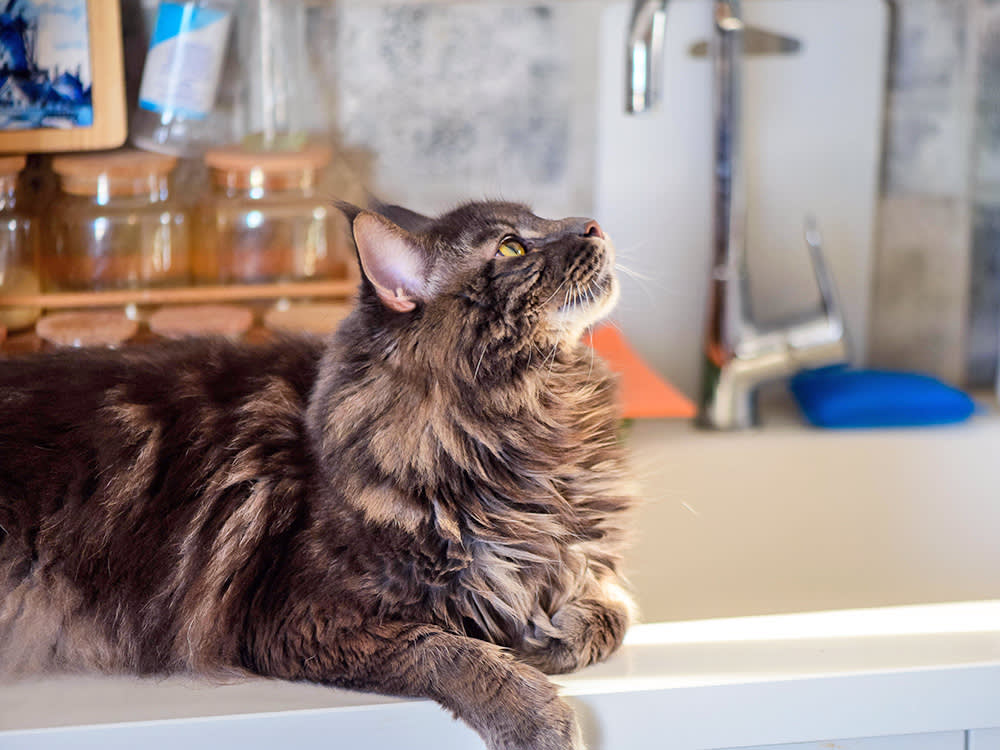
There is a specific kind of frustration in watching a cat you love hop onto the counter, hold eye contact with you, and settle in. It reads as defiance. It reads as a cat who knows the rule and has decided the rule does not apply to her.
She does not know the rule. She has never known the rule. What she knows is that the counter is the highest surface in the room, it periodically produces food, it is next to the only running water in the house, it has the best view of what you are doing, and it is warm when the sun hits it. Against that, the floor is offering nothing.
You are not in a discipline problem. You are in an auction, and you are currently losing it on every line item. So stop trying to make the counter feel bad, and start trying to make something else feel better. Here is what she is actually bidding on.
What the counter is really selling
Height
Cats are climbers, and they are climbers for reasons that predate your kitchen by several thousand years. As both predator and prey, a cat gains a great deal from being above things: she can see what is coming, she cannot be surprised from behind, and she has a hunting vantage point. Position, for a cat, is a safety strategy.
Now ask a hard question about your home. If your cat wants to be high up, what is her highest legal option? For a great many households, the honest answer is the back of the sofa, which is about waist height. The counter is not her rebellion. It is the only mountain in the room.
Food, and the memory of food
Counters are where food gets prepared, and cats have an extraordinary sense of smell. A hungry or simply curious cat will patrol the places where food has recently been.
More importantly, if she has ever gotten up there and found so much as a crumb of chicken, that jackpot has been logged. She was rewarded, by food, for going to that location, and she will absolutely go back to check. Intermittent payouts are the most durable kind of reinforcement there is, which is the same reason slot machines work.
Water
The persistent myth that cats hate water is wrong, and it obscures something practical: many cats are drawn to moving water. A running tap, a dripping faucet, a bowl left in the sink is a water source, and if your cat’s actual water setup is one small bowl parked next to her food, she may be visiting your sink because it is the more appealing option.
The view, and you
Cats are curious and cats are nosy, and it is genuinely difficult to figure out what a human is doing from floor level. Add a window over the sink with birds in it, or a warm rectangle of afternoon sun on the tile, and there is no mystery left about why she is up there.
The plan: win each line item
Clear the counter, permanently
This is the least fun and most important step. If your cat patrols the counter when you are out and never finds anything, the patrol stops being worth doing. If she finds something once a fortnight, it becomes worth doing forever. No food left out. Not the butter, not the loaf, not the plate that is going in the dishwasher in a minute.
Build a taller mountain, and put it in the kitchen
Vertical space is not a luxury purchase. It is the direct competitor to your counter. Cat trees, wall shelves, a tall bookcase with a cleared top, a window perch: give her somewhere higher than the counter, with a better view than the counter, and the counter becomes second-best.
The one people skip is putting the alternative inside the kitchen. Park something tall directly alongside the counter, a stool she can reach, a slim tree, a cleared shelf, and you have handed her a legal way to be exactly where she wanted to be, at the height she wanted, watching precisely what she came to watch. Refusing to give her a kitchen option and then being surprised she takes the counter is not a plan.
Pay the perch
Here is where training actually starts. When she gets on the perch, she gets something she likes: a treat, praise, a scratch, a tossed toy. When she stays on it, the good things keep arriving. When she leaves it, they stop.
Now run the comparison she is running. Counter: no rewards. Perch: rewards. This is not a moral appeal, it is a better offer, and cats respond to better offers.
A clicker sharpens it. Click the instant her paws land on the perch, then deliver the treat. The click marks the precise moment that earned the reward, and it buys you the two seconds you need to get a treat out of the bag without muddying the message. Eight weeks old is early enough to start, and a young cat’s session length should match her attention span, which is short.
Fix the underlying needs
A cat who is genuinely hungry will forage no matter how nice the perch is. If counter-surfing is chronic, do a calorie check with your vet rather than assuming she is being greedy. Give her more than one water station, and consider a fountain, since moving water is what she was going to your sink for anyway. Give her play, and enough of it that she is not arriving in your kitchen with the entire day’s energy unspent.
Make the counter boring, not scary
There is a version of deterrence that is fine and a version that is harmful, and the line between them is fear.
Double-sided sticky tape on a sheet of cardboard or a placemat, laid on the counter where she lands, works because cats dislike walking on sticky surfaces. It is not startling, it is not painful, and it teaches a lesson she can act on: this surface is unpleasant to stand on. Most cats stop trying within a week or two.
What you must not do is startle her. Compressed-air blasts, motion alarms, anything designed to frighten: these create stress, and stressed cats do not simply stop the behavior, they develop new ones you will like less, including aggression and urinating outside the box.
The four mistakes that undo everything
You rewarded the wrong link in the chain. This is the one almost everyone does. She jumps on the counter, you say “off,” she hops down, you give her a treat for hopping down. Congratulations, you have just taught her that the route to a treat begins with getting on the counter. Reward her for getting on the perch and for staying on it. Do not reward her for getting off the counter, ever, no matter how satisfying it feels.
You are inconsistent. If she is fed on the counter, or allowed up there when you are cooking and not when you are eating, or told to get down half the time and ignored the other half, there is no rule for her to learn. There is only a confusing human. Pick a line and hold it, and get everyone in the house to hold the same one.
You skipped the underlying need. Covered above, and it is the reason a perfectly designed training plan sometimes just fails. If she is hungry, thirsty, bored, or anxious, no amount of clicking fixes it.
You punished her. The spray bottle deserves its own paragraph, below, because it is still the most commonly recommended piece of bad advice in cat ownership.
Why the spray bottle is worse than doing nothing
It feels like it works, which is the trap. She gets sprayed, she jumps down, the behavior stops. Case closed.
What she has actually learned is much narrower than what you think you taught. She has learned that the counter is dangerous when a human is standing three feet away, facing her, with a bottle in hand. That is the contingency she experienced, and it is the contingency she encoded. So she waits. She gets on the counter when you are in the shower, when you are asleep, when you are at work. The behavior did not go away, it went underground, and now you cannot even see it to work on it.
Meanwhile you have made yourself, specifically you, a source of unpredictable unpleasantness. That cost is real, it accumulates, and it is very hard to pay back.
The spray bottle doesn’t teach a cat that counters are off-limits. It teaches her that you are. And a cat who has learned to be a little afraid of you is a much harder cat to solve any other problem with.
When nothing works
If you have done all of the above honestly, for weeks, and she is still up there with an intensity that feels driven rather than casual, stop training and start investigating.
Relentless food-seeking is a symptom. Hyperthyroidism and diabetes both produce a cat who is genuinely, physiologically hungry, and no perch on earth outbids that. A sudden change in behavior in a cat who used to respect the counter deserves a vet visit, not a stricter plan. If the bloodwork is clean, a certified cat behavior consultant can usually spot the thing the plan is missing, because it is nearly always a need going unmet rather than a cat going rogue.
What newer research adds
The vertical-space piece has moved from folk wisdom to something closer to evidence. Work on cats in group housing has found that when cats are given raised refuges rather than floor-level ones, they use the raised option substantially more and spend longer there, and that adding both horizontal and vertical enrichment increases how much of a space cats will use at all. Height is not a preference cats express when they are being difficult. It is a default they revert to when they have the option.
Veterinary behavior guidance has followed. The current environmental-needs consensus treats climbing surfaces, elevated resting places, and multiple separated resource stations, food, water, litter, rest, not as enrichment extras but as basic requirements of a home a cat can be well in.
There is a slightly humbling implication in that. In a house with no legal high ground, one water bowl, and food left on the counter, the cat on the counter is not the problem in the room. She is the symptom.
References
- Ellis, S.L.H., Rodan, I., Carney, H.C., et al. “AAFP and ISFM Feline Environmental Needs Guidelines.” Journal of Feline Medicine and Surgery, vol. 15, no. 3, 2013, pp. 219–230.
- American Association of Feline Practitioners. “AAFP Feline Behavior Guidelines.” AAFP, 2022.
- Desforges, E.J., et al. “The Use of Refuges by Communally Housed Cats.” Applied Animal Behaviour Science, 2015. PMC4494404.
- American Veterinary Society of Animal Behavior. “Position Statement on Punishment.” AVSAB.
- Bradshaw, J.W.S., Casey, R.A., Brown, S.L. The Behaviour of the Domestic Cat, 2nd ed. CABI, 2012.
Common questions
Can you clicker train a cat to stay off the counter?
Not directly, because there is nothing to click. What you clicker train is the alternative. Put a stool or cat tree beside the counter, click the moment your cat lands on it, and follow the click immediately with a reward. The click marks the exact instant she made the right choice and buys you a few seconds to deliver the treat. Over time the perch becomes the paying spot and the counter becomes the dead one.
Should you use a spray bottle to train a cat?
No. A spray bottle does not teach a cat that counters are off limits, it teaches her that counters are dangerous while you are standing there holding a bottle. The behavior continues the moment you leave the room, and you have added stress, which can surface as aggression or house-soiling, plus a cat who is now slightly afraid of you.
What if nothing works and my cat still gets on the counter?
Persistent counter-surfing that survives a real management plan is worth a vet visit. Conditions that drive hunger, thirst, or anxiety, including hyperthyroidism and diabetes, will keep a cat foraging no matter how good your training is. If medical causes are ruled out, a certified cat behavior consultant can find what the plan is missing.
Dr. Chen is a small-animal veterinarian who leads health and safety coverage at The Pet Times. She writes and reviews the bulk of our illness, condition, and safety content, translating clinical guidance into clear, practical advice owners can act on at home.
Meet our experts ↗Keep reading
 TrainingYou Can't Discipline a Cat. Trying Is Making the Behavior WorseDr. Nina Kohl · 8 min
 TrainingThe Spray Bottle Doesn't Teach Your Cat to Stop. It Teaches Them to Wait Until You Leave.Dr. Ravi Mehta · 6 min
 TrainingYour Cat Screams at 3am Because You Never Let It Finish the HuntDr. Mara Chen · 8 min
 TrainingYour Cat Isn't Attacking You. You Live on a Hunting Route.Dr. Amara Solis · 9 min
 TrainingThe Couch Isn't the Problem. It's Where You Put the Scratching Post.Dr. Nina Kohl · 7 min
 Training8 Kind Things You Do That Your Cat Reads as ThreatsDr. Amara Solis · 8 min