


The N+1 Litter Box Rule Isn't About Sharing. It's About Choice
You can't actually stop your cats from sharing a box, so that was never the point. The N+1 rule is choice architecture, and once you see it that way, even a tiny apartment can pull it off. Here's the small-space playbook.

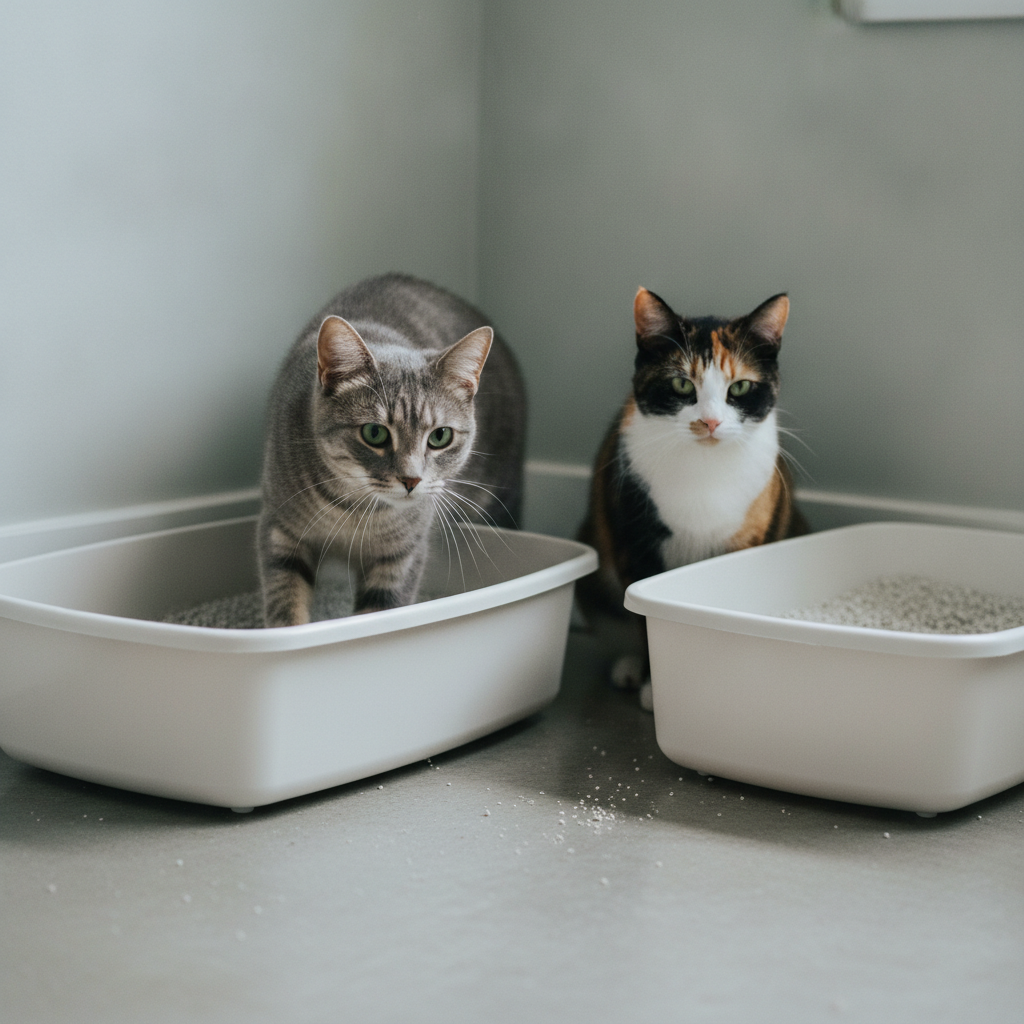
The standard advice, one litter box per cat plus one extra, gets resisted for one very practical reason: it sounds absurd in a small home. Three cats means four boxes? In a one-bedroom? People hear “N+1” and picture their apartment turning into a litter showroom, so they quietly ignore it and hope for the best.
The resistance comes from a misunderstanding of what the rule is for. N+1 is not a plan to keep cats from sharing a box, that’s impossible, and everyone who’s owned more than one cat knows it. Two cats will use the same box sometimes no matter how many you put out. The rule is about something subtler and more important: making sure that at any given moment, every cat has a clean, safe, uncontested option it can choose. It’s choice architecture, not traffic control. And once you frame it that way, the small-apartment objection mostly dissolves, because you can build choice into very little floor space.
What the rule is really protecting
They can share, but it isn’t what most of us recommend. The guidance among vets and behaviorists is one more box than you have cats. Two cats, three boxes. And the boxes shouldn’t be bunched together, cats often read two boxes side by side as one resource, which defeats the whole purpose. Spread them out, different rooms, different levels if you can.
Feline behavior consultant Tom Hadley frames the why in terms of agency. “Competition is the enemy here,” he says. “The moment a cat has to wait, or muscle past another cat, or settle for a dirty box, you’ve created a reason for it to go somewhere else, and ‘somewhere else’ is your rug. Give a cat real options and it’ll almost always pick a box. The litter box only loses when it’s the worse choice.”
This isn’t folklore. The 2021 AAHA/AAFP Feline Life Stage Guidelines, issued jointly by the American Animal Hospital Association and the American Association of Feline Practitioners, explicitly recommend one box per cat plus one more, placed in different, easily accessible locations. The number is the floor, not a suggestion.
The case for choice, in concrete terms
Why does an uncontested option matter so much? Three reasons that go beyond “cats are fussy.”
- It protects your window into their health. “When cats share one box, and one of them is straining, or producing abnormal stool, it’s very hard to tell which cat,” Dr. Chen says. Litter habits are one of the clearest early signals of urinary and digestive disease, and a shared box fogs the glass. Knowing which cat favors which box gives you a baseline to spot trouble against.
- It limits disease transfer. Feces can carry parasites and bacteria, so a single shared box is a single shared exposure point. More boxes won’t guarantee separation, cats will still cross over, but it’s one more layer.
- It heads off conflict before it starts. Forcing cats to compete for a scarce resource breeds tension, and tension between cats leaks into far more than the bathroom.
The honest counterweight, because it’s real: fewer boxes are simpler and cleaner for the human. You don’t manage separate setups, and you empty and scrub fewer boxes. Even a self-cleaning box still needs its drawer emptied and the occasional deep clean, so one box is genuinely less work. That convenience is the entire pull toward sharing, and it’s why the case for choice has to be made on the cats’ terms.
The small-space playbook: building choice into tight quarters
This is the part most “just follow N+1” articles skip, and it’s where the rule actually lives or dies. You don’t need a big home to give cats options. You need to think in three dimensions and disguise.
Go vertical and around corners. Choice is about distinct locations, not square footage. A box in the bathroom, a second tucked beside a bookshelf in the living room, and a third in a bedroom closet count as three real options even in a one-bedroom, because they’re spread across the cat’s territory.
Hide boxes inside furniture. Litter-box enclosures, cabinets and benches that conceal a box and read as decor, let you place a box in a living space without it looking like one. A console that doubles as a box in the living room is a second location your guests will never spot.
Use the box footprint you already waste. The gap beside a washer, the dead space under a console table, a closet floor, these are box locations that cost you no usable room. The goal is separation, so even modest distance between boxes does the job.
Reclaim a box from a top-entry or corner model. Corner-fit and top-entry boxes slot into spots a rectangular pan can’t, which is often what makes the third box physically possible in a tight layout.
The reframe is the whole point: in a small home, the question isn’t “do I really need this many boxes,” it’s “where can I tuck uncontested options so no cat ever has to compete.” That’s a solvable puzzle.
Bonded cats and mixed-sex pairs don’t get an exception
A common hope: cats who adore each other will happily share. Bonded cats cuddle, wrestle, and nap in a pile, but that closeness doesn’t extend to the bathroom. N+1 applies to bonded siblings exactly as it does to cats who merely coexist. And sex makes no difference, a male and a female don’t need separate boxes on account of being male and female. More cats of any combination means more boxes, full stop.
How many boxes you actually need
Back to the math, and it doesn’t bend: one more box than you have cats. Two cats, three boxes. Three cats, four. Every credible source lands on the same number, so the productive question isn’t whether you need them, it’s how to fit and conceal them gracefully, which the playbook above is built to answer.
Setting multiple boxes up so they actually work
Having the boxes isn’t enough; placement and upkeep decide whether cats use them.
Give each box room and an exit. Leave enough space around every box that a cat feels comfortable, with more than one way in and out. A cat should never feel cornered while it’s going.
Keep a consistent cleaning rhythm. Scoop each box at least once a day and do a full clean monthly, all at once or staggered. Hadley calls a dirty box the single biggest reason cats start going elsewhere, and the more cats per box, the faster it turns unpleasant.
Try pheromone products, after the vet. Some owners swear by synthetic-pheromone sprays or diffusers for litter-box stress, worth a try, but only once a vet has ruled out a medical cause.
Separate the other resources too. Space permitting, give each cat its own feeding station, water, and resting spot. Reducing competition everywhere, not just at the box, lowers the household tension that drives accidents.
When a cat stops using the box entirely
A cat suddenly refusing the box is communicating, not misbehaving. Rule out the simple stuff first: clean, roomy, quiet, private. Try a different litter or a bigger pan, since many cats want more space than people assume. If the basics are covered and the problem persists, it’s vet time, eliminating outside the box can signal a urinary or digestive issue that needs medical attention, not just behavioral troubleshooting. And whether you have one cat or five, reinforce good habits: introduce boxes thoughtfully, learn your cat’s litter preference, and keep the experience consistent.
What’s changed lately
Smart litter setups have taken off, automatic and app-connected boxes are now common in multi-cat homes. They’re convenient, but the underlying advice hasn’t budged: even the fanciest self-cleaning box is still one box, so N+1 applies to automatic boxes too. Safety has also entered the picture, there have been reports and recalls involving certain low-cost automatic boxes with faulty sensors, so buy from reputable brands and supervise new gadgets until you trust them.
On the veterinary side, feline practitioners keep stressing that litter-box changes are often the first visible sign of medical trouble, from urinary issues to early kidney disease. The 2021 AAHA/AAFP guidelines that anchor N+1 remain the current standard, which reframes the whole exercise one more time: adequate, well-placed boxes aren’t a luxury for fussy cats, they’re preventive care.
References
Common questions
Does the N+1 rule apply to automatic litter boxes?
Yes. A self-cleaning box saves you scooping, but it's still one box. It doesn't change a cat's need for multiple uncontested options in different locations.
My cat suddenly won't use the box. What now?
Check the basics first, is it clean, roomy, and in a quiet private spot. Try a different litter or a bigger box. If it persists, see your vet, because refusing the box can signal a urinary or digestive problem, not just a preference.
Dr. Chen is a small-animal veterinarian who leads health and safety coverage at The Pet Times. She writes and reviews the bulk of our illness, condition, and safety content, translating clinical guidance into clear, practical advice owners can act on at home.
Meet our experts ↗Keep reading
 Health & WellnessYour Cat vs. the Christmas Tree: The Climbing Isn't the Real DangerDr. Ravi Mehta · 6 min
 Health & WellnessCat Peeing in the Bathtub? Reach for the Vet, Not the Bleach.Dr. Lena Park · 9 min
 Health & WellnessYour Cat Peed on Your Clothes. The Fabric Is the Clue.Dr. Lena Park · 8 min
 TrainingYour Cat Screams at 3am Because You Never Let It Finish the HuntDr. Mara Chen · 8 min
 TrainingYour Cat Isn't Attacking You. You Live on a Hunting Route.Dr. Amara Solis · 9 min
 TrainingToilet-Training Your Cat Means Throwing Away Their Health ChartDr. Ravi Mehta · 8 min