


The Paw on Your Mouth at 4 A.M.? You Trained That.
A litter-box paw on your lips is not affection and it is not random. It's a behavior your cat learned works, and the way most people react is exactly what keeps it working. Here's the fix, and the hygiene part nobody mentions.

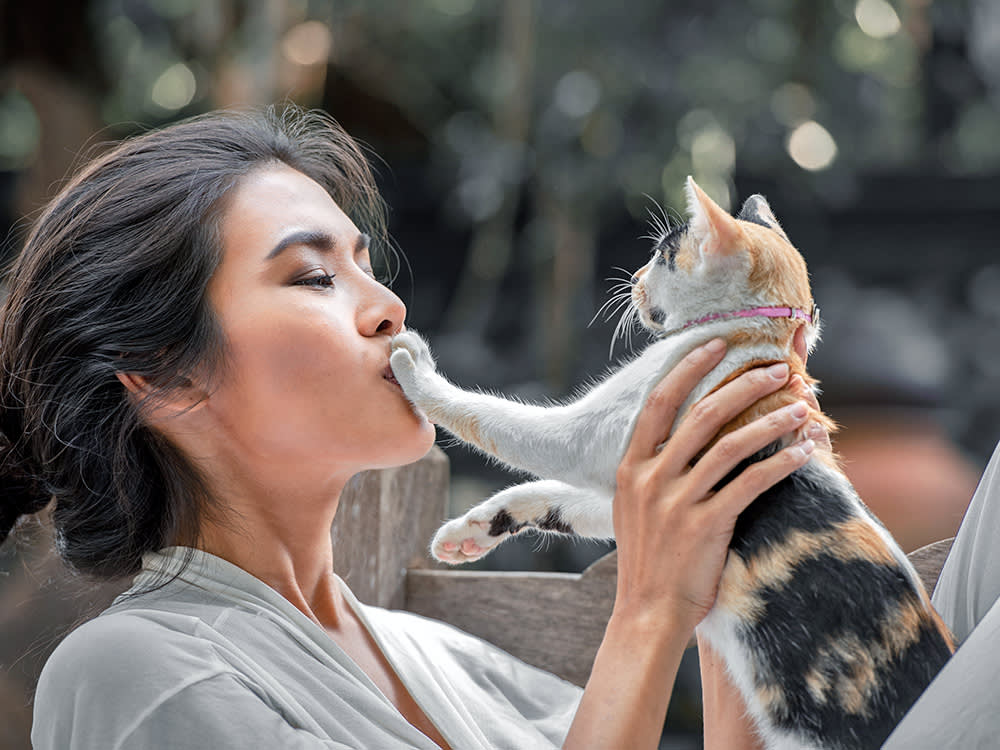
You are asleep. It is dark. And then, with no warning at all, a paw arrives on your lips. A paw that, twenty minutes ago, was in a box of gravel.
You are now awake, upright, and in the bathroom washing your face. And so, from your cat’s point of view, the experiment was a spectacular success.
That’s the thing nobody tells you about the 4 a.m. mouth paw. It isn’t spite, and it usually isn’t affection either. It is a trained behavior. And the trainer is you.
The mechanics of how this got built
Cats do things for reasons, and the reasons fall into a few buckets. Some behaviors are learned because they produce a result the cat wants. Some are the cat meeting a need directly, like scratching to leave scent. Some are simply instinct, like kneading.
Face-pawing is almost always the first kind, and it’s the first kind because of how good the payoff is.
Think about what happens from the cat’s side. Everyone is asleep. Nothing is happening. Nothing has been happening for hours. The cat touches your mouth. And instantly: you move, you make noise, you sit up, you talk, you leave the room, water runs, lights come on. It is the biggest event of the entire night, and it was produced by one small gesture.
Cats are excellent at noticing what works. A behavior that reliably converts a sleeping human into an active one is a behavior worth repeating.
This is the most successful thing your cat does all day, measured purely in results. And an under-occupied cat values that result even more highly. A cat with nothing on their calendar will absolutely put a paw in your mouth for entertainment.
The other explanations, ranked honestly
Attention is the leading answer, but not the only one.
Curiosity. Especially in kittens and young cats, paws are exploratory tools. Your mouth, at night, is doing interesting things. You snore. You breathe warm air. You mutter. Something’s happening down there and a cat would like to investigate.
Affection. Possible, and worth granting. Cats express affection with contact, and your mouth is the part of you that makes all the warm noises and the praise. A gentle tap there is not an unreasonable place for a cat to aim a love-tap.
Scent-marking. Cats do have scent glands in their paw pads, and they do deposit scent by scratching and touching. But this is the least likely explanation for a mouth-tap, because marking behavior usually looks like repeated rubbing or scratching, not one soft touch. If your cat were marking you, they’d be doing what they do to the cat tree.
The tell is repetition and timing. If it happens when the house is quiet and boring, and it stops the moment you engage, it’s attention. Every time.
Now the part people skip
Cat paws walk through a litter box. Then they arrive on your face.
None of what follows is common, and none of it is a reason to panic or to stop loving your cat. It is a reason to keep paws off your mouth, and to wash after.
Salmonella. Usually a food-borne infection in people, but it can pass through the feces of an infected cat. Risk goes up in cats fed raw diets or who hunt.
Intestinal parasites. Roundworms and hookworms are usually picked up from contaminated soil, but eggs in litter-box feces are a plausible route to a paw and then to you.
Cryptosporidium. Spread through the feces of infected animals. Uncommon in this context, but on the list.
E. coli. A cat who contacts contaminated food, water, or feces can move it onto surfaces, or onto you.
If you’re immunocompromised, pregnant, elderly, or living with someone who is, be strict about this. Everyone else: wash your face, keep the litter box scooped, and don’t kiss the toe beans.
How to actually stop it
Here is where most people get it exactly backwards, and it is worth being precise, because the two obvious responses both make it worse.
Do not punish or startle. Yelling, spraying, or shoving the cat off adds stress. A stressed cat is a needier, more attention-seeking cat. You will make the behavior more frequent, not less.
Do not reward it either. This is the sneaky one. Do not toss a toy, do not pet them, do not feed them, do not “just give in and play for five minutes so I can go back to sleep.” You have now taught your cat that touching your mouth causes food, play, and love to appear. That habit will last for years.
The move is neutrality. Nothing good, nothing bad, nothing at all.
- Interrupt with zero drama. Say nothing. No big movements. Turn away, get up and leave, or calmly lift the cat and set them down somewhere farther off. That’s it.
- Then ignore. If your cat rolls out the rest of the attention-seeking catalog, meowing, knocking things off shelves, walking on you, do not respond to any of it for a few minutes. You are teaching one sentence: the mouth thing makes everything stop being fun.
- Come back to it later, on your terms. After a few minutes of nothing, then give them something. Toss treats, play, pet them. The connection you want is the paw got me nothing; being calm got me everything.
- Move the enrichment earlier. You are not going to play at 4 a.m., and you shouldn’t. So front-load it. A real hunting-style play session before bed, followed by a meal, is the single most effective change most people can make. A cat who hunted, caught something, ate, and groomed is a cat who sleeps. That is the natural sequence and it works.
- Consider a timed feeder. If the pawing is happening at dawn and it’s food-motivated, an automatic feeder that dispenses at 5 a.m. breaks the link between waking the human and breakfast appearing. The feeder becomes the source of food. You become irrelevant to it, which is the goal.
- And go clean your face. It costs you thirty seconds and it removes the only real health argument in this whole article.
What newer research adds
The most useful shift in feline behavior work over the last few years is how seriously boredom is now taken as a driver of “problem” behaviors. Attention-seeking, night activity, destructive scratching, and overgrooming all rise in cats whose needs for predation-style play, vertical space, and routine aren’t met. The current environmental-needs guidelines from the American Association of Feline Practitioners treat opportunity for play and predatory behavior as a core need, not a luxury, and that framing is why the fix for a 4 a.m. paw is usually a 9 p.m. wand toy.
The zoonotic risks, meanwhile, remain exactly what they were: real, uncommon, and easily managed by washing your hands and your face. Cornell’s feline health center still lists them under “things to know about, not things to fear.”
References
- Cornell University College of Veterinary Medicine, Feline Health Center. “Zoonotic Disease: What Can I Catch from My Cat?” https://www.vet.cornell.edu/departments-centers-and-institutes/cornell-feline-health-center/health-information/feline-health-topics/zoonotic-disease-what-can-i-catch-my-cat
- Centers for Disease Control and Prevention. “Healthy Pets, Healthy People: Cats.” https://www.cdc.gov/healthypets/pets/cats.html
- American Association of Feline Practitioners and International Society of Feline Medicine. “Feline Environmental Needs Guidelines.” Journal of Feline Medicine and Surgery, vol. 15, no. 3, 2013, pp. 219–230. https://doi.org/10.1177/1098612X13477537
- Centers for Disease Control and Prevention. “About Toxocariasis.” https://www.cdc.gov/toxocariasis/about/index.html
Common questions
Why do cats lift a paw and hold it in the air?
Context is everything. A raised paw can mean play is coming, that they've spotted something small and moving, that they want your attention, or, if the body is tense and low, that they're uncertain or afraid. Read the whole cat, not the paw.
Can I actually get sick from my cat's paws?
It's uncommon, and it isn't worth panicking about. But paws that visit a litter box can carry Salmonella, roundworm and hookworm eggs, Cryptosporidium, and E. coli. If you're immunocompromised, pregnant, or elderly, keep paws away from your mouth and wash after handling.
Dr. Solis is a board-certified veterinary dermatologist with over twelve years of clinical experience. She advises on skin conditions, allergies, and grooming practices that affect coat and skin health. All dermatology and allergy content at The Pet Times is reviewed by her team before publication.
Meet our experts ↗Keep reading
 TrainingYour Cat Isn't Attacking You. You Live on a Hunting Route.Dr. Amara Solis · 9 min
 TrainingCord Chewing Is a Fire Hazard First and a Bad Habit Second. Treat It in That OrderDr. Nina Kohl · 7 min
 TrainingThat 'Come Here' Cat Video Works. Your Own Voice Works Better.Dr. Lena Park · 7 min
 Health & WellnessThe Toy Brick Your Cat Swallowed Won't Show Up on an X-RayDr. Mara Chen · 7 min
 LivingYour Cat Isn't Watching You Cook. He's Reading the Room.Dr. Mara Chen · 7 min
 TrainingPaper Is the Best Cat Toy in Your House. It's Also a Trap.Dr. Ravi Mehta · 7 min