


Your Cat Eating Your Shoelaces Isn't a Quirk. It Might Be Pica.
When a cat chews and swallows things that aren't food, it's easy to laugh it off. But pica can hide a real medical problem, and a swallowed string is a genuine emergency. Here's how to tell trouble from mischief.

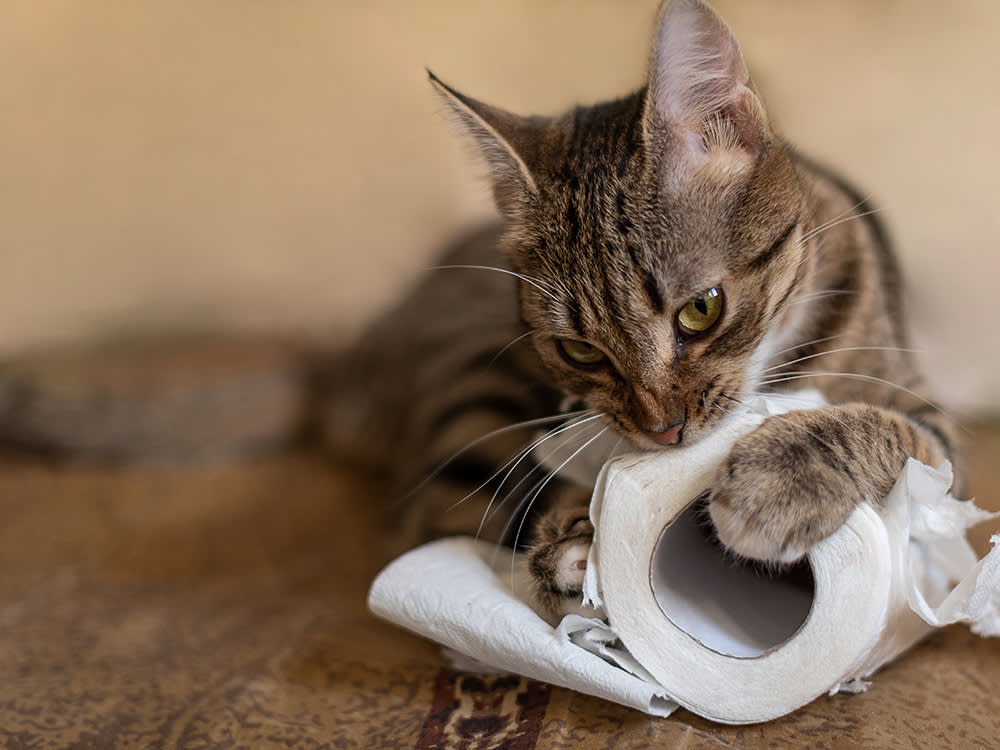
There is a specific flavor of cat-owner denial that goes: he’s just playing with it. And most of the time, that read is correct. Cats gnaw on boxes, bat around hair ties, and shred the occasional roll of toilet paper because they are cats. But there is a line, and some cats cross it, chewing and actually swallowing things that are not food and offer them nothing. That behavior has a name, pica, and treating it as a personality quirk is where owners get into trouble.
The reason this matters is not the ruined sweaters. It is that pica is usually a symptom of something else, and the objects a cat swallows can put them in surgery. So the goal of this piece is not to catalog every odd thing cats eat. It is to help you sort ordinary feline weirdness from a signal worth acting on.
What pica actually is
Pica is the repeated chewing on, and often swallowing of, non-food items that do nothing beneficial for the cat. The usual suspects are wool and other fabrics, shoelaces and string, and plastic, but the real list is limited only by what a cat can get its teeth around. One case study in the Journal of Feline Medicine and Surgery logged cats that had gone after toilet paper, hair bands, dryer sheets, cotton swabs, adhesive tape, earplugs, soap, sponges, pebbles, litter, and dirt.
The key word in the definition is repeated. A single curious nibble is not pica. A cat that returns to the same forbidden object again and again, seemingly unable to leave it alone even after you redirect them, is showing the pattern that counts.
How common is it, really
Nobody has a precise number, partly because pica hasn’t been studied enough and partly because it is genuinely hard to draw the line in a survey between a cat who occasionally mouths something and a cat who compulsively eats it. What the research does suggest is that pica skews young. One UK study found signs of it in roughly 42.9 percent of six-month-old cats, dropping to about 30 percent by 12 to 18 months. A smaller group keeps the habit for life, and a smaller group still develops it later on, usually because a medical condition kicked it off.
Why this is the wrong thing to shrug off
Here is the reframe I want owners to sit with: with pica, the danger comes from two directions at once. There is whatever underlying problem is driving the behavior, and there is the physical hazard of the objects themselves. Either one alone would justify a vet visit. Together, they make “let’s see if it stops” a bad plan.
On the object side, the risks are concrete:
- Blockages. Swallowed items can lodge in the stomach or intestines, creating a life-threatening obstruction. String and other linear objects are especially dangerous, because they can bunch the intestine and saw through the wall. These often require emergency surgery.
- Poisoning. A cat with pica does not screen for safety. Toxic plants, human medications, cleaning products, and off-limits human foods are all fair game.
- Broken teeth. Gnawing on hard materials chips and fractures teeth, sometimes badly enough to need extraction.
- Electrical burns. Cats who chew cords can burn their tongue and face, injure their lungs, or worse.
- Losing the cat. This is the one people miss. Cats with severe pica are surrendered to shelters at higher rates, because the property damage and repeated surgery bills wear families down. Getting the behavior under control early is part of keeping the cat.
What’s driving it
The frustrating truth about pica is the sheer length of the possible-cause list. It helps to sort it into medical and behavioral buckets, because that is how your vet will approach it.
On the medical side: neurological problems such as tumors, infections, or head injuries; gastrointestinal disorders including intestinal parasites, inflammatory bowel disease, exocrine pancreatic insufficiency, and cancer, where pain or poor nutrient absorption can push a cat to eat more of anything; and nutritional deficiencies, classically iron-deficiency anemia and low B12. In older cats, conditions like hyperthyroidism, GI disease, and cognitive decline can newly trigger it.
On the behavioral side, when every medical test comes back clean, pica is usually chalked up to anxiety, compulsive disorder, or plain boredom. Predisposing factors include very early weaning and the hereditary streak seen in Siamese, Burmese, Oriental Shorthair, and Tonkinese cats.
How vets get to the bottom of it
Diagnosing pica is the easy part, any cat that repeatedly eats non-food items has it. Figuring out why is the work. Because the medical list is so long, your vet moves methodically: a full physical and neurological exam first, then bloodwork to check for anemia, deficiencies, and hyperthyroidism, then imaging like X-rays and ultrasound to look at the digestive tract and organs. In some cases, tiny tissue biopsies from the GI tract are needed to catch conditions that don’t show on imaging. Only when all of that comes back normal does the diagnosis land on behavioral pica, and a veterinary behaviorist can help pin down whether anxiety, compulsion, or boredom is the engine.
The single mistake I see is families treating a swallowed string like a hairball, something the cat will just pass. Linear objects are the ones that turn a funny story into abdominal surgery. If you ever see thread hanging from either end of your cat, resist every instinct to tug it, and get to a clinic. The methodical workup after that is worth it, because you cannot treat pica until you know what’s causing it.
Treatment follows the cause
There is no single fix, because the right treatment depends entirely on what the workup uncovers. A cat with a medical driver gets the primary condition treated, which usually quiets the urge, whether that means prescription medication, a supplement, or a special diet. A cat with behavioral pica gets a combination approach: behavior modification to redirect them, enrichment to fill the void, and often medication, since these cats can be relentless and the stakes are high. Desensitization and counterconditioning help the anxious ones.
What you can do at home, alongside the vet
Home changes support treatment, they do not replace it. Because the consequences are serious, pica is not a manage-it-yourself condition. But three things genuinely help, especially for behavioral cases:
Cat-proof harder than you think you need to. Most owners have already done a version of this, but a cat with pica demands the next level: nothing tempting left out, and sometimes confining the cat to the safest rooms. You will not achieve a perfectly sterile home, but every removed temptation is a swallowed object avoided.
Fight the boredom. Indoor cats especially need stimulation, and a bored cat with a compulsion is a bad combination. Cat grass they are allowed to chew, water fountains, scratching posts, cat trees, and puzzle or interactive toys all give a restless mouth and brain somewhere better to go.
Rethink meals, with your vet’s blessing. Some cats need a prescription diet for an underlying condition, so check first. For others, small frequent meals give them something safe to eat through the day. There is even some evidence that cats with behavioral pica settle better on dry food than canned, and dry food doubles nicely as puzzle-feeder fuel.
Can you prevent it?
Mostly, no. Pica usually arises from an underlying disease or a psychological pattern that appears on its own. The handful of levers you do control: don’t wean kittens too early, and keep indoor cats genuinely enriched. Beyond that, the best “prevention” is early detection, annual exams, staying current on deworming and vaccines, and getting any sign of illness checked promptly, so that a condition capable of triggering pica is caught before it does.
Pica can feel overwhelming precisely because the list of causes is so long. But that length is also the reassurance: with a good vet working through it methodically, most cats can be helped.
References
- Unusual Eating Habits in Dogs and Cats. UC Davis School of Veterinary Medicine.
- Demontigny-Bédard, I., et al. “Characterization of Pica and Chewing Behaviors in Privately Owned Cats: A Case-Control Study.” Journal of Feline Medicine and Surgery.
- “Owner-Reported Pica in Domestic Cats Enrolled onto a Birth Cohort Study.” Animals.
- “Medical and Behavioral Evaluation of Cats Presenting With Fabric Ingestion.” The Canadian Veterinary Journal.
- The Indoor Pet Initiative. The Ohio State University College of Veterinary Medicine.
Common questions
Which cats are most likely to develop pica?
It shows up most in young cats, and some breeds carry a hereditary tendency, including Siamese, Burmese, Oriental Shorthairs, and Tonkinese. Kittens weaned very early and indoor-only cats also appear more prone to it.
My cat swallowed a string. What do I do?
Call your vet or an emergency clinic now, and if any part of the string is visible from the mouth or rear, do not pull it. Pulling a swallowed string can saw through the intestine. Let a professional handle it.
Not a substitute for your vet. Our guidance is educational. For urgent symptoms, contact a vet or emergency clinic right away. Editorial standards
Dr. Chen is a small-animal veterinarian who leads health and safety coverage at The Pet Times. She writes and reviews the bulk of our illness, condition, and safety content, translating clinical guidance into clear, practical advice owners can act on at home.
Meet our experts ↗Keep reading
 Health & WellnessYour Male Cat Isn't Being Spiteful. He's Leaving You a Note.Dr. Mara Chen · 7 min
 Health & WellnessYes, Female Cats Spray. Spaying Doesn't Always Stop It.Dr. Lena Park · 7 min
 Health & WellnessYour Cat Isn't Being Spiteful. Almost Every 'Bad Cat' Behavior Is Anxiety.Dr. Priya Nair · 9 min
 TrainingYour Cat Is Trying to Bury Something. The Question Is What.Dr. Lena Park · 8 min
 Health & WellnessYour Cat Isn't Being Weird. Plastic Bags Smell Like Food.Dr. Mara Chen · 7 min
 TrainingYour Cat Isn't Attacking You. You Live on a Hunting Route.Dr. Amara Solis · 9 min