


Your Cat Isn't Attacking You. It's Sending One of 5 Messages.
That ambush from behind the couch feels personal. It almost never is. Here are the five things a pouncing cat is actually telling you, and how to answer each one.


You are walking to the kitchen, minding your business, when a small predator explodes out from behind the sofa, wraps itself around your ankle, and vanishes. If you have ever wondered whether your cat actually likes you, a well-aimed pounce can make you doubt it.
Relax. A pounce is not a verdict on your relationship. In cats it is closer to a sentence, one of a handful of specific things your cat is trying to communicate, using the only body it has. The trick to living with a pouncer is figuring out which message you are getting, because the right response is different for each. Start with the one most owners misread.
1. This is redirected hunting, not aggression
Here is the message that gets misread most: cats are ambush predators, wired to stalk, chase, pounce, grab, and bite in a fixed sequence. In a home with no gazelles, that sequence still needs somewhere to go. Feet moving down a hallway, a hand dangling off the couch, a shape darting past a doorway, all of it can trip the predatory wiring and trigger the full pounce-and-grab.
This is why ankle attacks so often happen at movement and from hiding. Your cat is not being vicious; it is running an instinct with no legal outlet. The fix is not to suppress the drive but to give it a legitimate target: toys that move like prey, hunt-and-capture games, and the chance to actually “catch” and bite something that isn’t you.
2. You are its favorite toy (and it’s a little bored)
Sometimes a pounce is affection with terrible manners. Your cat wants to play, and you are the most interesting playmate in the house, so it launches at you the way it would launch at a feather wand. The cat is not trying to hurt you; it genuinely does not grasp that being sprung on is less fun from your side.
The tell here is frequency. A cat that ambushes you constantly is often a cat that is not getting enough real play. Under-stimulation is one of the most common reasons an otherwise sweet cat turns your hallway into a hunting ground.
When a cat keeps pouncing on their person, my first question is never ‘how do I stop it,’ it’s ‘when did you last tire this cat out on purpose.’ Ten focused minutes with a wand toy in the evening solves more ankle ambushes than any correction ever will. You are not punishing a bad habit, you are filling a hole in the day.
3. You’ve hit the “enough now” line
The flip side of too little stimulation is too much. You are petting your cat, everything seems blissful, and then it spins around and grabs your hand. This is often petting-induced overstimulation, sometimes softened to “love bites.” The cat was enjoying the contact right up until it wasn’t, and it ran out of gentler ways to say stop.
Cats usually warn you first. A rippling patch of skin along the back, a tail that starts flicking, ears that rotate or flatten, a body that stiffens, these are the yellow lights. Miss them and you get the pounce. Many cats also have strong opinions about where they like to be touched; the belly and the base of the tail are common no-go zones. Learn your cat’s map and watch for the early signals, and most of these grabs disappear.
4. It’s actually scared
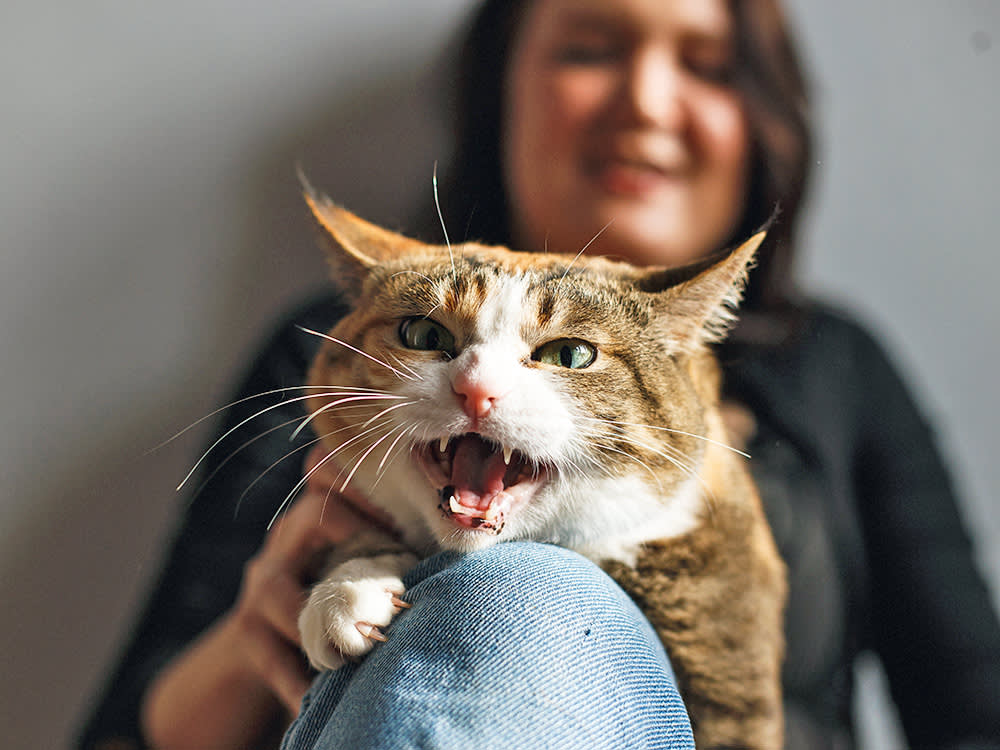
Sometimes a pounce is not play at all but defense. A cat that feels cornered, startled, or threatened may lash out, and that looks a lot like a game to a human who missed the fear. The difference is in the extras. Growling, hissing, a puffed body, flattened ears, and swatting are not play signals. They mean the cat is genuinely upset, and the pounce is a “back off,” not a “let’s wrestle.”
If your cat’s attacks come wrapped in those signs, do not try to push through it. Figure out what is frightening the cat, give it space and an escape route, and treat the emotion, not the behavior.
5. It’s a kitten, and this is the whole job
Finally, if your pouncer is a kitten, pouncing is not a behavior problem at all. It is the curriculum. Ambushing your feet, wrestling your hand, and springing at shadows is how a kitten builds coordination, tests its own reflexes, and learns the physics of its body. Swatting, light biting, and dramatic sneak attacks are all normal kitten software running for the first time.
None of it is aimed at you personally. You are simply the largest moving object in the room. Kitten pouncing almost always fades as the cat matures, so the job here is mostly to redirect the energy onto toys instead of skin and let time do the rest.
So how do you call off the ambushes?
For most cats, the recipe is short. Play with your cat every day, on purpose, with toys that let it stalk and catch. Keep a rotation of engaging toys so novelty does not run out. Read the body language and give your cat room when it signals it has had enough. And once a cat is past kittenhood, expect the random attacks to taper off on their own.
Draw the line at genuine aggression. Real hissing, biting, and growling, especially if they are new, are worth a conversation with your veterinarian or a certified cat behavior consultant, because an underlying medical or emotional issue may be driving it. But barring that, take heart: a pouncing cat is almost never being malicious. It is bored, wired to hunt, or trying to talk to you in the only language it has.
What newer research adds
Behavior researchers keep landing on the same practical point: structured daily play is one of the most reliable ways to cut down unwanted feline behavior, because it drains the predatory drive that would otherwise find your ankles. Short, consistent hunting-style sessions do more than sporadic marathon play. If your cat is a chronic pouncer, treat play less like a treat and more like a daily need, on par with food and a clean litter box.
Dr. Solis is a board-certified veterinary dermatologist with over twelve years of clinical experience. She advises on skin conditions, allergies, and grooming practices that affect coat and skin health. All dermatology and allergy content at The Pet Times is reviewed by her team before publication.
Meet our experts ↗Keep reading
 TrainingThat Old Sweater Isn't Comforting Your Cat. It's Just Soft.Dr. Mara Chen · 8 min
 Health & WellnessYour Cat Isn't Being Spiteful. Almost Every 'Bad Cat' Behavior Is Anxiety.Dr. Priya Nair · 9 min
 TrainingThat Adorable Chirping Is the Sound of a Cat FailingDr. Nina Kohl · 7 min
 TrainingYour Cat Didn't Choose You. You're Just the Safe One.Dr. Nina Kohl · 6 min
 TrainingYour Cat Isn't Guarding You in the Bathroom. They Hate the Door.Dr. Nina Kohl · 6 min
 TrainingThat Sound Isn't a Meow. And It Isn't Good News.Dr. Lena Park · 8 min