


Your Cat Doesn't Bury Their Poop? The Only Question That Matters
A cat who never covered is usually just a cat. A cat who suddenly stops is a different story. Here is how to tell a personality quirk from a warning sign, and what to do about each.

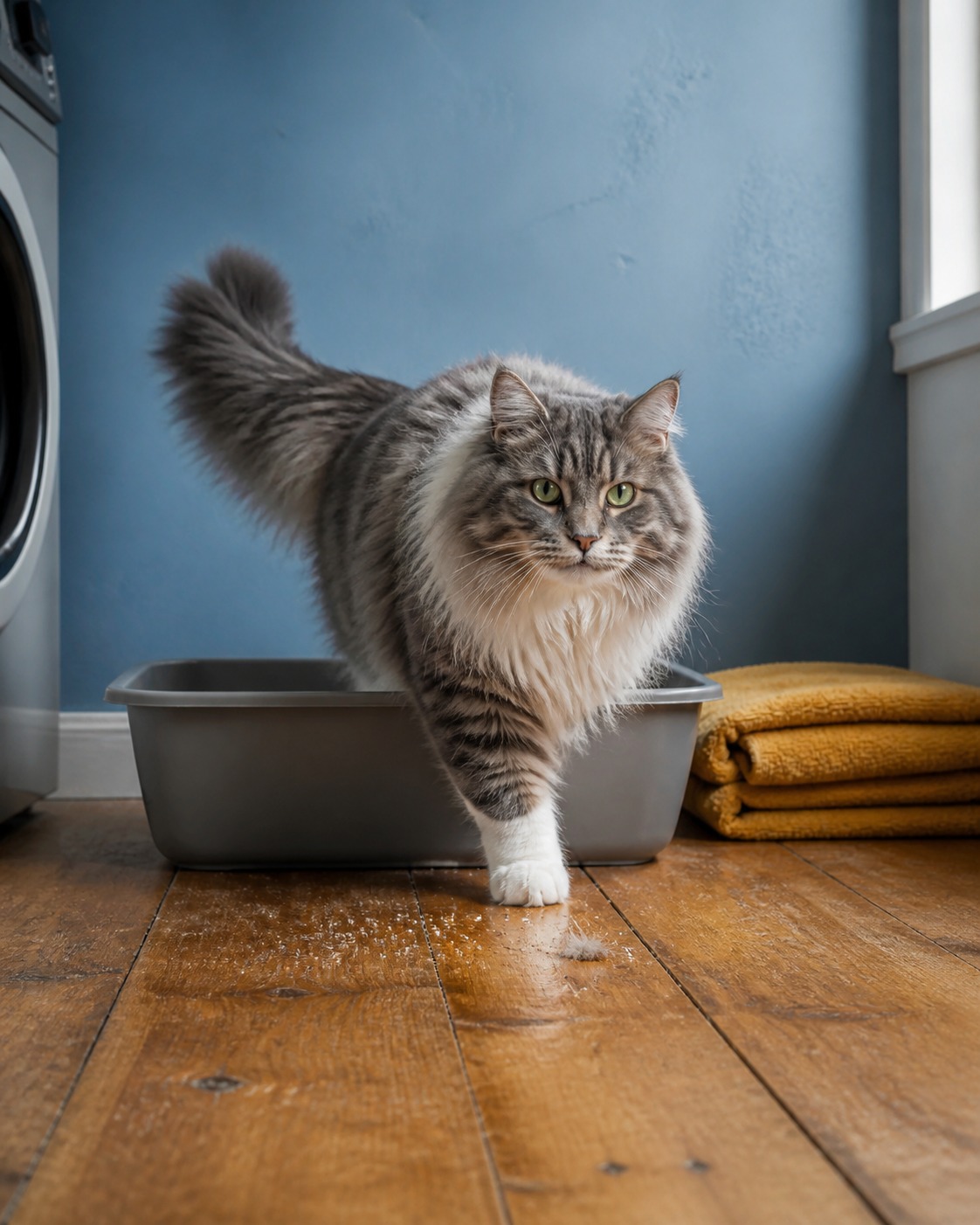
Most advice about cats and poop-covering answers the wrong question. It walks you through how to make a non-covering cat start covering, as if covering were the goal. For most cats, it is not. Plenty of perfectly healthy cats simply never bury their business, and there is nothing to fix.
The question that actually matters is different, and it is a diagnostic one: is your cat’s uncovered poop a lifelong personality trait, or is it a recent change? Those two situations look identical in the litter box and mean completely opposite things. One is a quirk you can shrug off. The other is your cat telling you something is wrong. Sort your cat into the right bucket first, and everything else follows.
First, why the instinct exists at all
It is flattering to imagine cats bury waste out of some innate tidiness, but that is a story we tell ourselves. The likelier driver is survival. Covering hides the scent of waste, and in the wild that makes an animal harder for predators to track, and harder for rival cats to locate. Your indoor cat has no predators prowling the hallway, but they are running ancestral software, behaving the way their lineage did rather than reacting to the actual safety of your living room.
That evolutionary backstory also explains the flip side. A very confident, socially dominant cat in the wild may deliberately leave waste uncovered as a territorial billboard, a scent signal broadcasting their presence. The same can happen at home with a self-assured cat. So both covering and not covering can be perfectly normal instincts, which is exactly why the behavior alone tells you so little. The context, and especially whether it changed, tells you everything.
Bucket one: the cat who never covered
If your cat has left poop uncovered for as long as you have known them, this is almost certainly who they are, not a symptom.
The most common reason is simply that they never learned. Covering is not fully hardwired; kittens pick it up largely by watching their mother do it. A kitten orphaned early, bottle-raised, or separated from mom before the lesson stuck may reach adulthood never having learned the behavior at all. Others learned it halfway and cover only sometimes. This is why kittens are famously inconsistent coverers and why adult cats, as a group, are more reliable than kittens.
For a lifelong non-coverer with no other litter box complaints, there is a genuinely reasonable option that most guides never mention: leave them alone. If a cat reliably uses the box and their only quirk is skipping the cover step, you can simply scoop promptly yourself and skip the behavior campaign entirely. Forcing the issue risks creating new litter box problems that are far worse than a little extra scooping. A cat who uses the box at all is worth being grateful for.
When an adult cat doesn’t cover, owners often assume something is broken. Frequently the cat just never learned the skill, and that is not a medical problem. I tell people the cat who has always been this way is usually fine. It is the cat who changes that I want to see.
Bucket two: the cat who used to cover and stopped
This is the version to take seriously. A cat who reliably buried their waste for years and then abruptly quits is showing a behavior change, and behavior changes in cats are one of the few windows we get into problems they cannot describe. There are three broad causes, and they run roughly in the order you should investigate them.
Pain and illness come first
Rule out medical causes before anything else. If defecating hurts, a cat wants out of the box as fast as possible and skips the leisurely covering routine, because they have come to associate the box with discomfort. Arthritis in an older cat can make the digging-and-covering motion itself painful, so they abandon the step even though the elimination is fine. General illness that makes a cat feel unwell can do the same. This is why a sudden change earns a vet visit, not a trip to the pet store. If something physical is at the root, no amount of litter box tinkering will fix it until the medical issue is addressed.
Then the litter box itself
An unhappy cat lodges complaints through behavior, and dropping the cover step is a common one. The box may be too small for the cat to turn and dig comfortably, too dirty to bother with, hooded in a way that feels like a trap, or placed somewhere that makes them uneasy. Cats dislike a box with a single exit that another pet or person could block, and they dislike a box in a high-traffic spot where someone might walk past mid-business. Any of these can be enough to make a cat do their business and leave in a hurry.
And finally, stress
Stress, whether or not it involves the box, can stop a cat from covering. Sometimes it is box-specific: a cat startled in the box once may quit lingering there. Often it is environmental and has nothing to do with the litter at all. A new cat or dog, a new baby, the racket of a home remodel, tension in the household, houseguests, a schedule change, a delivery person who rings instead of knocks, an unfamiliar candle or perfume, the list of feline stressors is effectively endless, and any of them can surface as a behavior change like this one.
“A stable habit that suddenly breaks is the signal I pay attention to,” Dr. Solis says. “If a cat changes their bathroom routine, I want to rule out pain and illness first, then look hard at what changed at home. The behavior is often the first clue we get, and sometimes the only one.”
If your cat is in bucket two, loop in a veterinarian, ideally one with behavior experience, or a qualified cat behaviorist. Do not start a training campaign on a cat who may be sick.
If you do want to encourage covering
Say your cat is in bucket one, healthy and settled, but you would genuinely prefer they cover. It is a reasonable want. Start with the environment, because a litter box makeover fixes far more cases than training ever does, and do not expect overnight results.
Get the litter box right
Design the box around the cat, not around what looks tidy to you. Cats overwhelmingly prefer large boxes with low sides and no hood; the cover is popular with humans and disliked by cats, so this is one place you defer to the cat. Put the box somewhere quiet and low-traffic, well away from where your cat eats, since cats, like us, want the kitchen and the bathroom to be separate rooms. Many cats start covering the moment they are given a bigger, more open box to work in.
Get the litter right
Litter preferences are real and sometimes strong. Most cats favor fine-textured, unscented litter over coarse or perfumed varieties, because large pellets feel rough on the paws and added scent is often off-putting. Clay is a common favorite, though some cats who reject everything else do surprisingly well on paper litter. Whatever you land on, keep it clean and scoop at least once a day, because some cats will happily cover in a fresh box and refuse in a dirty one.
Provide enough boxes
Cats value choice, and the number of boxes matters more than people expect. The AAFP and ISFM house-soiling guidelines put the standard at one box per cat plus one extra, placed in separate locations rather than lined up in a row. Crucially, that math means even a single-cat household should have two boxes in two different spots, not one. In a multi-floor home, keep at least one box on each level. Some cats also like to urinate in one box and defecate in another, which a single box makes impossible.
Only then, train
If the makeover does not do it and you still want covering, you can shape the behavior with a clicker. Start by reinforcing, with a click and a treat, any behavior even loosely related to covering: a single paw-scratch at the litter, pawing the air against the side of the box, or lingering a beat after eliminating. Then raise the bar gradually, rewarding motions that get closer to the real thing, pawing longer, pawing lower and nearer the litter, until your cat is reliably covering. Go slowly. Your cat has no idea how much this matters to you, and they deserve patience while they learn.
The honest bottom line
Covering is like any feline behavior in that it varies enormously, cat to cat and even day to day in the same cat. Some cats are fastidious, some are relaxed and cannot be bothered, and many land in the middle. On its own, an uncovered pile is not a verdict on your cat’s health or manners.
What it can be is a message, but only when it is new. So keep the one question front of mind. Has your cat always been this way, or did something change? A lifelong non-coverer is just a cat being a cat. A recent convert to leaving it uncovered is a cat worth a closer look, and sometimes a vet’s.
References
- American Association of Feline Practitioners and International Society of Feline Medicine. “AAFP and ISFM Guidelines for Diagnosing and Solving House-Soiling Behavior in Cats.” Journal of Feline Medicine and Surgery.
- Cornell Feline Health Center. “Feline Behavior Problems: House Soiling.” Cornell University College of Veterinary Medicine.
- American Animal Hospital Association and AAFP. “General Litter Box Considerations.” 2021 AAHA/AAFP Feline Life Stage Guidelines.
Common questions
Is a cat who never covers their poop a problem?
Usually no. If a cat has always left poop uncovered and has no other litter box issues, it is most often a personality quirk or a skill they never learned as a kitten, not a medical concern.
My cat used to cover and suddenly stopped. Should I worry?
Yes, this is the version worth investigating. A sudden change in a previously reliable coverer can signal pain, illness, litter box aversion, or stress, and it warrants a vet visit to rule out a medical cause first.
How many litter boxes should I have?
The AAFP guideline is one box per cat plus one extra, in separate locations. Even a single-cat home should have two boxes in two different spots.
Can I train my cat to cover their poop?
Yes. Clicker training can shape covering by rewarding each step toward the behavior, though some cats learn quickly and others take longer. A litter box makeover often works before training is needed.
Is it normal for kittens not to cover their poop?
Yes. Kittens learn covering by watching their mother, and many are still works in progress, covering inconsistently or not at all until they mature.
Dr. Solis is a board-certified veterinary dermatologist with over twelve years of clinical experience. She advises on skin conditions, allergies, and grooming practices that affect coat and skin health. All dermatology and allergy content at The Pet Times is reviewed by her team before publication.
Meet our experts ↗Keep reading
 TrainingYour Cat Isn't Attacking You. You Live on a Hunting Route.Dr. Amara Solis · 9 min
 Health & WellnessYour Cat Pooping on the Carpet Isn't Spite. It's a Message You Rule Out in OrderDr. Amara Solis · 8 min
 Health & WellnessCat Peeing in the Bathtub? Reach for the Vet, Not the Bleach.Dr. Lena Park · 9 min
 Health & WellnessYour Cat vs. the Christmas Tree: The Climbing Isn't the Real DangerDr. Ravi Mehta · 6 min
 TrainingThe Holiday Decoration That Sends Cats to Surgery (It Isn't the Ornament)Marcus Webb · 6 min
 TrainingWhy Your Cat Wakes You at Night, and How to Reclaim Your SleepDr. Lena Park · 5 min