


The Holiday Decoration That Sends Cats to Surgery (It Isn't the Ornament)
A shattered ornament is a mess. A swallowed ribbon is emergency surgery. Here is how to sort holiday decorations by real risk to your cat, and decorate around it.

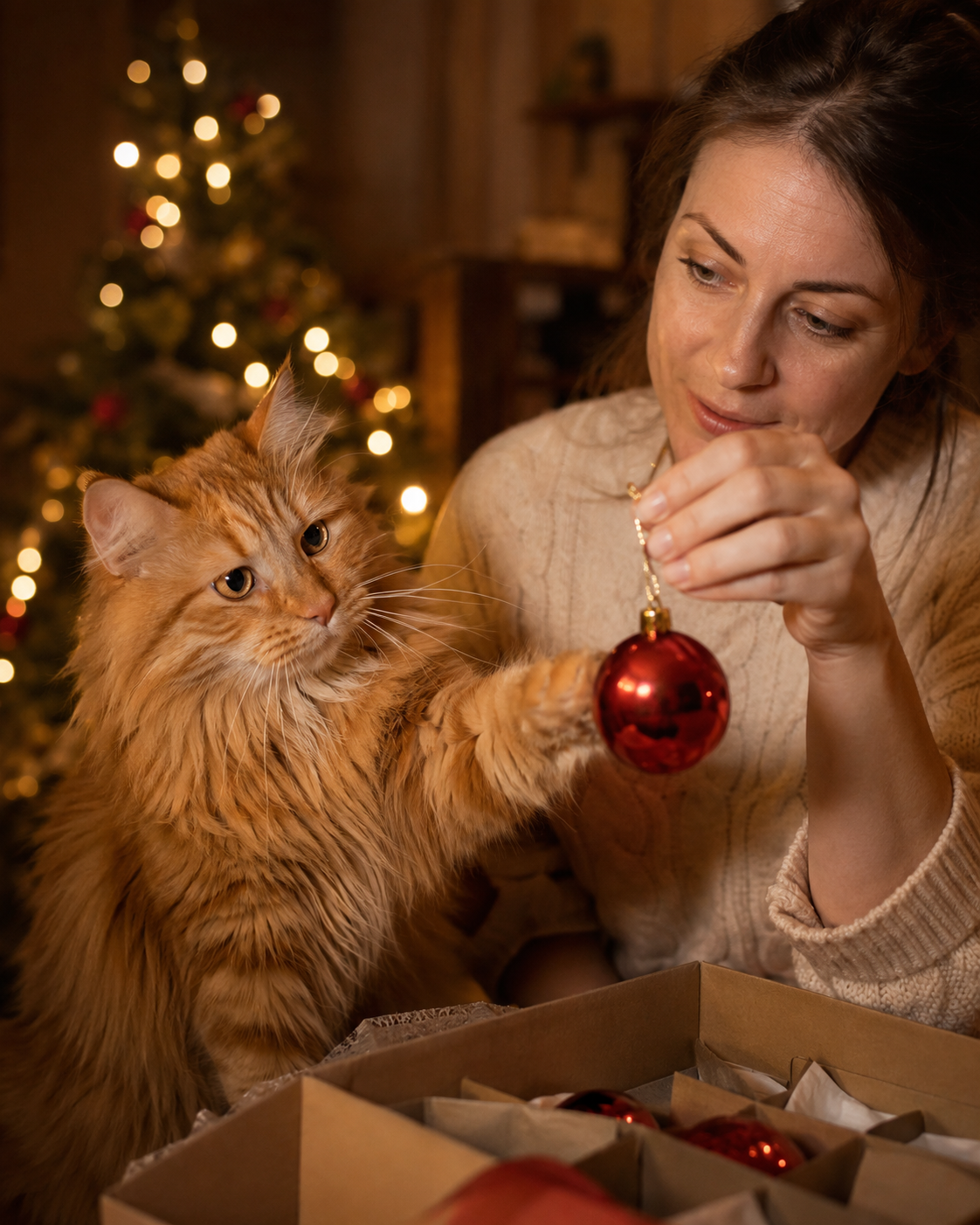
Most holiday cat advice treats every knocked-over ornament as the disaster. It is not. A broken bauble is a mess you sweep up and forget. The decorations that actually hurt cats are the quiet ones: a strand of tinsel, a length of curling ribbon, a low string of lights, a lily in a gift bouquet. Those do not make a sound when they go wrong, and by the time you notice, your cat may be at the emergency vet.
So this guide is sorted by risk, not by room. First the hazards that can genuinely injure or kill a cat, then the merely annoying breakage problem, then the training that makes December calmer for everyone. Get the first category right and the rest is just tidying.
The three decorations that are actually dangerous
Tinsel, ribbon, and garland. This is the big one, and it is worth being blunt about. Cats are hardwired to chase and mouth anything long, thin, and glittering, and a swallowed strand can bunch the intestine into an accordion. Vets call it a linear foreign body, and it is one of the classic feline holiday emergencies, often requiring surgery to fix. The safest move in a cat home is to skip tinsel entirely and to keep ribbon and garland cut short, secured, and off the floor. If you find a string hanging from your cat’s mouth or rear, do not pull it. Get to a vet.
Certain plants, lilies above all. A festive bouquet is one of the most dangerous things you can carry through your front door in December. Every part of a true lily, including the pollen and the water in the vase, can cause kidney failure in cats, and even a small exposure is a medical emergency. Poinsettias are mildly irritating and badly overhyped by comparison; lilies are the real threat. Before any bouquet comes inside, confirm it is lily-free, and when in doubt, keep flowers in a room your cat cannot reach.
Low light strands and cords. A chewed light cord is an electrical-burn and shock risk, and dangling low lights are an invitation. Run cords along walls, tape them down, and keep the bottom foot or two of the tree free of plugged-in lights.
“People brace for the dramatic crash of a falling tree, but the injuries I actually see are from the silent stuff a cat swallowed,” says Dr. Nina Kohl, a veterinarian on the Pet Times roster. “Tinsel and ribbon send more cats to the operating table over the holidays than a toppled tree ever will.”
Let your cat conquer the tree before you decorate it
Once the genuine hazards are handled, the tree is more of a logistics problem than a danger. Real or artificial, your cat reads it as a new tower to climb, and fighting that instinct head-on rarely works.
A holiday decoration is essentially a cat toy you have forbidden: it dangles, it swings, it catches the light. Add a cat’s twin urges to hunt from a high perch and to tuck themselves out of sight, and a decorated tree reads as a playground with a lookout tower built in.
The counterintuitive fix is to let the novelty burn off before a single ornament goes up. Give your cat a couple of days to sniff, bat at, and yes, climb the bare tree. A tree anchored to the wall or ceiling with fishing line survives that phase far better than a free-standing one. Once the tree is boring, you stand a real chance of decorating in peace.
Put the breakables and the heirlooms out of reach
It takes a determined cat about five seconds to end a family ornament’s multi-generational run. Store anything fragile or irreplaceable, or confine it to a room with a door you can close. For the spots your cat can reach, choose sturdier materials. Felt, paper, wood, and shatterproof ornaments are your friends, and they double as low-stakes cat toys if one comes down.
If your cat is especially busy-pawed, consider keeping the whole display to a single closeable room. It is less festive to lock the holiday spirit behind a door, but your nutcrackers will make it to next year.
Give the hunting drive somewhere better to go
You do not have to wait until the 25th to hand your cat a present, and they will not know the difference. A fresh scratching post, a new catnip toy, or a puzzle feeder redirects the same energy that would otherwise go into the garland.
“A cat whose day is already full of legal outlets has far less appetite for your garland,” Webb says. “You are giving their hunting drive somewhere better to go.”
If your cat is in the roughly one in three who shrug at catnip, reach for a silver vine toy instead. In a study of 100 cats, close to 80 percent responded to silver vine, and about 75 percent of the catnip non-responders lit up for it. A toy your cat actually cares about is worth more than any deterrent spray.
Yes, you can train a cat, and December is a fine time to start
Cats respond well to positive reinforcement, and it is never too late to begin, even mid-season.
“You cannot argue a cat out of a behavior; you can only outbid it,” Webb says. “Offer something more tempting than the ornaments, and pay out the instant they choose it, whether the currency is a treat, a chin scratch, or a feather wand. Stay consistent, because a new habit takes a little time to set.”
The earlier in the season you start, the better. Stock up on your cat’s favorite treats and use them to reward play with designated scratchers and toys instead of the string of lights. Your decorations, and your holiday sanity, will be in far better shape for it.
When to call the vet
Do not wait and watch if you see any of these after a run-in with the decorations:
- A string, ribbon, or tinsel visible in the mouth or coming from the rear. Do not pull it, and go to a vet.
- Repeated vomiting, a hunched posture, or refusing food, which can signal an intestinal obstruction.
- Any known or suspected lily exposure, including chewed leaves, pollen on the fur, or drinking vase water. This is an emergency; lily toxicity is time-sensitive.
- Drooling, a burned or blistered mouth, or a chewed light cord.
The mess you can see is never the problem. The one you cannot is.
References
- “Foreign Bodies (Gastrointestinal) in Cats.” Cornell University College of Veterinary Medicine, Feline Health Center. https://www.vet.cornell.edu/departments-centers-and-institutes/cornell-feline-health-center
- “Lily Poisoning in Cats.” Pet Poison Helpline. https://www.petpoisonhelpline.com/poison/lilies/
- Bol, S., et al. “Responsiveness of cats (Felidae) to silver vine, Tatarian honeysuckle, valerian and catnip.” BMC Veterinary Research, 2017. https://bmcvetres.biomedcentral.com/articles/10.1186/s12917-017-0987-6
Marcus Webb writes about the gear, gadgets, and everyday choices that make life with a pet easier. His coverage runs from product picks to training and the causes worth paying attention to, always with an eye on what actually earns a place in your home.
Meet our experts ↗Keep reading
 TrainingThe N+1 Litter Box Rule Isn't About Sharing. It's About ChoiceDr. Mara Chen · 7 min
 Health & WellnessYour Cat vs. the Christmas Tree: The Climbing Isn't the Real DangerDr. Ravi Mehta · 6 min
 TrainingYour Cat Doesn't Bury Their Poop? The Only Question That MattersDr. Amara Solis · 8 min
 Health & WellnessYour Cat Peed on Your Clothes. The Fabric Is the Clue.Dr. Lena Park · 8 min
 Health & WellnessYour Cat Pooping on the Carpet Isn't Spite. It's a Message You Rule Out in OrderDr. Amara Solis · 8 min
 TrainingYour House Is Too Cold for Your Cat. Your Laptop Isn't.Dr. Nina Kohl · 6 min