


Stop Watching Who's Winning. The Real Tell in a Cat Fight Is Who Trades Places
Owners try to referee cat scuffles by who's on top. Researchers found the honest signal is reciprocity, and three quick checks tell you whether to relax or step in.

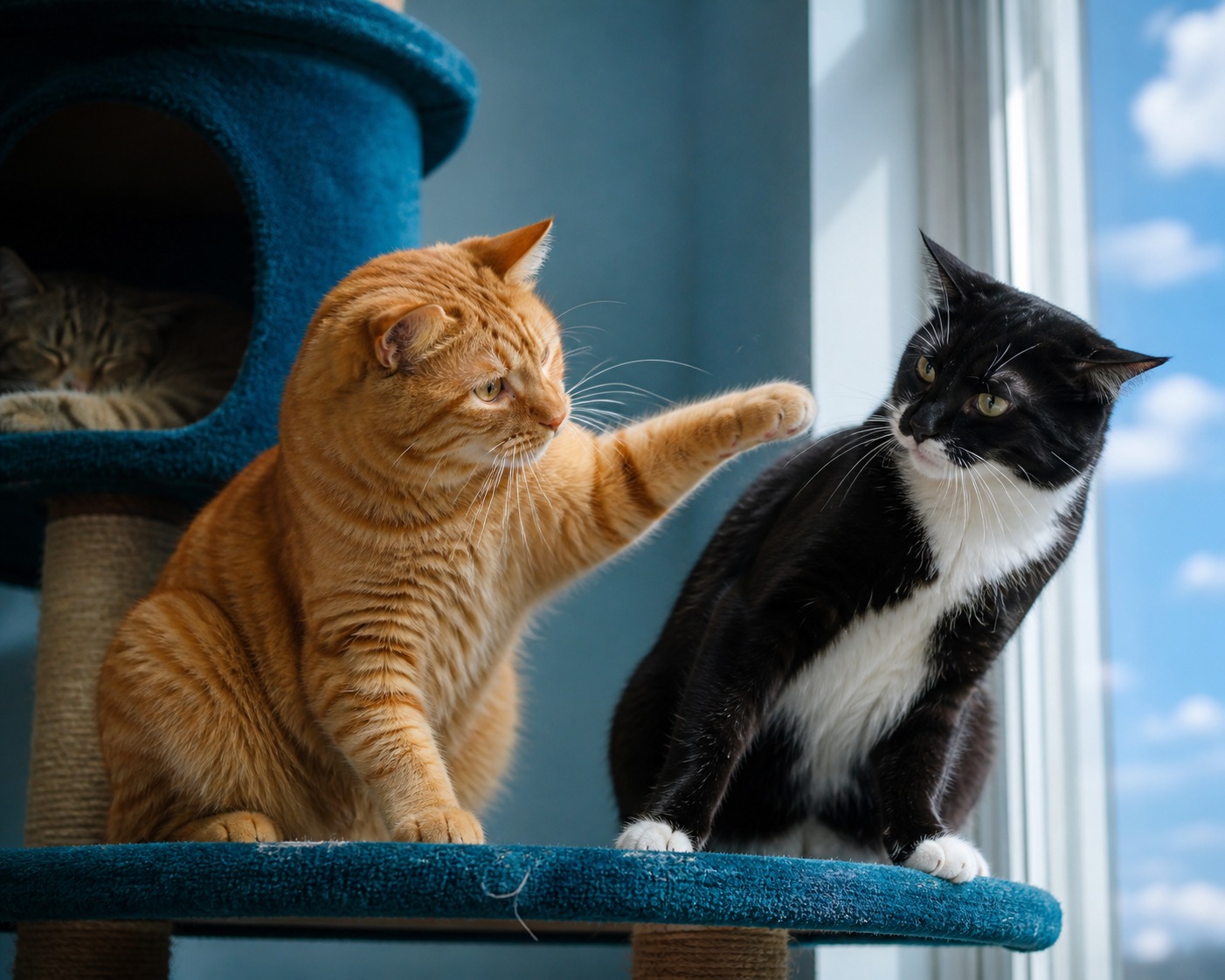
When two cats hit the floor in a tangle of legs, most of us instinctively scan for a winner and a loser, who’s pinning whom, who looks like they’re getting the worst of it. That instinct is exactly backward. A study that put cat interactions under a microscope found that the single most reliable way to tell play from a real fight isn’t who’s on top. It’s whether the two cats keep trading places. Play is a conversation. A fight is a one-way street.
That reframing turns a stressful guessing game into something you can actually read in a few seconds. Here’s the science behind it, and a quick on-the-spot check you can run the next time the living room erupts.
Why “who’s winning” misleads you
A lot of cat play is borrowed wholesale from hunting and fighting. The pounce, the bite, the bunny-kick, the chase: strip away context and a friendly wrestling match looks alarmingly like combat. That’s the whole problem. The individual moves don’t distinguish play from aggression, because play uses the same moves on purpose. Judging by who appears dominant in any given second tells you almost nothing.
Researchers analyzed 105 videos of cat pairs (210 cats total) pulled from YouTube and submitted by owners. Four experts, two academics and two applied animal behaviorists, independently sorted each clip as playful, intermediate, or agonistic (the technical term for conflict-related behavior). Seven clips were tossed because the experts couldn’t agree, which is itself a useful reminder: even professionals find the middle zone genuinely hard. A statistical analysis then grouped the videos by which behaviors clustered together, and those data-driven groups lined up cleanly with the experts’ three categories. Tellingly, play and the intermediate category had more in common with each other than the intermediate category had with true fighting.
The three checks that actually work
Forget refereeing. Run these three reads instead. None requires expertise, and together they’ll resolve the large majority of tussles.
1. Are they swapping positions?
This is the headline finding. Cats that wrestle and regularly switch who’s on top and who’s on the bottom, the same cat ending up underneath and then on top repeatedly, are almost certainly playing. Reciprocity is the signature of play. The flip side is the clearest red flag in the study: if one cat is always the chaser, or always the one on top, the interaction isn’t reciprocal and is likely agonistic.
2. Is it quiet?
Silence is a good sign. Cats that wrestled without vocalizing were generally being playful, especially when the bout went on for a while. Conflict, by contrast, came packaged with vocalizations, hissing, growling, yowling, often combined with bouts of inactivity and a lot of chasing with little actual contact. So lots of noise plus lots of chasing plus little wrestling is the pattern to worry about. A long, silent, hands-on wrestling match is usually friendly.
3. Are there breaks?
Watch for the pauses. Intermediate interactions, the genuine gray zone, tend to involve lots of breaks where the cats stop and reassess. In those moments you might see an arched back, raised fur, a hiss, or one cat declining to re-engage. Some of these bouts flip back and forth, clear mutual play one minute, one cat wanting to continue while the other has had enough the next. Breaks aren’t automatically bad, but a break where one cat is trying to disengage and the other won’t let up is the moment tension is building.
A 10-second scorecard
If you want one mental tally, score the scene as you watch:
- Lean toward “just playing” if positions keep switching, it’s mostly quiet, bodies are loose, and there’s plenty of full-contact wrestling rather than chasing.
- Lean toward “stop this” if one cat does all the chasing or stays on top, there’s repeated hissing or yowling, you see lots of chase with little contact, or one cat is clearly trying to leave and can’t.
- Watch a beat longer if it keeps pausing and resetting with mixed signals. That’s the intermediate zone, and the next 20 seconds usually tip it one way.
The background context matters too. Cats that otherwise sleep curled together, share food and toys, and stay in easy contact have a relationship that can absorb the occasional flash of friction during play. Kittens, the study noted, were especially likely to be playing. A spat between two cats who normally can’t stand each other deserves a closer look than the same spat between bonded littermates.
If you do need to break it up
The one thing not to do is reach in and grab a cat mid-scuffle; you’ll likely get bitten or scratched by a redirected, adrenaline-charged animal, and you may make the cats associate each other with the unpleasant interruption.
“Never use your hands to separate fighting cats,” said Dr. Mara Chen, a veterinarian who consults for The Pet Times. “Break their line of sight instead. Toss a thick towel over one, slide a piece of cardboard or a couch cushion between them, or make a sharp noise from across the room. Then let each cat retreat to its own space and decompress separately before you try to reintroduce calm.”
The deeper point is that play, by definition, only counts as play if everyone’s a willing participant. No checklist sorts every interaction perfectly, because cat play is flexible and shades into the gray zone by design. But once you stop scoring the match like a wrestling judge and start watching for reciprocity, quiet, and willing breaks, the calls you actually need to make, relax or intervene, get a great deal easier.
References
- Gajdoš Kmecová, Noema, et al. “Are These Cats Playing? A Closer Look at Social Play in Cats and Proposal for a Psychobiological Approach and Standard Terminology.” Scientific Reports, vol. 13, 2023. https://www.nature.com/articles/s41598-022-26121-1
- International Cat Care. “Playtime and Play Behaviour in Cats.” https://icatcare.org/
Nina Vasquez writes about life at home with pets and the relationships at the heart of it. Her work covers day-to-day living, people-and-pet stories, and the products that fit into a real household, with a warm, grounded take on everyday pet ownership.
Meet our experts ↗Keep reading
 TrainingPawmistry Is Nonsense. But the Urge Behind It Just Got a Real AnswerSasha Ford · 5 min
 TrainingStop Looking at Your Cat's Mouth. That's Not Where the Smile IsTom Hadley · 7 min
 TrainingYour Cat Isn't Seeing Ghosts. They're Seeing What You Can't.Nina Vasquez · 5 min
 Health & WellnessThe Cat Loaf Has a Dark Version. It's in the Face, Not the Paws.Dr. Mara Chen · 8 min
 TrainingYou Can Tell When Your Cat Is Happy. That's the Problem.Dr. Priya Nair · 7 min
 TrainingYour Cat's Trust Isn't Affection. It's a Threat Assessment You Keep Passing.Dr. Lena Park · 8 min