


Stop Looking at Your Cat's Mouth. That's Not Where the Smile Is
A cat's mouth is the least honest part of their face. The real emotional signals, contentment and, more importantly, pain, live in the eyes, ears, and whiskers. Here's how to read the parts that actually tell the truth.

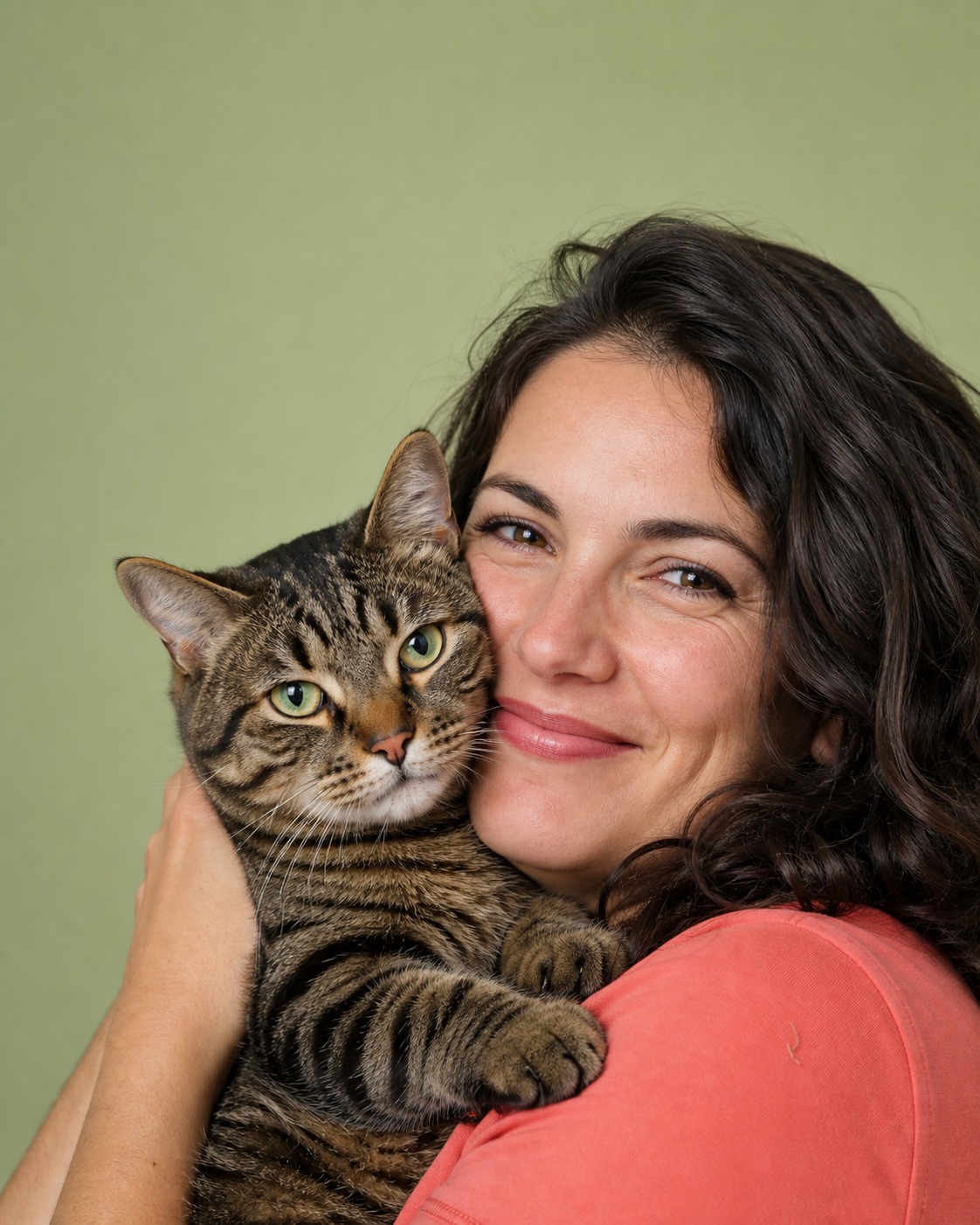
Ask whether a cat can smile and you have already made the mistake, because you are staring at the mouth. And the mouth is the one part of a cat’s face you should more or less ignore. It is the least expressive real estate they have. The genuine emotional broadcast, whether your cat is content, wary, or hurting, plays out in the eyes, ears, and whiskers. Learn to read those, and you will not only know when your cat is happy. You will catch when something is wrong, which is the far more valuable skill.
People look for a smile in the wrong place. A cat’s mouth barely moves. If you want to know how a cat feels, watch the eyes and ears first, every time.
There is a humbling reason to get better at this: cats are already good at reading us. Research has shown cats can recognize and even match human emotions expressed through facial expression and tone of voice. So the honest question is not whether cats smile. It is whether we are paying close enough attention to notice what they are actually telling us.
Why a cat’s face is built to be subtle
Cats did not evolve big, obvious expressions, and there is a reason. They developed in arid regions where resources were thin, which meant large territories and rare, mostly hostile encounters with other cats outside of mating and raising kittens. With little need to broadcast feelings at close range, cats never grew the elaborate facial musculature that humans and dogs did. We evolved in social groups and lean on faces; cats leaned on signals that carry across a distance instead, tail and ear position, body posture, and vocalizations like hissing.
It is an efficient system. A cat can warn off a rival from across a clearing. And frankly, if a cat is terrified or furious, you want to read it from the far side of the room. The catch is that this leaves the up-close facial signals subtle, half-hidden in fur, and easy to misread, which is exactly why most people default to the mouth and get it wrong.
The eyes: where the real “smile” happens
If a cat has anything like a smile, it is in the eyes, and it is called the slow blink: a series of half-blinks followed by the cat narrowing or briefly closing their eyes. It reads as relaxation and trust, and it is one of the few cat signals with solid experimental backing. A 2020 study found cats are more likely to slow-blink back at a human who slow-blinks at them, and more likely to approach that person afterward. Try it: send your cat a few slow blinks and watch.
The flip side matters just as much. A hard, unbroken stare is the opposite of a slow blink. It is the opening move of the hunting sequence, so to another cat, and often to yours, direct staring reads as a threat. Gentle blinks are an invitation; a fixed gaze is a challenge.
The face that tells you your cat hurts
Here is where reading the face stops being cute and starts being important. A cat’s expression is one of the earliest windows into pain, and cats are experts at hiding pain until it is advanced.
The Feline Grimace Scale is a validated clinical tool for assessing pain in cats, and its cues are worth memorizing. A cat in significant pain tends to show a tense, elliptical muzzle, straight whiskers angled stiffly away from the face, squinted eyes, and ears rotated outward or flattened. A comfortable cat shows the opposite: a rounder, relaxed muzzle and softly curved, forward whiskers. Because it lives in the eyes, ears, and whiskers, this is precisely the information you miss if you are watching the mouth for a grin. Catching it early can mean catching a dental problem, an injury, or an illness before it becomes an emergency.
The other mouth move that isn’t a smile (or a sneer)
While we are near the mouth, one look deserves clearing up: the Flehmen response. Ever seen your cat sniff something and freeze with an open-mouthed, faintly disgusted grimace? That is not distaste. The cat is pulling scent over the Jacobson’s organ in the roof of the mouth, just behind the front teeth, to decode pheromone information. It looks hilarious. It is actually sophisticated chemical analysis.
The ears, in one glance
Ears are the fastest read on the face. Upright and forward means interest and ease. Flattened out to the sides, the classic “airplane ears,” means fear. Pinned back tight means anger, and a clear cue to give your cat room.
Five signs of a genuinely happy cat
Once you are reading the honest parts of the face, these five signs confirm a content cat. Notice how few of them involve the mouth.
1. Soft, slow-blinking eyes
The single best sign, and the one to return. Drowsy half-blinks signal a relaxed, trusting cat, and blinking back is the simplest way to say it is mutual.
2. Upright, forward ears in a loose posture
Ears up and pointed forward on a loosely held body means an at-ease cat tuned into the world without alarm. A cat sprawled on their side is usually more relaxed than one in a tight, ready-to-launch loaf.
3. A high tail with a question-mark curve
Think of the tail as a mood barometer: generally, the higher the tail, the happier the cat, especially with that little hooked curve at the tip that signals a friendly cat open to interaction. (A few exceptions exist, so always read the rest of the body too.)
4. Purring while kneading
Purring and kneading during petting is one of the clearest signs of contentment. If you have thought my cat smiles when I pet him, you are usually seeing relaxed facial muscles form a soft mouth shape while the purr and knead do the real talking.
5. Playing, and head-bunting you
Scared cats do not play; happy cats do. When a cat lets loose with a toy, they have dropped their guard. And when they rub or bonk their head against you, they are marking you with their scent, a compliment reserved for favorite people, and a way of “petting themselves” on someone they trust.
A few faces that look like smiles but aren’t
Worth flagging the look-alikes. Bared teeth almost never mean happiness in a cat; teeth come out with a hiss, which signals your cat is upset with someone or something, possibly you. And a normally sweet cat who turns persistently moody or withdrawn is worth a second look at their environment, routine, and health rather than a shrug, sometimes that “grumpy face” is the grimace scale trying to tell you something.
The science is catching up, on both sides
Reading a cat’s face is becoming an evidence-based skill rather than pure intuition. The developers of the Feline Grimace Scale at the Université de Montréal now offer a free companion training tool and app, helping owners and clinicians spot pain more reliably. And the gap between how well cats read us and how well we read them may be closing: a 2025 study in Frontiers in Ethology found that watching a short training video measurably improved people’s ability to recognize cat emotions during play. In other words, this genuinely gets better with practice, which is the best argument for stopping the mouth-watching and starting with the eyes.
FAQs
Where should I look to tell if my cat is happy?
The eyes and ears first. Soft slow-blinking eyes and upright forward ears signal ease, confirmed by a high question-mark tail, purring, kneading, and head-bunting. The mouth is the least expressive part of the face.
Can a cat’s face tell me if they’re in pain?
Yes, more reliably than it shows happiness. The Feline Grimace Scale reads pain from a tense elliptical muzzle, straight whiskers pulled from the face, squinted eyes, and flattened ears.
Why is my cat showing their teeth?
Almost never a smile. Cats bare teeth when they hiss, a sign of fear or anger. Read the eyes, ears, and body first.
References
- Humphrey, Tasmin, et al. “The Role of Cat Eye Narrowing Movements in Cat–Human Communication.” Scientific Reports, vol. 10, 2020. https://www.nature.com/articles/s41598-020-73426-0
- Quaranta, Angelo, et al. “Emotion Recognition in Cats.” Animals, vol. 10, no. 7, 2020. https://www.mdpi.com/2076-2615/10/7/1107
- Evangelista, Marina C., et al. “Feline Grimace Scale.” Université de Montréal. https://www.felinegrimacescale.com/
Tom Hadley writes about training and behavior, helping owners understand what their pets are trying to tell them. His work covers everyday manners, decoding common behaviors, and the small changes at home that make dogs and cats easier to live with.
Meet our experts ↗Keep reading
 TrainingYour Cat Follows You Everywhere Because You're the RestaurantDr. Nina Kohl · 7 min
 TrainingYes, Cats Are Ticklish. The Real Skill Is Knowing When to StopSasha Ford · 6 min
 TrainingYour Cat's 3 A.M. Meltdown Isn't Random. It's a Schedule You BuiltDr. Nina Kohl · 4 min
 TrainingYour Cat Isn't Attacking You. You Live on a Hunting Route.Dr. Amara Solis · 9 min
 TrainingWhy Your Cat Rolling in Catnip Is Actually Bug SprayDr. Lena Park · 4 min
 TrainingThe Couch Isn't the Problem. It's Where You Put the Scratching Post.Dr. Nina Kohl · 7 min