


Why Your Cat Rolling in Catnip Is Actually Bug Spray
Catnip turns cats into happy, drooly goofballs, but researchers discovered it does something useful too: the same chemical that makes cats high also repels mosquitoes.

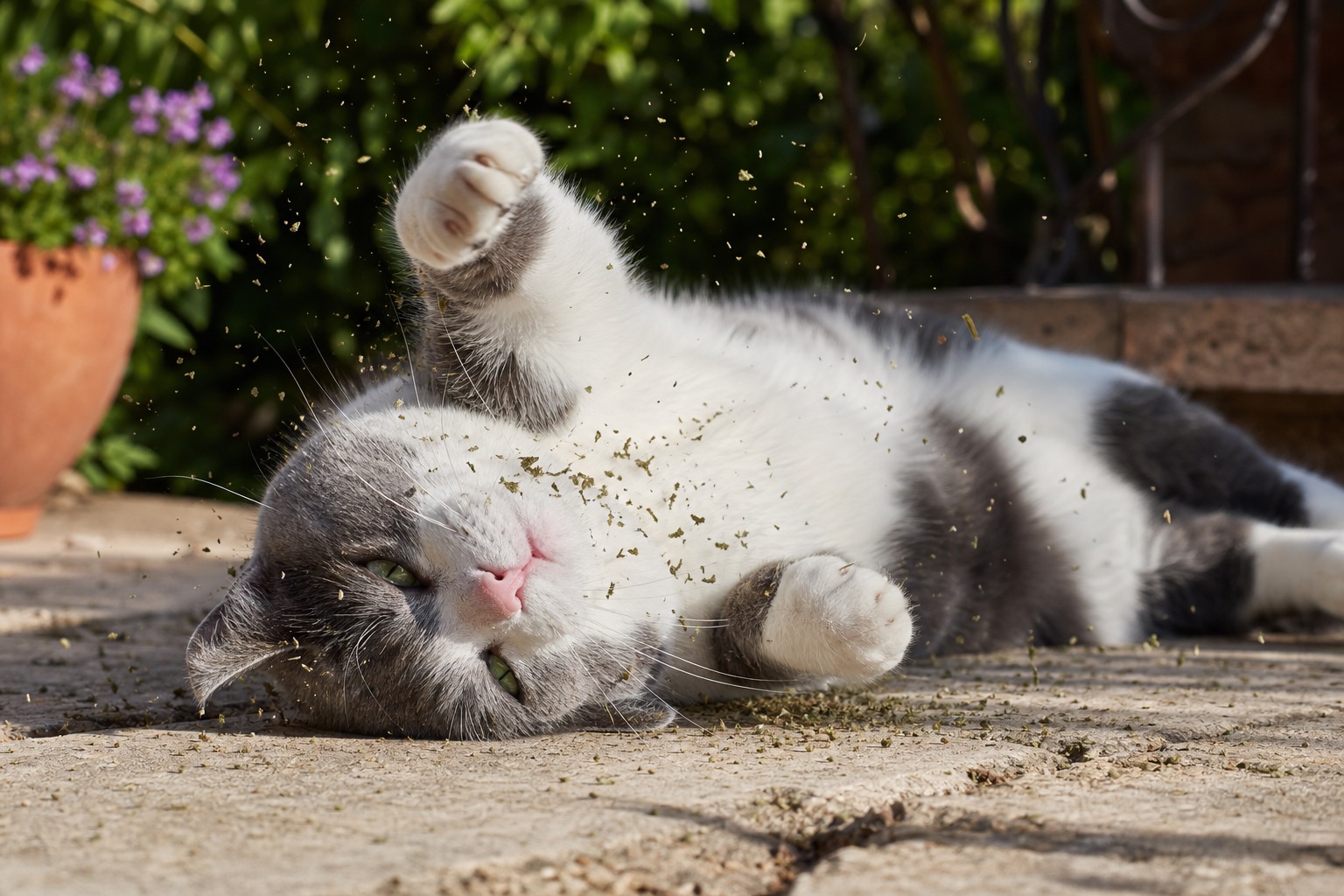
We could watch our cats lose their minds over catnip all day. They roll, purr, drool, and generally behave like they have been possessed by some mischievous green spirit. (If your cat is one of the roughly 40 percent who feel nothing from catnip, we feel for you. It really is a great show.)
But here is the part most cat parents do not know. All that rolling and rubbing is not just adorable, and it is not just for fun. When your cat anoints themselves with catnip, they are essentially applying natural bug spray.
What catnip actually is
Catnip goes by a lot of names, including catmint, catwort, field balm, and its botanical name Nepeta cataria. It is a perennial herb in the mint family, a muted green plant with fuzzy stems and jagged, spear-shaped leaves that can grow up to three feet tall. Its small, pale purple flowers bloom from July through October. People grow it as a kitchen herb, and it is completely safe to give to cats even though it briefly turns some of them into adorable little gremlins.
A second plant produces a similar effect: silver vine (Actinidia polygama), known as matabi in Japanese.
Catnip and silver vine come from totally different plant families, but they make compounds with strikingly similar chemical structures, which is why both can send a cat into that classic licking, chewing, rubbing, rolling routine.
The active ingredient in catnip is a compound called nepetalactone. Silver vine carries a close cousin called nepetalactol. When a cat smells these compounds, it stimulates the opioid system in their brain and produces that blissed-out, feel-good response, a finding documented in a 2021 study published in the journal Science Advances. Every cat reacts differently. Some mellow out, some go wild, some melt into a purring puddle, and some feel nothing at all. Even big cats like lions, tigers, and bobcats can get in on it.
The bug-spray discovery
That 2021 study, run by researchers at Iwate University in Japan, set out to do more than confirm that cats find catnip delightful. The team wanted to know why cats are so drawn to it in the first place, and the answer turned out to be surprisingly practical.
Nepetalactone is a natural mosquito repellent. When a cat rubs their face and body against catnip, they coat themselves in the compound and gain a measure of protection against biting insects. This self-anointing behavior appears to be a uniquely feline trick. The researchers tested dogs too, and the dogs could not have cared less.
Cats are not the only animals that do this, though. Spider monkeys rub themselves with leaves from the piper plant, another natural insect repellent. The white-nosed coati, a raccoon relative found from southern Arizona down through Central and South America, uses citrus fruit to fend off pests. The logic is easy to follow. Mosquitoes and other parasites spread disease and leave itchy, maddening bites, so anything that keeps them away is worth the effort.
Why the rubbing matters
That compulsive face-rubbing your cat does on their catnip toy is not random. A follow-up study from the same Iwate University team found that the rubbing and biting is what makes the repellent work better.
For the experiment, researchers offered cats a synthetic blend of chemicals matching what is found in both intact and damaged catnip leaves. The effect lasted noticeably longer with the mixtures that mimicked damaged leaves. In other words, when a cat chews, claws, and rolls on catnip, the bruised plant releases more nepetalactone, which gives the cat a stronger chemical shield against mosquitoes and may protect them from other biting insects too. It also keeps the instinct to play going.
Researchers still want to pin down exactly why cats evolved this behavior, but they suspect it is unique to the cat family. As the team put it, it seems only the Felidae species developed the specific scent receptors that respond to these compounds, receptors other mammals simply do not have.
What’s new since this was written
Scientists have continued digging into the genetics behind this behavior. The Iwate University team has signaled interest in identifying the specific gene that drives the catnip response, which could eventually explain why some cats react and others stay completely unbothered. For now the takeaway for pet parents is simple and a little charming: your cat’s goofiest habit may double as old-fashioned pest control.
Your cat does not really need to worry much about bugs day to day, but there is no harm in letting them go wild. A catnip toy is cheap entertainment, good enrichment, and apparently a tiny act of self-care all at once.
References
- Uenoyama, Reiko, et al. “The Characteristic Response of Domestic Cats to Plant Iridoids Allows Them to Gain Chemical Defense against Mosquitoes.” Science Advances, vol. 7, no. 4, 2021. https://www.science.org/doi/10.1126/sciadv.abd9135
- Uenoyama, Reiko, et al. “Domestic Cat Damage to Plant Leaves Containing Iridoids Enhances Cat Attraction.” iScience, vol. 25, no. 7, 2022. https://www.cell.com/iscience/fulltext/S2589-0042(22)00726-X
Dr. Park is a board-certified emergency and critical care specialist. She reviews our health and safety content for clinical accuracy and contributes guides on recognising urgent conditions. Her focus is helping owners act quickly and correctly when it matters most.
Meet our experts ↗Keep reading
 TrainingThe 'Talking Cat' Videos Get It Backwards: Your Cat Is Working You, Not CopyingTom Hadley · 7 min
 TrainingYour Cat Isn't Being Weird. Your Bowl IsDr. Ravi Mehta · 8 min
 TrainingYour Cat Is Trying to Bury Something. The Question Is What.Dr. Lena Park · 8 min
 TrainingYes, Cats Are Ticklish. The Real Skill Is Knowing When to StopSasha Ford · 6 min
 TrainingThat Sound Isn't a Meow. And It Isn't Good News.Dr. Lena Park · 8 min
 TrainingYour Cat Doesn't Care About the Bathroom. They Care That You Finally Sat Down.Dr. Priya Nair · 8 min