


The 'Talking Cat' Videos Get It Backwards: Your Cat Is Working You, Not Copying
Cats can't physically reproduce human words, and the viral clips prove it. The real story is stranger: domestication rebuilt the meow into a tool aimed at one species, us, so your cat doesn't need language to get exactly what it wants.

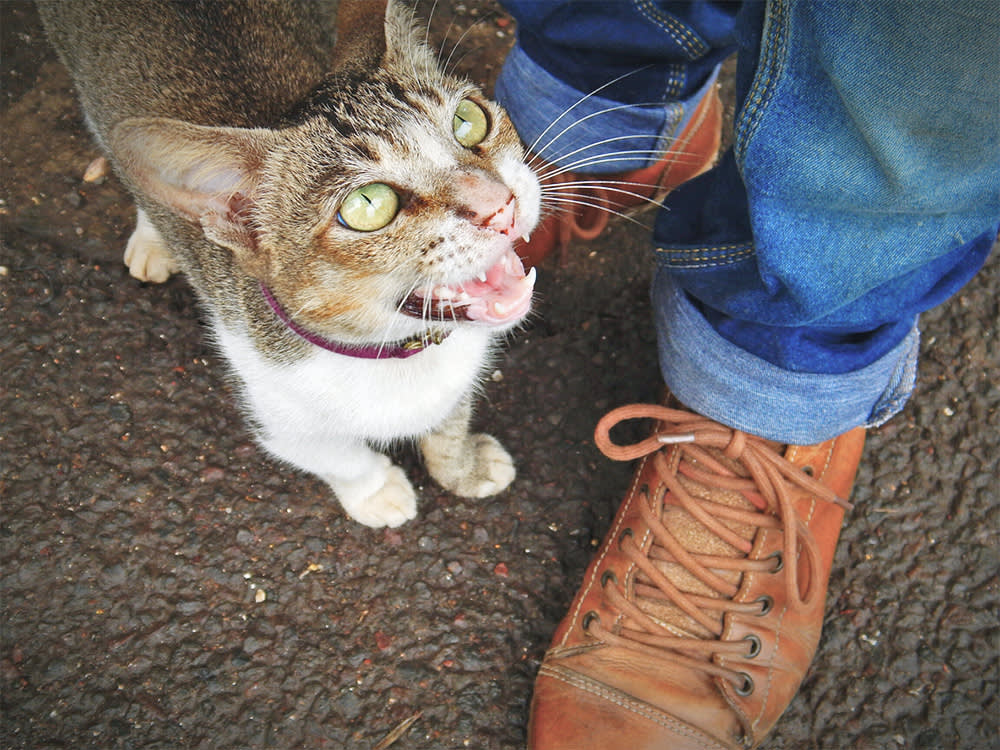
Here is the uncomfortable thing about the cat who “says hello.” Your cat doesn’t need to learn English, because it already runs a more efficient system: a sound it evolved to fire straight at your nervous system until you do what it wants. The viral clips ask the wrong question. The interesting one isn’t “can cats copy our words.” It’s “why does a creature that can’t form a single human word still get fed, petted, and let onto the counter on demand.” The answer is the opposite of mimicry, and it’s a far better story.
Why the words are physically off the table
Start with the ceiling, because it settles the headline fast. A cat cannot reproduce human speech, full stop, and the reason is plumbing, not motivation.
Humans draw on a vast sound inventory. Across the world’s languages there are roughly 600 consonant sounds and 200 vowel sounds; English alone uses 24 consonant phonemes and 15 vowel phonemes to build 39 distinct, meaningful sounds, recombined endlessly into words. A cat’s vocal apparatus produces around 21 distinct sounds total, chirps, growls, gurgles, hisses, moans, mews, and each one signals a blunt internal state, pain, pleasure, want, threat, rather than a unit you can stack into sentences.
A cat’s larynx and vocal tract simply aren’t built for the range of sounds we call speech. They have a rich vocal palette, but it’s the wrong palette. Expecting articulate English from it is like expecting a trumpet to play a chord. It’s an anatomy limit, not a willpower one.
And cats don’t assemble sounds into words the way we do. Even if the hardware allowed it, the operating system doesn’t run that program. So whatever you’re hearing in the clip, it isn’t a word being formed.
So what are you actually hearing?
Once you accept the words are impossible, the “hello” cat needs a different explanation, and there are four, none of which require a talking cat.
The audio may be edited. Plenty of these clips are sweetened or pitched before posting to nudge a meow toward something human.
You’re primed to hear it. In the famous “Bongiorno” clip the woman says the word a beat before the cat meows, so your brain is handed the template and goes looking for the match. Even with no spoken cue, you probably rewatched the video to “get” it, and the instant you knew what to listen for, it snapped into place. It’s the song-lyric effect: you can’t make out the line until you read it, and then you can never un-hear it.
It’s almost always a one-off. These are isolated moments, not a repertoire. If a cat actually said “hello” on cue, its owner would have posted a supercut for the clout by now. The single-clip pattern is the tell.
It can be plain chance. Think of the infinite-monkey idea. Across enough cats meowing enough times, a handful of meows will land, by coincidence, near a human word.
The plot twist domestication wrote
Here’s the part the videos miss entirely, and it’s the reason your cat doesn’t need words.
The adult meow is not really a cat-to-cat signal. Feral cats raised without human contact barely meow at people at all; they reserve it, and even kittens taper it off with other adult cats. The chatty, insistent, aimed-at-your-face meow is something housecats developed specifically for us. Researchers comparing domestic cats with their wildcat relatives have found that domestic meows are shorter, higher-pitched, and rated by human listeners as distinctly more pleasant than the harsher calls of African wildcats. Domestic meows also vary far more from cat to cat, the acoustic signature of a vocal tool that’s been bent, over generations of living with humans, to push human buttons.
In other words, your cat skipped language and went straight for leverage. It didn’t learn your words; it engineered a sound you find hard to ignore and easy to like, then learned which version of it gets the can opener moving.
“What looks like a cat trying to talk is usually a cat that has learned, very precisely, which sound gets a result from you,” Hadley says. “A particular meow brings food, so that meow gets sharper and more frequent. That’s not imitation. That’s training, and you’re the one being trained.”
That reframes the viral cat completely. The animal isn’t reaching up toward human language. It has built a shortcut around it.
Smart enough to read you, not to recite you
This works because cats are genuinely good at reading people, even though they fall well short of language-level cognition. Cat brains resemble ours in structure and folding, but the scale is different: roughly 300 million neurons in the cerebral cortex against our 21 to 26 billion. (For the record, that’s about double a dog’s cortical neuron count, so that particular bar argument is over.)
“Cats understand far more of our speech than people assume, just not as language,” Hadley says. “They’re locked onto how you say something, and they catch the load-bearing words, their name, the sound of you reaching for the food. They run on tone, context, and pattern. They can’t parse a sentence, but they can predict what a sentence usually leads to, food, play, the lap.”
Which is exactly what makes the meow-as-tool strategy pay off. A cat doesn’t need to decode your words; it needs to clock your patterns and aim the right noise at the right moment.
The button cats, and why they’re not mimics either
The natural follow-up is the soundboard buttons, the recordable pads that supposedly let a cat “talk.” You record a word, then teach the cat to link pressing the pad with an outcome, usually starting with “food”: press, food, repeat, until the association sticks, then add the next word.
Some animals do strikingly well. The largest effort here, a citizen-science project run with researchers at UC San Diego, has been collecting button data from thousands of pets, and the numbers have grown fast: by late 2024 more than 500 dogs in the dataset were producing multi-button sequences, well up from around 150 a year earlier, with cats in the mix too. Early analysis suggests a meaningful share of presses aren’t random, which is genuinely interesting. But the researchers are careful, and so should we be: a button is an outcome lever, not speech. The pet is associating a pad with a result, the same trick as the targeted meow, just with a plastic interface. It’s communication, not imitation, and definitely not copying your voice.
How to actually talk with your cat
The fantasy under all these videos is a real conversation, knowing for certain what your cat wants, when it’s scared, when it hurts. The good news is your cat already tells you all of that. The bad news, if you want to call it that, is that it’s on you to learn the channel, because cats lean far harder on non-verbal signals than on sound.
Tail position, ear orientation, eye contact, and scent marking carry most of the message. A threatened cat puffs and hisses; a content one purrs and kneads; a cat rubbing its cheek on your shin is tagging you as familiar territory.
“If you want to be a better communicator with your cat, watch the body, not just the mouth,” Hadley says. “Learn what a particular meow, purr, or tail set actually predicts in your house. That’s the dialect, and you get fluent by paying attention, not by waiting for words.”
None of this means you should stop chatting at your cat. Every cat owner does it, your cat likes the attention, and the back-and-forth is part of the bond even if only one of you is using words. Just drop the expectation that it’ll ever say “hello” back. It found a better way to run the household than talking, and it’s been using it on you the whole time.
References
- Tavernier, Chloé, et al. “Feline Vocal Communication.” Journal of Veterinary Science, vol. 21, no. 1, 2020
- Nicastro, Nicholas. “Perceptual and Acoustic Evidence for Species-Level Differences in Meow Vocalizations by Domestic Cats and African Wild Cats.” Journal of Comparative Psychology, summary via Live Science
- “Talking Pets: The Citizen-Science Project That Could Reshape What We Know About Animals and Language.” WHYY
- Bellos, Alex. “Can You Solve It? The Infinite Monkey Theorem.” The Guardian, 20 Mar. 2023
- “How Smart Are Cats?” Bond Vet
Tom Hadley writes about training and behavior, helping owners understand what their pets are trying to tell them. His work covers everyday manners, decoding common behaviors, and the small changes at home that make dogs and cats easier to live with.
Meet our experts ↗Keep reading
 TrainingYour Cat Knows Your Smell From a Stranger's, Science ConfirmsDr. Priya Nair · 4 min
 TrainingYour Cat Isn't Attacking You. It's Sending One of 5 Messages.Dr. Amara Solis · 5 min
 TrainingYour Cat Rubbing Your Legs Isn't a Hug. It's a Deposit.Dr. Priya Nair · 7 min
 First DaysYour New Cat Isn't Aloof. They're Running a Background Check.Dr. Nina Kohl · 8 min
 TrainingMaking Biscuits Isn't One Thing. How to Read What Your Cat MeansJames Okafor · 8 min
 TrainingYour Cat Snubbing a Toy Is Data. Here's How to Read ItDr. Lena Park · 4 min