


Your Cat Rubbing Your Legs Isn't a Hug. It's a Deposit.
The figure-eight around your ankles is a chemical transaction, and it tells you more about your cat's social world than any purr. Here's what's being exchanged, why some cats never do it, and the version that means call the vet.

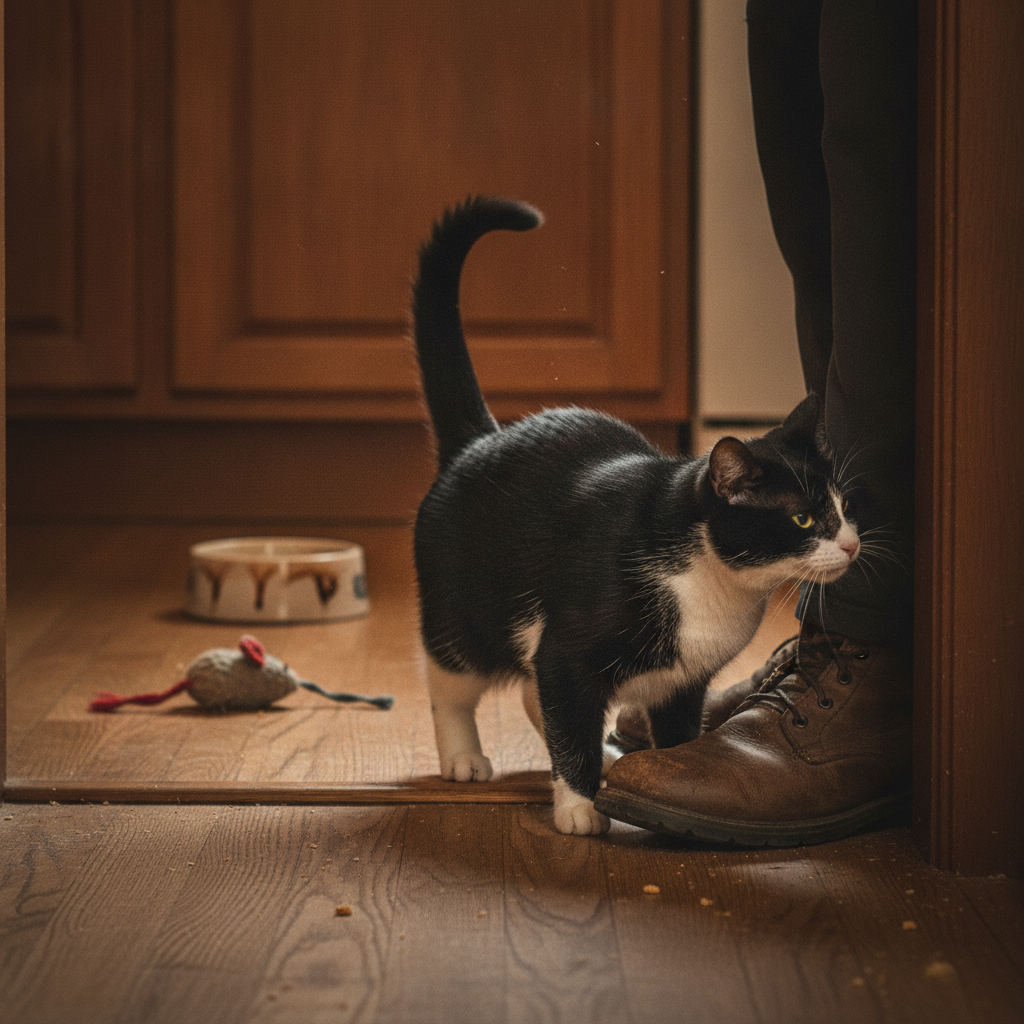
Your cat winds a figure-eight through your ankles while you are trying to get the pasta water on. You call it love, you step over them, and you get on with the evening.
Close, but not quite. What just happened was closer to a document being stamped.
The glands that make this work are spread across the parts of a cat that get pressed into things: the chin, the cheeks, the crown of the head, the paws, and the base of the tail. When your cat runs those areas along your leg, they are moving chemical information onto you. They are marking you as familiar, as safe, and as part of the group. The affection is real. It is just delivered as a transaction, not a hug, and understanding that is the difference between watching your cat and actually reading them.
What is actually getting exchanged
The pheromones a cat deposits are invisible to us and completely legible to them. Rubbing serves at least three purposes at once, and any single leg-wind is probably doing all of them:
Building a group smell. This is the big one, and it is the piece people miss. In cat colonies, animals rub against each other to blend their scents into one shared odor that identifies the group. A cat who smells like the group is family. A cat who does not is a stranger, and gets treated like one. When your cat rubs you, you are being added to that shared smell. You are being made to smell like home.
Marking the territory as safe. Not “this is mine, back off,” the way spraying is. This is closer to “this is checked, this is fine.” A cat who moves into a new house and immediately starts cheek-rubbing the corners of the furniture is doing exactly what your cat does to your calf: converting unfamiliar into familiar, one deposit at a time.
Saying hello. Rubbing is the standard feline greeting, and it is why the routine spikes when you come back after a day out or a weekend away. Even cats who live outdoors and want nothing to do with humans will rub against each other in greeting. It is the handshake.
The scent your cat puts on you has a shelf life, and they know it. The reason it happens every single evening is not that your cat forgot. It is that the mark wore off while you were at work, and they are refreshing the file.
Why the same cat rubs you and then bites you
Here is a distinction worth holding onto, because it clears up the single most confusing thing cats do.
Rubbing is something your cat does to you. Petting is something you do to your cat. They are not the same event, and consenting to one is not consenting to the other.
A cat can be genuinely thrilled to see you, deposit scent all over your shins, and still not want your hand on their spine right now, because they are keyed up, or sore, or already at the edge of what their nervous system will tolerate. Cats overstimulate fast. A session that started well can flip in seconds, which is why the tail flick, the rippling skin, and the sideways ears matter more than the purr.
If the rubbing itself turns frantic, hard, and shovey, especially with another cat in the room, read it as tension rather than affection. Territory and jealousy are real motivators, and a cat pressing hard while hissing is not conflicted, they are stressed. Step back. Let the room settle. If the pattern sticks, get a qualified behavior consultant involved rather than trying to referee it yourself.
The cat who never rubs is not a broken cat
This is the question people are too embarrassed to ask out loud: my friend’s cat wraps around her legs every night, and mine has never done it once. Does mine love me less?
No. Rubbing is one dialect. Plenty of deeply bonded cats mostly speak the others:
- Sitting beside you, or on you, and going boneless
- The slow blink, which is about as close to a spoken word as cats get
- Kneading, which is a leftover from nursing and shows up when a cat feels safe
- Following you from room to room
- Greeting you with the tail held straight up, which is the clearest “I’m pleased about this” cats have
- Rolling over near you, which is a display of trust and not, to be clear, a request for a belly rub
The trap is judging your cat against someone else’s. Learn the two or three signals your cat actually uses, and the relationship stops looking one-sided.
When rubbing stops being behavior and starts being a symptom
Normal rubbing is unhurried, social, and directed at you or the furniture. The version to worry about is the one that changes.
Take it to a vet when the rubbing:
- Suddenly increases, or appears in a cat who never did it
- Looks like scrubbing rather than greeting, especially face, head, and ears against hard edges
- Comes with head shaking, scratching, or a smell from the ears
- Comes with scabs, hair loss, or broken skin
- Comes with pressing the head against a wall and holding it there, which is a different behavior entirely and an emergency
The likely culprits behind a genuine spike are ordinary and treatable: allergies, fleas or mites, a skin condition, an ear infection, or dental pain. Rarely, neurological disease. The rule is not “rubbing is bad.” The rule is new plus intense equals check it out.
What newer research adds
Two threads have sharpened the picture recently.
The first is that scent runs the relationship far more than we assumed. A 2025 study in PLOS One looking at how cats respond to human odor found they investigate their own person’s smell differently than a stranger’s. Your cat is not identifying you primarily by your face. They are identifying you by a signature you cannot perceive and cannot fake, which is exactly the signature they have been topping up on your ankles.
The second is that reunion behavior is where rubbing concentrates. In studies where cats are separated from their person and then reunited, rubbing is the dominant thing they do on the way back in. Which means the leg-wind at the front door is not a habit. It is the moment.
The bottom line
That figure-eight is your cat closing the gap the day opened up: refreshing the mark, re-blending the group smell, confirming that the big loud animal in the kitchen still counts as theirs.
You do not have to do anything with it. Just stop calling it needy, and stop calling it nothing.
References
- “Behavioral Responses of Domestic Cats to Human Odor.” PLOS One, 2025. journals.plos.org
- Haywood, Camilla, et al. “Providing Humans With Practical, Best Practice Handling Guidelines During Human-Cat Interactions Increases Cats’ Affiliative Behaviour and Reduces Aggression and Signs of Conflict.” Frontiers in Veterinary Science, vol. 8, July 23, 2021. doi.org/10.3389/fvets.2021.714143
- International Cat Care. “Cat Communication and Scent.” icatcare.org
Common questions
Why does my cat rub against me over and over?
The scent your cat leaves on you does not last. It fades, gets washed off, and gets overwritten by everything else you touch. Re-rubbing is maintenance, not repetition. Your cat is topping up a mark that keeps expiring.
My cat rubs on me but hisses when I pet her. What is going on?
Rubbing is something your cat does to you. Petting is something you do to your cat. Those are different transactions, and a cat can want the first without agreeing to the second, especially if they are already tense, sore, or on edge about another animal in the house.
My cat never rubs against me. Does she not love me?
No. Rubbing is one dialect out of several. Slow blinks, kneading, sleeping on or beside you, following you room to room, and greeting you with an upright tail are all the same message in different words. Learn the ones your cat actually uses.
When is rubbing a medical problem?
When it changes. A sudden increase in rubbing, or rubbing that is focused on the face, head, or ears and looks more like scrubbing than greeting, can point to itch, allergy, parasites, an ear infection, dental pain, or in rare cases a neurological problem. New and intense is the pattern to take to the vet.
Dr. Nair is a veterinarian focused on diet and feeding. She covers everyday nutrition, treats, and the many "can they eat this?" questions owners ask, grounding each answer in what is actually safe and sensible for dogs and cats.
Meet our experts ↗Keep reading
 TrainingCat Behavior Has a Photo Problem. Someone Finally Drew Their Way Out of It.Dr. Mara Chen · 7 min
 TrainingYour Cat's Trust Isn't Affection. It's a Threat Assessment You Keep Passing.Dr. Lena Park · 8 min
 LivingHating Cats Doesn't Make You a Narcissist. The Rush to Diagnose Says More.Claire Sutton · 6 min
 LivingYour Cat Isn't Trying to Cuddle. They're Doing Math.Dr. Nina Kohl · 6 min
 TrainingYour Cat's 'Favorite Person' Is a Job, Not a Feeling. You Can Take It.Dr. Nina Kohl · 8 min
 TrainingThe Cat on Your Lap Isn't the One Who Loves You MostDr. Amara Solis · 9 min