


The Real Kitten-Food Problem Isn't a Stolen Bite. It's the Shared Bowl
A kitten sneaking a mouthful of the adult cat's food is harmless. A kitten quietly raised on it is not. Two vets explain the difference, and how to run a multi-cat kitchen so the growing one gets what it needs.

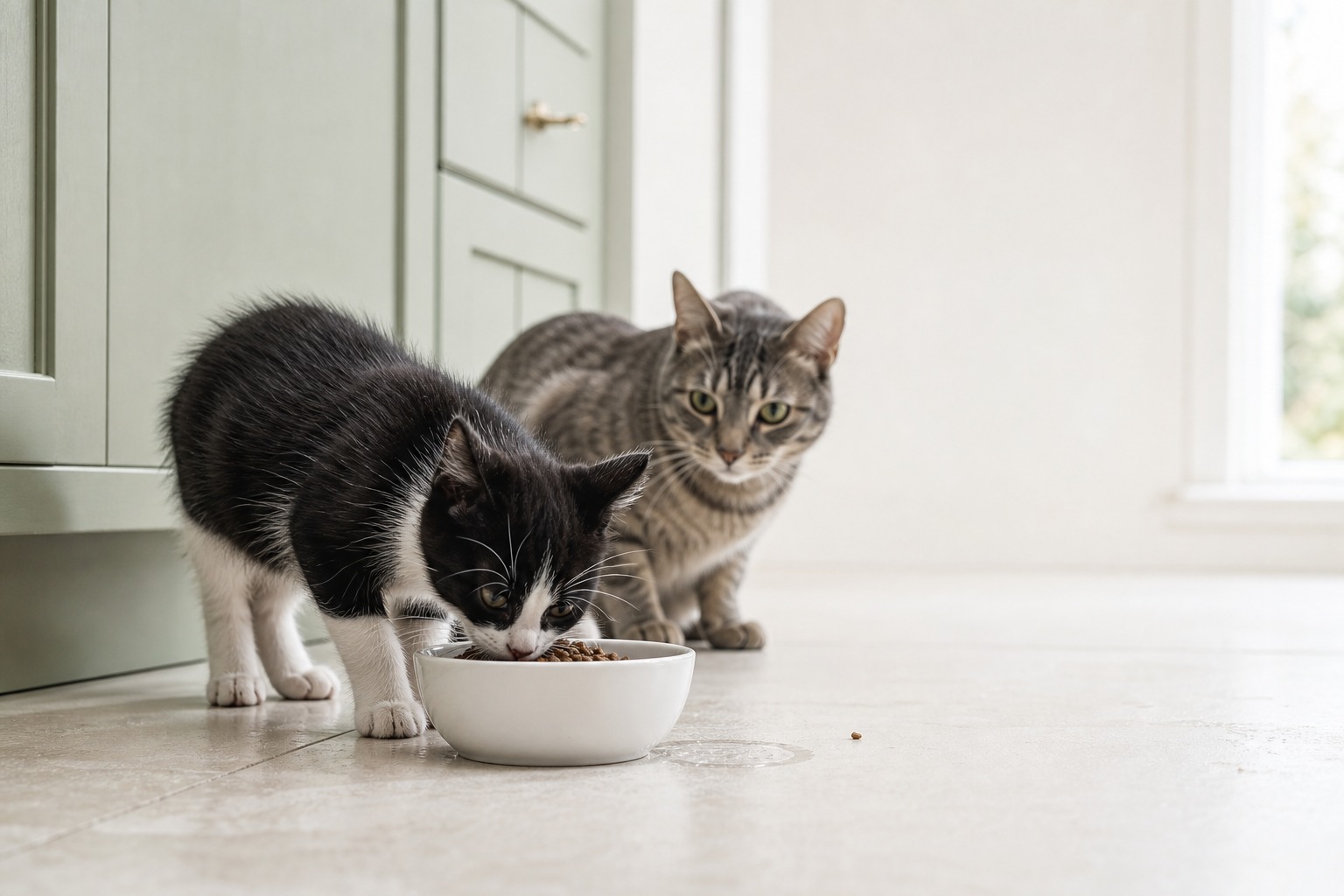
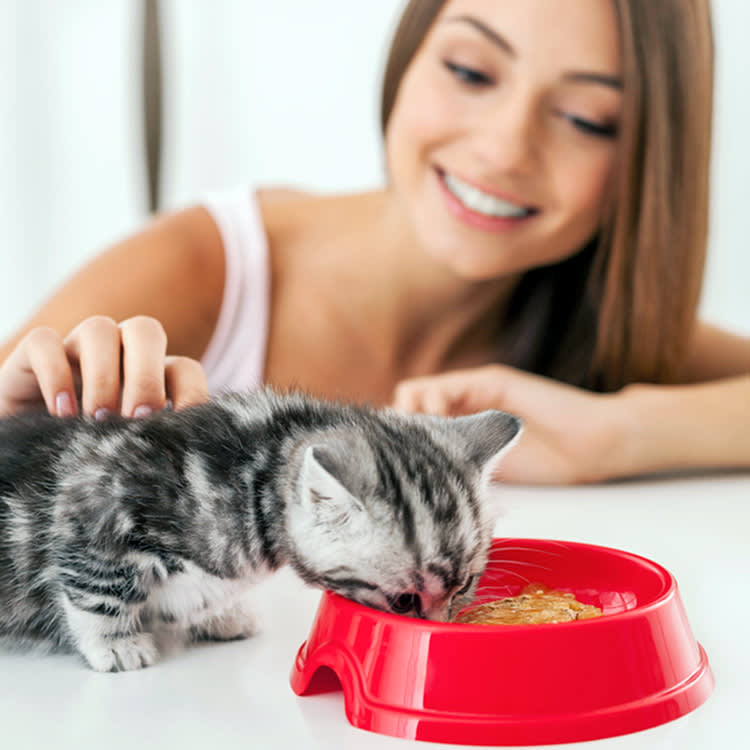
If you have more than one cat, you already know the scene: a curious kitten muscling in on the older cat’s bowl, or the reverse, the adult helping itself to the kitten’s plate. Most “can a kitten eat adult cat food” articles answer a yes-or-no question. But the question almost nobody is actually asking that way. The worry that brings people here is rarely a single stolen bite. It is the slow, invisible version: a kitten that ends up living on adult food because that is what is in the house, in the bowl, on the floor. A one-time raid is a non-issue. A diet built on the wrong food during the most important growth window of a cat’s life is the real risk. So this is less a food-safety question than a household-logistics one, and that is how we will treat it.
The non-event and the real event
Let’s separate the two scenarios up front, because they get tangled together constantly.
The stolen bite. Your kitten sneaks a mouthful of the adult’s kibble. Nothing bad happens. As Dr. Preston Turano, a veterinary spokesperson at Felix Cat Insurance, puts it, an accidental nibble “will not hurt them.” File this under “do not worry.”
The default diet. Your kitten is primarily eating adult food, day after day, because that is what is being served. This is the one to prevent. Adult, or “maintenance,” formulas are built to keep a fully grown cat steady, not to fuel a body that is doubling in size. Fed as a kitten’s main diet, Turano warns, adult food “can slow or even harm their development.” That harm is quiet, you will not see it in a day, which is exactly why it is easy to let happen.
Nobody intends to underfeed a kitten on nutrients, it happens by drift, one shared bowl at a time. The fix isn’t a panic over a single bite. It’s setting up the kitchen so the growing cat reliably gets growth food.
Why a kitten can’t run on adult food
Kittens grow at a startling rate, and that growth has specific fuel requirements that maintenance food is not designed to meet. The differences are not marketing; they are set by the American Association of Feed Control Officials (AAFCO), which defines the nutrient minimums:
- Protein. Kitten (“growth”) food must contain at least 30 percent crude protein on a dry-matter basis, versus 26 percent for adult food.
- Fat and calories. Kitten food carries 12 to 24 percent fat (adult food, at least 9 percent), making it more calorie-dense, more energy per ounce, for a body that burns through it.
- DHA and omega-3s. This is the one people overlook. AAFCO sets a minimum for combined EPA and DHA in kitten food (0.012 percent) but sets no minimum for adult food. DHA is critical for brain and eye development, and many adult formulas contain little or none. A kitten on adult food can be quietly shorted on a nutrient it only gets one chance to use well.
- Kibble size and minerals. Dry kitten food usually has smaller pieces for small mouths, and the vitamin-and-mineral balance is tuned for building a body rather than maintaining one.
In short, adult food is not toxic to a kitten. It is insufficient, and during a one-time-only growth window, insufficient is its own kind of harm.
Running a multi-cat kitchen: the part that actually solves it
Here is the net-new core of the matter, the playbook the old “just buy kitten food” advice skips. When you have cats of different life stages, the goal is for each to eat the right food without policing every meal. Practical options, from most to least precise:
- Separate, timed meals. Feed both cats at the same time in different rooms or on different surfaces, pick up the bowls after 20 to 30 minutes, and store leftovers. This is the cleanest way to guarantee the kitten gets growth food and the adult gets maintenance, and it is Turano’s preferred approach: “It is generally better to do separate feedings with the most appropriate diet so your growing kitten can get the best nutrition for development.”
- Height separation. Feed the adult somewhere a young kitten cannot yet reach (a counter or cat tree) and the kitten at floor level. Useful while a kitten is small, less reliable as it gets athletic.
- Microchip or selective feeders. Bowls that open only for a specific pet’s microchip or collar tag are the technology answer to bowl-stealing, and worth it in households where supervised feeding is impractical.
- The all-life-stages shortcut, with eyes open. A food labeled “for all life stages” is formulated to the higher kitten standard, so it is safe for the kitten and the adult to share. But that richness is the catch: it can be too calorie-dense for an overweight adult or a senior with medical needs. Dr. Konvalinka, a veterinarian at Bahama Road Veterinary Hospital, notes that some senior cats have special requirements an all-life-stages diet would not meet. It is a fine option, but treat it as a decision to confirm with your vet, not a default.
When to make the switch, and how
Most kittens are ready to move to adult food between eight months and one year, once they have completed most of their growth; large or slow-maturing cats may need longer. Turano recommends confirming timing with your vet for a personalized call.
Whenever you change foods, go slow to protect the gut. Over one to two weeks, mix increasing amounts of the new food into the old until the transition is complete. An abrupt swap is the usual cause of the diarrhea people then blame on the new food itself.
The warning signs that a kitten is being shorted
Because the harm from chronic underfeeding-by-formula is gradual, know what it looks like: slowed or stalled growth, weight loss, a dull coat or hair loss, dull eyes, low energy, bowed legs, pale gums, or persistent diarrhea or vomiting. Any of these is a reason to see your vet promptly and reassess what your kitten is actually eating, not just what you are putting in the bowl.
The bottom line
A kitten can survive a stolen bite of adult food without a second thought. What a kitten cannot afford is to be raised on it, because growth food carries the extra protein, fat, calories, and DHA that a one-time growth window demands. The answer, then, is not vigilance over every mouthful but a feeding setup, separate meals, height, selective feeders, or a vet-blessed all-life-stages food, that quietly routes the right food to the right cat. Solve the kitchen, and the kitten takes care of itself.
References
Common questions
Can I just feed an all-life-stages food to everyone?
You can, and it is convenient, but it is a compromise. All-life-stages diets are formulated to the higher kitten standard, so they are richer than adult maintenance food and can be too calorie-dense for an overweight or senior adult cat. Ask your vet whether it is the best choice for your specific cats, not just an adequate one.
When should I switch my kitten to adult food?
Most kittens are ready between eight months and one year, once they have done the bulk of their growing. Large breeds may take longer. Confirm timing with your vet, and transition gradually over one to two weeks.
How can I tell if my kitten isn't getting proper nutrition?
Watch for slowed or stalled growth, weight loss, a dull or patchy coat, low energy, pale gums, bowed legs, or persistent diarrhea or vomiting. Any of these warrants a vet visit.
Not a substitute for your vet. Our guidance is educational. For urgent symptoms, contact a vet or emergency clinic right away. Editorial standards
Dr. Solis is a board-certified veterinary dermatologist with over twelve years of clinical experience. She advises on skin conditions, allergies, and grooming practices that affect coat and skin health. All dermatology and allergy content at The Pet Times is reviewed by her team before publication.
Meet our experts ↗Keep reading
 FoodYour Kitten Isn't Starving. Weigh Them Every Week.Dr. Priya Nair · 7 min
 FoodThat Saucer of Milk Could Land a Kitten in the ER. What to Feed Instead.Dr. Amara Solis · 5 min
 FoodWhen a Kitten Can Eat Dry Food, and the Tradeoff Nobody MentionsDr. Amara Solis · 8 min
 First DaysThe Kitten Feeding Rule Flips at 16 WeeksDr. Priya Nair · 8 min
 First DaysYour Older Cat Doesn't Hate the Kitten. It Hates the Energy.Dr. Priya Nair · 7 min
 First DaysYour New Kitten Will Bond With You. It's the Other Pets You Have to Win OverDr. Lena Park · 9 min