


The Kitten Feeding Rule Flips at 16 Weeks
Whether you can overfeed a kitten depends almost entirely on age. Here's why early kittens self-regulate, when that protection disappears, and how to weigh instead of guess.

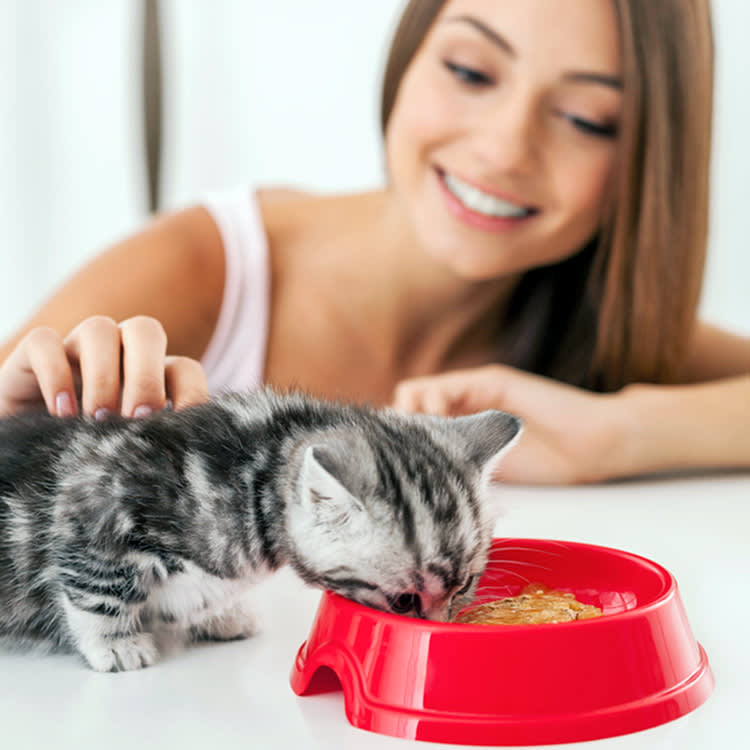
“Can you overfeed a kitten?” is the wrong question to ask in the abstract, because the answer is not fixed. It flips depending on how old the kitten is. For a tiny newborn, overfeeding is genuinely hard to do and underfeeding is the thing that kills. For a four-month-old, the opposite is true: the natural off-switch fades, and a kitten left with a full bowl will happily eat itself into trouble. Treating “kitten” as one stage with one rule is how owners get this wrong in both directions.
So the useful version of the question is: at this age, which way is my kitten likely to go wrong, and how would I know? This guide is organized around that, because a feeding plan that protects a six-week-old is not the same one that protects a six-month-old.
The hidden off-switch (and when it breaks)
Here is the single fact that reorganizes everything: under roughly three months of age, most kittens self-regulate and stop eating when they are full. After three to four months, that self-control becomes unreliable, and many kittens will overeat given the chance.
That one shift explains the whole arc. Early on, the smart move is making sure enough food is going in. Later, the smart move is controlling how much. The window right after weaning, when kittens get genuinely excited about mealtime, is the hinge point where overeating first becomes plausible. Get the timing of your transition from “always available” to “measured meals” right and you sidestep most weight problems before they start.
Before 16 weeks: underfeeding is the real danger
For the youngest kittens, the thing to fear is not too much food. It is too little.
Kittens nursing from their mother almost never overeat. Bottle-fed orphans are the exception, because a person controls the volume and can overshoot, raising the risk of food going down the wrong way (aspiration) and pneumonia. But the far more common and more dangerous failure in this window is a kitten not getting enough, which leads quickly to dehydration, low blood sugar, and the cascade that shelters call fading kitten syndrome. A neonatal kitten can decline within hours, not days.
That is why the measuring stick at this age is weight, not appetite. Buy a kitchen scale that reads in grams and weigh the kitten at the same time each day.
- Healthy newborns gain roughly 7 to 14 grams a day in the first weeks, and should about double their birth weight in the first week.
- A kitten that fails to gain at least 7 grams a day for more than a single day deserves attention.
- Flat or falling weight in a young kitten is an emergency, not a wait-and-see. Call a vet the same day.
Weight gain is the clearest signal a newborn is getting enough food. The bowl tells you nothing; the scale tells you everything.
After 16 weeks: now overfeeding takes over
Once a kitten passes three to four months and loses reliable self-regulation, the job switches to portion control. From this point, meal-feed measured amounts rather than leaving food out around the clock, because many kittens will overeat with unlimited access, and that habit hardens into adult weight problems.
What overeating does to an older kitten is worth spelling out, because the consequences are not just a cute pot belly:
Obesity. Carrying extra weight young sets up chronic problems later, including a higher diabetes risk. It also strains developing joints, which can lead to painful, mobility-limiting conditions like arthritis or hip dysplasia. Excess weight even raises some young adult cats’ risk of femoral capital physeal fractures, where the femur breaks at the top near the hip joint.
Diarrhea. A perpetually overfull stomach can cause malabsorption, where the body fails to take in all the nutrients from food. That drives diarrhea, and the fluid loss can leave a kitten dehydrated.
Vomiting and regurgitation. A stomach stretches with each meal, but only so far. Push past capacity and the extra food comes back up, with the same aspiration and pneumonia risk that threatens bottle babies.
Constipation. A kitten overeating dry kibble without drinking enough water can get backed up. Kibble holds little moisture and digestion pulls out more, so low water intake makes stool hard and painful to pass, sometimes badly enough to need enemas and fluids.
How much to feed, stage by stage
Across both windows, the daily amount depends on age and body weight. You do not need a formula. Pick a high-quality, life-stage-appropriate food, follow the feeding guide on the package as a starting point, and adjust with your kitten’s weight trend and your vet’s input. How you split that daily amount is what changes with age.
Nursing kittens. Newborns nurse roughly every two hours until full. Bottle-fed orphans eat every two to four hours, with the volume set by the specific milk replacer. Watch the scale, not the clock alone.
Weaning kittens (around 3 to 4 weeks). As kittens shift from milk to solids, offer small, frequent meals, ideally four to six a day. With wet food, work out the daily number of cans and divide it across those meals. Since moistened kibble is recommended during weaning, split the daily allowance and refresh it through the day rather than leaving 12-hour-old mush in the bowl. Once weaned, drop to three larger meals.
Six months and up. Move to a twice-daily schedule. Stop free-feeding, since it invites overeating, and keep watching growth. Depending on breed and sex, cats reach full adult size somewhere between 7 and 15 months.
The body check that beats any chart
Numbers on a bag are a starting point; your hands are the final word. A kitten in ideal condition has a visible but not dramatic narrowing at the waist and a slight upward tuck to the belly. Run your hands along the ribs and you should feel them easily without seeing them.
An overweight kitten looks rounded with a poorly defined waist. Extra fat makes the belly hang low and the ribs hard to feel, and these kittens often have less energy. If yours is carrying too much, ask your vet for a plan that still supports growth while gently correcting the over-conditioning, rather than crash-dieting a growing animal.
Watch, too, for the symptoms that can signal a kitten is simply getting too much food. They overlap with other problems, so they are flags to investigate, not diagnoses on their own: diarrhea, a distended abdomen, a dropped appetite, straining to defecate, vomiting, and lethargy.
The bottom line
You can absolutely overfeed a kitten, but only at the ages where it is possible to, and for the youngest kittens the more pressing danger runs the other way. Before three to four months, focus on getting enough in and weigh daily to catch trouble early. After that, the self-regulation fades, so switch to measured meals and let your hands on the ribs, not the empty bowl, tell you whether the amount is right. The habits you build in these months set your cat’s relationship with food for life.
References
- “Caring for Kittens from Birth to Eight Weeks.” University of Wisconsin–Madison Shelter Medicine Program, 2024, sheltermedicine.wisc.edu.
- “Orphan Kitten Care for Shelters.” Maddie’s Fund / University of Florida, 2024, www.maddiesfund.org.
- “Spontaneous Femoral Capital Physeal Fractures in Cats.” Journal of the American Veterinary Medical Association, jamanetwork.com.
- “Body Condition Scoring Chart for Cats.” WSAVA Global Nutrition Committee, wsava.org/global-guidelines/global-nutrition-guidelines/.
Common questions
How do I know if my kitten is eating the right amount?
Weigh, don't guess. A healthy young kitten gains weight steadily, roughly 7 to 14 grams a day in the first weeks. A kitchen scale that reads in grams tells you more than the bowl does. Stalled or dropping weight in a young kitten is an urgent problem, not a wait-and-see one.
How many times a day should a kitten eat?
Nursing and bottle-fed newborns eat every two to four hours. Weaning kittens do best on four to six small meals a day. From four to six months, three meals a day works well. After six months, most kittens can move to a twice-daily schedule.
Dr. Nair is a veterinarian focused on diet and feeding. She covers everyday nutrition, treats, and the many "can they eat this?" questions owners ask, grounding each answer in what is actually safe and sensible for dogs and cats.
Meet our experts ↗Keep reading
 FoodThat Saucer of Milk Could Land a Kitten in the ER. What to Feed Instead.Dr. Amara Solis · 5 min
 FoodA Kitten Can Eat Wet Food at Four Weeks. That Doesn't Mean They Can Leave.Dr. Amara Solis · 10 min
 FoodThe Real Kitten-Food Problem Isn't a Stolen Bite. It's the Shared BowlDr. Amara Solis · 7 min
 FoodWhen a Kitten Can Eat Dry Food, and the Tradeoff Nobody MentionsDr. Amara Solis · 8 min
 Health & WellnessYour Kitten Stops Growing Months Before You Stop Feeding Them Like OneDr. Priya Nair · 7 min
 First DaysEight Weeks Is a Shelter Deadline, Not a Kitten's Biology. The Data Says 14.Dr. Priya Nair · 9 min