


That Saucer of Milk Could Land a Kitten in the ER. What to Feed Instead.
The storybook bowl of milk is one of the worst things you can give a kitten. Why cow's milk causes dangerous diarrhea, what a proper milk replacer does, and how to bottle-feed safely.

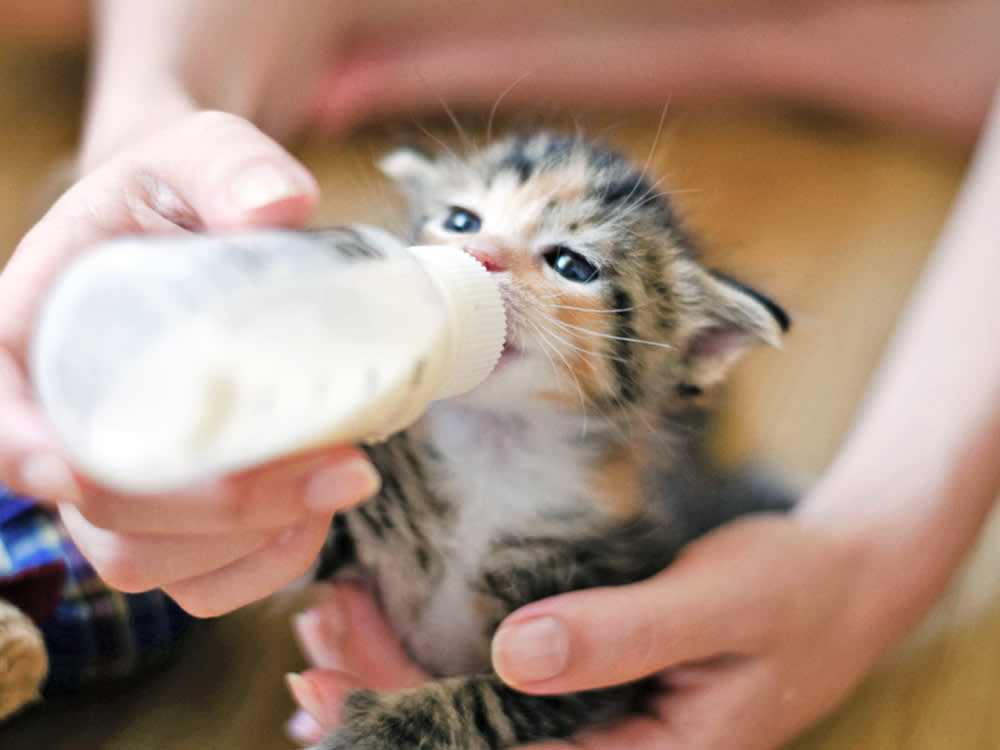
The image is so old it feels like fact: a kitten, a saucer, a puddle of milk. It’s also close to the worst starter meal you can offer. Cow’s milk isn’t a gentle, natural food for a kitten, it’s a fast route to diarrhea, and in a body that small, diarrhea isn’t a nuisance, it’s a dehydration emergency waiting to happen. The picture we inherited gets the whole thing backward.
Here’s the frame that actually helps: a kitten doesn’t need “milk,” it needs the right milk, and the right milk is a very specific thing. Get that distinction straight and the rest of the feeding decisions fall into place, whether you’re raising an orphan by bottle or just resisting the urge to pour your fridge milk into a bowl.
Why cow’s milk backfires
Some kittens can physically drink cow’s milk. Whether they should is a firm no. Cow’s milk doesn’t carry the nutritional profile a growing kitten needs, and it frequently triggers diarrhea. That matters more in kittens than in adults because a small kitten has almost no reserve, fluid lost to loose stool pulls it toward dehydration quickly, and dehydration in a young kitten escalates fast.
Underneath it is the same issue that plagues many adult cats: lactose. Cats tend to lose the ability to process milk sugar as they mature, so cow’s milk simply doesn’t sit well. In a newborn, the digestive consequences are just more dangerous.
The saucer of milk is a myth I spend real time undoing. A kitten that has lost its mother needs a replacer built for kittens, warmed to body temperature, full stop. Cow’s milk fills the belly and empties the electrolytes, which is the opposite of what a fragile kitten can afford.
The plant-milk detour, and why it’s also out
People reaching for a “healthier” pour often land on almond or soy milk. These aren’t a safe alternative either. Kittens can’t digest plant milks well, and the result is the same upset stomach you were trying to avoid. There’s no version of the bowl-of-milk idea that works. The only correct substitutes for a kitten without its mother are a nursing surrogate or a commercial kitten milk replacer.
What KMR actually is
Kitten milk replacer, usually sold as KMR, is formulated to deliver the nutrition a kitten would otherwise get from its mother, the right balance of protein, fat, and carbohydrate for rapid early growth. That’s the whole reason it exists: to stand in for a very particular biological recipe that cow, goat, and plant milks don’t match. Some cats find goat’s milk a bit easier to digest than cow’s milk, but even that is an occasional-treat idea for adults, not a kitten formula.
A few widely available options:
- Pet-Ag KMR Kitten Milk Replacer Powder
- Nutri-Vet Milk Replacement For Kittens
- Hartz Powdered Kitten Milk Replacer Formula
- Pet-Ag KMR 2nd Step Kitten Weaning Food
Bottle-feeding without the common mistakes
For kittens up to about eight weeks that genuinely need bottle-feeding, technique matters as much as the formula. Feed only kitten milk replacer, never cow’s milk or any plant milk. Warm the formula to body temperature before offering it. Go slowly, feeding too fast or too much invites digestive trouble, and never wake a sleeping kitten to force a feeding. It takes patience to get the rhythm right, especially with a true orphan, and that’s normal.
As the kitten grows, it moves off milk and onto solid food. Weaning often runs through gruel, a mixture of canned kitten food and warm water (or KMR) whipped to about the consistency of applesauce, before the kitten graduates to wet kitten food or kibble. Even then, the food has to be kitten-specific, because a growing kitten needs more vitamins and minerals than an adult cat, and only a kitten formula reliably supplies them. A healthy kitten should gain roughly four ounces a week, a simple number to track that tells you feeding is on course.
What adult cats should actually drink
Once a cat is grown, milk earns its place only as, at most, a novelty. On a balanced diet, an adult cat gets no meaningful nutrition from milk, and the best everyday drink is plain fresh water. If you want to add a little interest, a small amount of cat-safe broth can be an occasional treat, just steer clear of ingredients like onion and garlic, which are toxic to cats.
What’s new since this was written
Shelter-medicine programs that raise unweaned kittens at scale continue to reinforce the same protocol, and if anything they’ve made it more precise: warmed kitten milk replacer, careful portioning, and steady weight gain as the key indicator, with cow’s milk explicitly discouraged because of the diarrhea-dehydration risk. The consistency across these programs is the point, this isn’t one clinic’s opinion, it’s the standard of care for orphaned kittens.
The other quiet update is on the “specialty cat milk” products marketed for adult cats. Current guidance treats them as a low-lactose treat rather than anything a cat needs, useful for a bit of variety, never a substitute for water or for a complete diet. The saucer, in other words, has finally been retired even in its fancy modern form.
References
Common questions
What milk can a newborn kitten drink?
Only its mother's milk or a commercial kitten milk replacer (KMR). If the mother isn't available, KMR warmed to body temperature is the correct substitute, not cow, almond, or soy milk.
Is almond or soy milk safe for kittens?
No. Kittens can't digest plant milks properly, and they can cause stomach upset. They're not a safe stand-in for KMR.
Do adult cats need milk?
No. Adult cats on a balanced diet get no real benefit from milk, and many are lactose intolerant. Fresh water is best; specialty cat milk is at most an occasional treat.
Not a substitute for your vet. Our guidance is educational. For urgent symptoms, contact a vet or emergency clinic right away. Editorial standards
Dr. Solis is a board-certified veterinary dermatologist with over twelve years of clinical experience. She advises on skin conditions, allergies, and grooming practices that affect coat and skin health. All dermatology and allergy content at The Pet Times is reviewed by her team before publication.
Meet our experts ↗Keep reading
 FoodWhen a Kitten Can Eat Dry Food, and the Tradeoff Nobody MentionsDr. Amara Solis · 8 min
 FoodA Kitten's Diet Changes Every Few Weeks. Here's the Whole Schedule on One Chart.Dr. Priya Nair · 7 min
 FoodA Kitten Can Eat Wet Food at Four Weeks. That Doesn't Mean They Can Leave.Dr. Amara Solis · 10 min
 First DaysThe Kitten Feeding Rule Flips at 16 WeeksDr. Priya Nair · 8 min
 Health & WellnessFading Kitten Syndrome Is a Race Against the Clock. Here's How to Win It.Dr. Mara Chen · 8 min
 First DaysThere's No 'Best' Kitten Dewormer. Why the Schedule Beats the BrandDr. Mara Chen · 7 min