


Your Older Cat Doesn't Hate the Kitten. It Hates the Energy.
The friction between a senior cat and a new kitten usually isn't about jealousy or territory, it's an energy mismatch. A kitten in its peak play-aggression window is exhausting to an older cat. Manage that gap and the introduction gets a lot easier.

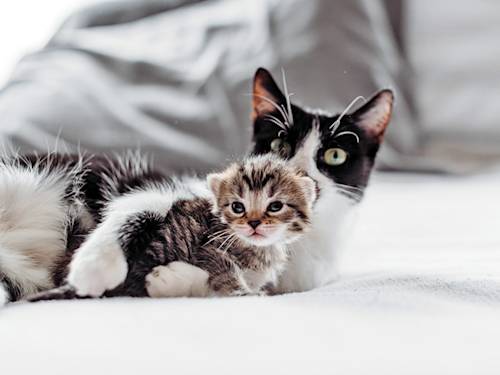
When a senior cat and a new kitten do not hit it off, the story we reach for is emotional: the old cat is jealous, territorial, set in their ways, unwilling to share the throne.
Usually that is not it. The real problem is physics, not feelings. A kitten and an older cat are running at wildly different speeds, and that gap, not some grudge, is what generates most of the friction. Get the energy mismatch under control and a huge share of the “my cats hate each other” problem simply dissolves. That reframing changes what you spend your effort on: less agonizing over the moment they meet, more managing the tornado of energy a kitten brings into an older cat’s quiet life.
Age can cut both ways
Bringing a kitten into an older cat’s home is sometimes easier than pairing two adults. Some senior cats read a kitten as less of a threat and respond with curiosity rather than defensiveness, though that same curiosity can feel intimidating to the kitten.
But plenty of older cats do not grade on a curve for age. A kitten grows up, and a growing cat can start fights and lay claim to resources, so a wary older cat may stay defensive and nervous no matter how tiny the newcomer is. Which of these you get depends on the individual cats, and the introduction process is how you steer through either reaction.
As for how long it takes, there is no set timeline, and the smart move is to let the cats guide the pace. If they barely react to each other, a careful process will just go faster. If there is tension, fear, or an older cat so rattled they could hurt the kitten, you slow down and think in months, not weeks. Plan for slow and be pleasantly surprised if it is quick.
The real culprit: an energy gap
Here is the mechanism behind most senior-and-kitten conflict. Kittens hit a peak energy and play-aggression window from roughly nine months to two years old. In that stretch they are biologically driven to practice the two great cat skills, hunting and defending, and anything that moves is fair game for practice. Two kittens together will burn this off wrestling and stalking each other for hours a day.
Your older cat is not a second kitten. So they absorb the brunt of all that play aggression, and if the kitten has no other outlet, the older cat can become defensive, fearful, even withdrawn, hiding to escape a small relentless predator who thinks they are playing.
Owners come to me convinced their senior cat has a personality problem, when what they have is an energy problem. The kitten is not being cruel, it is being a kitten. Give that drive somewhere else to go, several real play sessions a day, food puzzles, climbing, and the older cat stops being the only toy in the house. Half the aggression I get called about eases once the kitten is genuinely tired.
The most powerful things you can do, then, are several daily play sessions that mimic hunting, plus plenty of enrichment for the body and brain: solo-play toys, puzzle feeders, and short training games. You are not just entertaining the kitten; you are protecting the older cat.
Prepare the older cat, and the space
Kittens bounce back from almost anything. A senior cat carries more baseline stress and spooks more easily, so part of the job is bringing that stress down and helping them feel secure through daily play, enrichment, and bonding time with you. Throughout, the golden rule is to never push either cat past their comfort zone. Watch for even small signs of stress or fear, and when you see them, dial the intensity down. Do not power through, especially with the older cat.
Set the environment up to support all of this. Until the cats are getting along, keep them separated and bring them together only for supervised time, each with a safe space stocked with everything they need. Rotate them through the shared living space so each one gets solo time with you. Put out multiples of every key resource, litter boxes, food and water stations, high perches, hiding nooks, resting places, and scratchers, and spread them around rather than clustering them, so neither cat has to run a gauntlet to reach what they need. Open, uncovered litter boxes are the safer bet, because an older cat feels more secure at a box with clear sightlines and no chance of a kitten lying in ambush.
Introduce, slowly and in the right order
When it is time to actually introduce them, scent comes before sight. Keep your older cat in another room when the kitten arrives, settle the kitten into their safe space, and keep them there for the first few days unless you are actively supervising. During this time, rub the kitten with a clean sock and set it near your older cat, topped with a few treats, doing this daily for two or three days, so the older cat learns the kitten’s smell paired with something good.
If the older cat eats the treats and ignores the sock, let the cats see each other through a barrier such as two stacked baby gates, from across a room, with something positive like treats to focus on. If that goes well, close the distance over several days, and once neither cat seems nervous, begin short, closely supervised sessions sharing space, extending them only as both stay relaxed. When they are together, make good things happen, treats, gentle praise, calm play, so proximity predicts rewards.
If at any point either cat shows fear, nervousness, or aggression during the test, back off to a slower, more careful version of the process. Once a cat’s defenses are up, they tend to stay up, so it is worth the patience. A certified feline behavior consultant can help if you are stuck.
Reading the room
Learn the difference between “back off” and “carry on.” Signs a cat is not okay, from either party, mean turn the intensity down: a hard intense stare, dilated saucer-eyes, an unwillingness to look away from the other cat, hissing or vocalizing, trying to look bigger or smaller, puffed fur, lip-licking, fidgeting, an agitated twitching tail, twitching skin, or general nervousness. Signs a cat is relaxed and things are going well: a soft face and posture, comfortably turning away rather than fixating, being easily distracted, sitting or lying down instead of staying on high alert, and calmly leaving the area rather than bolting or hiding. Any genuinely positive interaction between them is a good sign.
What newer research adds
Two additions round this out. First, a synthetic feline-appeasing pheromone diffuser has some randomized, placebo-controlled support for easing tension in multi-cat homes over a few weeks, so it can be a low-risk helper alongside the energy management above, though the overall evidence for pheromones is mixed and it is no substitute for the real work of tiring out the kitten and protecting the older cat. Second, the modern behavior consensus reinforces the whole premise here: intercat conflict is driven far more by unmet needs, resource competition, and mismatched arousal than by “personality,” which is exactly why the interventions that work are about outlets, space, and pacing rather than forcing the cats to like each other.
References
- Intercat Aggression. Cornell Feline Health Center. Accessed July 2026.
- Evaluation of the efficacy of an appeasing pheromone diffuser product vs placebo for management of feline aggression in multi-cat households: a pilot study. Journal of Feline Medicine and Surgery, 2018.
- Intercat Aggression in Households Following the Introduction of a New Cat. Applied Animal Behaviour Science. Accessed July 2026.
Common questions
How long does it take to introduce a kitten to an older cat?
There's no fixed timeline, and it's best to let the cats set the pace. If neither reacts strongly, you can move through the introduction quickly. If there's tension, fear, or an older cat overwhelmed by the kitten's energy, plan on months rather than weeks. Expecting it to take a while means you won't be tempted to rush the part that matters.
Why is my older cat hissing at the new kitten?
Usually because the kitten's relentless energy feels threatening or exhausting, not because your older cat is 'mean.' Some hissing early on is normal communication for space. What you want is for it to settle over time. Draining the kitten's energy with daily play and giving your older cat secure retreats does more to stop the hissing than anything you do at the moment of contact.
Will my older cat and kitten eventually get along?
Most do, especially if you protect the older cat from being harassed and go at a pace that keeps both cats under their stress threshold. The relationship may settle into anything from close friendship to polite coexistence. Both are fine outcomes, and both are far more likely if the kitten has other outlets for its energy.
Dr. Nair is a veterinarian focused on diet and feeding. She covers everyday nutrition, treats, and the many "can they eat this?" questions owners ask, grounding each answer in what is actually safe and sensible for dogs and cats.
Meet our experts ↗Keep reading
 Training'My Cat Doesn't Like to Play' Is Almost Always a You ProblemDr. Lena Park · 8 min
 TrainingKitten Biting Has a Closing Window. This Is What You Do in It.Dr. Amara Solis · 6 min
 TrainingYour Kitten Isn't Kissing You. It's Filing You Under 'Family.'Dr. Amara Solis · 7 min
 TrainingLittermates Don't Replace a Mother Cat. The Study Is Blunt About It.Dr. Amara Solis · 6 min
 First DaysKittens Litter-Train Themselves. Here's How Not to Ruin It.Dr. Amara Solis · 5 min
 TrainingThe Cat Your Kitten Becomes Is Mostly Decided by Week SevenDr. Nina Kohl · 7 min