


The Cat Your Kitten Becomes Is Mostly Decided by Week Seven
Kitten behavior isn't random. Each stage has a job, and one short, early window quietly sets the temperament of the adult cat you'll live with for the next 15 years.

Here is the uncomfortable truth about raising a friendly cat: the most important developmental work happens before most kittens ever reach their new homes. By the time you are carrying your kitten through your front door, the window that shapes whether they grow up bold or fearful is often already closing, or closed.
That is not a reason to panic. It is a reason to understand what each stage of kitten development is actually for, so you know what to reinforce and what you cannot get back. Kittens grow in predictable phases, each with its own behavioral job, and every phase rewards a different kind of attention from you. Think of these less as milestones to check off and more as jobs your kitten is quietly working on.
The socialization window in kittens is brutally short compared to puppies, and it does its work early, often before eight weeks. What a kitten meets gently and pleasantly in that window, people, dogs, handling, noise, becomes normal for life. What they miss can stay scary forever. You cannot re-open that door later, so the goal in those first weeks is a steady drip of good, calm experiences, not a flood.
The newborn stretch: fully dependent (birth to about two weeks)
In the neonatal phase, kittens can do almost nothing for themselves. They rely on their mother completely, for food, for warmth, and for comfort, and they spend the time eating and sleeping. This is not a stage for handling or training. Leave kittens with their mother and littermates, where they belong, and if you must handle one for a real reason, keep it brief and gentle. The learning here is happening at a level you cannot rush.
The window that decides everything (about two to seven weeks)
This is the stage that matters most, and it is short. Kittens start seeing their mother and walking toward her on purpose, their coordination sharpens fast, and they become able to run. Underneath that motor development is the socialization window, the period when a kitten’s brain is unusually willing to file new experiences under “normal.”
The key word is positive. Socialization is not the same as mere exposure. Simply parading a kitten past a lot of new things can backfire; the goal is a stream of genuinely good experiences with all sorts of people, objects, sounds, and other friendly animals, so the kitten builds pleasant associations rather than frightened ones. Gentle handling from several different people, calm introductions to dogs and other cats, and matter-of-fact exposure to everyday household life all belong here.
The cruel part is the timing. A kitten’s socialization window is much shorter than a puppy’s, and it is often largely finished by the time kittens go to their new homes. That is exactly why breeders, fosters, and shelters carry so much of the responsibility, and why choosing a kitten who was raised underfoot in a busy household, rather than isolated, matters so much.
You can also start the gentlest training here: teaching a kitten to touch a target, to sit, to use the litter box (which they may already grasp), and to play with toys rather than hands, feet, or hair. That last rule is not fussiness. Hands-as-prey is a habit that gets a lot less cute at nine months.
Peak play, closing window (about seven to 14 weeks)
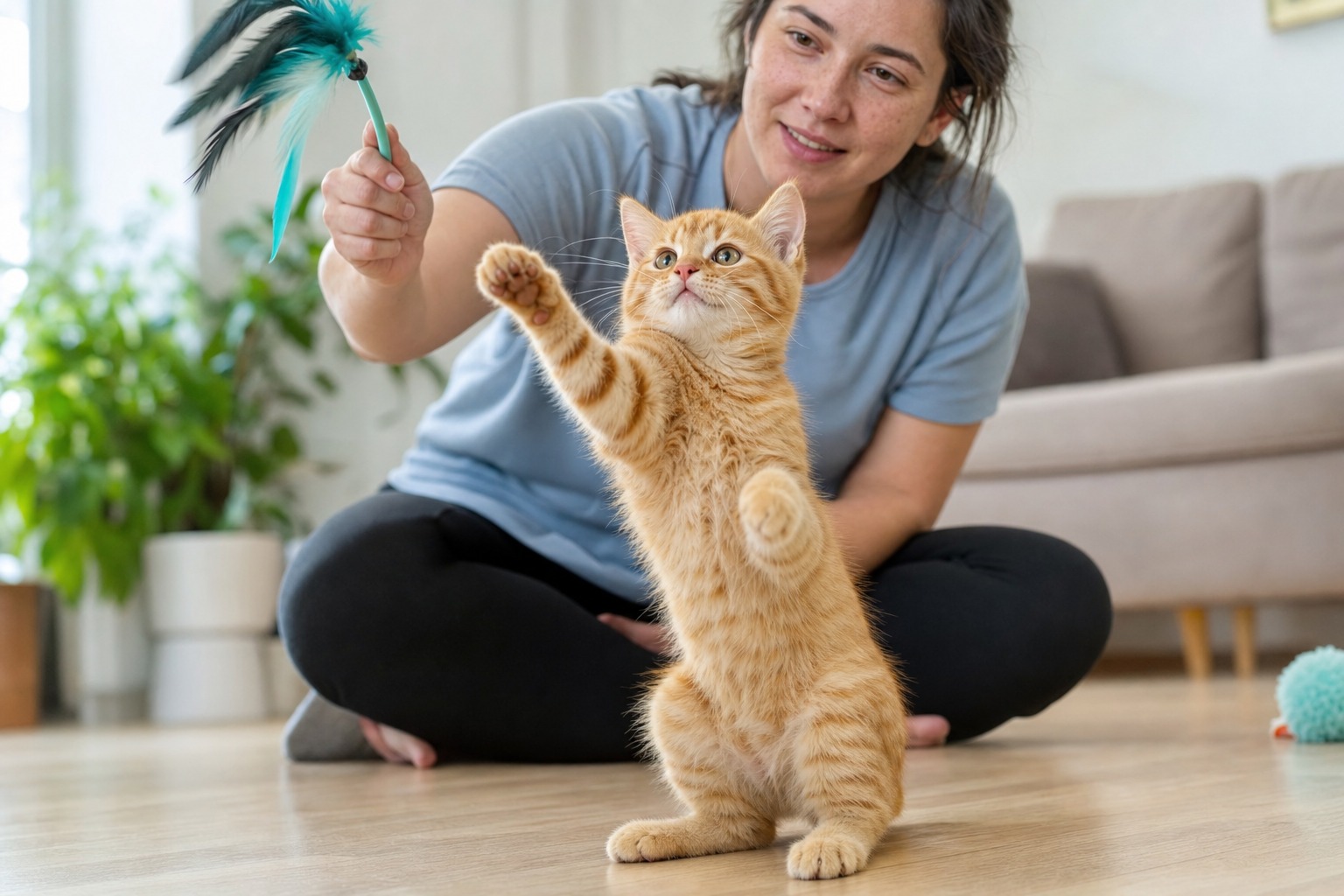
If the early window is about safety, this stage is about play, play, and more play. Kittens this age are usually obsessed with toys, objects, other kittens, and people, and they spend their days pouncing, chasing, leaping, and pawing. They grow more coordinated and faster, groom themselves more, and start scratching whatever is available, which is your cue to make sure a scratching post is more appealing than your couch.
The socialization window is closing now but not slammed shut, so keep offering positive exposure to people, cats, dogs, and household life. Keep play going many times a day, always with toys rather than body parts, and keep redirecting predatory attention onto appropriate targets. This is also a fine time to continue litter-box habits (most cats have it down by now), work on come-when-called, and begin gentle grooming, brushing, nail trims, and handling their feet, always paired with treats and a soft touch. Overwhelming a kitten during grooming is counterproductive; the point is to make handling feel safe.
The tiny daredevil (about 14 weeks to six months)
Energy and curiosity spike. Kittens explore more, climb everything, and leap around with abandon, and they become more willing to investigate the places you would rather they left alone, which means your window coverings and shelves are now part of the playground. There is often a stretch where their newfound size outpaces their coordination, so expect some clumsy landings.
Interest in play stays high, and it splits into two flavors: object play that looks like hunting, and social play that looks a lot like fighting. Both are normal. Meet the demand with real enrichment, physical and mental, plenty of interactive play, and chances to play with any gentle animal housemates. Balance the play with grooming, training, and calm attention so your kitten finds you and the house interesting enough to be a little less desperate to bolt out the door. Practically, this is a great age to keep working on sit, tricks, leash and harness tolerance, and, crucially, teaching your kitten to walk willingly into a carrier and take short car rides. A cat who thinks the carrier is fine is a gift to your future self.
Adolescence (about six months to a year)
Now your kitten is a teenager, and they change fast enough to catch people off guard. They grow noticeably more independent, more adventurous, and more opinionated, about which toy, which resting spot, whether they feel like being touched right now. Behavior that seems to come out of nowhere is usually just adolescence doing its thing.
The best strategy is respect. If your cat is not in the mood for cuddling or petting, let it go, and take enthusiastic advantage of the moments when they do invite interaction, whether that is play, training, or a willingness to be groomed. They still want and need a lot of connection with you; they just want it on a more negotiated schedule. The specific games and tricks matter far less than the steady supply of positive interaction and chances to use their brain and body in satisfying ways.
Young adult (about one to two years)
At a year, cats are officially adults, but they are such young adults, so freshly out of adolescence, that you will keep seeing behavioral shifts through the second year. They may get a little less demanding of your attention, but they still need it. Keep playing every day, multiple times, with toys rather than hands or feet, and rotate the toy selection so they do not get bored. Pet and cuddle strictly on their terms, never forcing it, and stay gentle during grooming and lifting. And keep training, not because you need a trained cat, but because training is fun mental and physical exercise and one of the best ways to spend enjoyable time together while strengthening your bond.
Take these as guidelines, not a schedule
Cats are individuals, so treat these stages as the general pattern most kittens follow, not a stopwatch. The value of thinking in phases is that it makes your kitten’s behavior legible: when you understand what job your kitten is working on, the sudden new habits stop feeling like problems and start feeling like development. It is simply more fun to live with a kitten when the changes make sense.
What newer research adds
Current feline-medicine guidance has leaned hard into the “sooner is better” message on socialization. Because the sensitive window can close as early as seven to nine weeks, veterinary behavior groups now encourage breeders and fosters to prioritize gentle handling and varied, positive exposure in those first weeks rather than waiting, and kitten “kindergarten” style classes for young kittens have gained traction as a way to extend positive socialization a little further. The takeaway for a new owner has not changed, but it has sharpened: with a young kitten, calm, pleasant, everyday exposure is not optional enrichment. It is the main event.
References
- American Association of Feline Practitioners, “Feline Behavior Guidelines.” https://catvets.com/guidelines/practice-guidelines/behavior-guidelines
- Karsh, E. B., & Turner, D. C., “The human-cat relationship,” in The Domestic Cat: The Biology of Its Behaviour. https://www.cambridge.org/core/books/domestic-cat/
Dr. Kohl is a board-certified veterinary dentist with a particular interest in preventive oral care. She reviews all dental health content at The Pet Times and contributes practical guides on home dental routines, professional cleaning, and oral disease prevention.
Meet our experts ↗Keep reading
 TrainingLittermates Don't Replace a Mother Cat. The Study Is Blunt About It.Dr. Amara Solis · 6 min
 First DaysYour Older Cat Doesn't Hate the Kitten. It Hates the Energy.Dr. Priya Nair · 7 min
 First DaysKittens Litter-Train Themselves. Here's How Not to Ruin It.Dr. Amara Solis · 5 min
 First DaysYour New Cat Isn't Aloof. They're Running a Background Check.Dr. Nina Kohl · 8 min
 First DaysTake a Kitten Home Too Early and You'll Pay for It for 15 YearsDr. Lena Park · 10 min
 First DaysBy the Time Your Cats Are Hissing, You Blew the Introduction Three Steps AgoDr. Mara Chen · 9 min